Somewhere between five and seven thousand buildings are demolished in London every year. Most of those torn down and replaced will not be mourned or even remembered. They are little more than the casualties of a city going about the never-ending business of change. Some buildings, however, qualify as “lost”. Buildings of such importance, whether especially beautiful, interesting, or unusual, that their loss through fire, war or, more often, the carelessness and greed of city developers and planners is remembered or regretted for generations. Fourteen churches built by Sir Christopher Wren after the Great Fire of London were demolished in the second half of the 19th century, many of them for no better reason than money was needed to build churches in the so-called godless suburbs while congregations in the capital dwindled. (A further fifteen were destroyed in the German bombardments of the Second World War). The losses are not just churches, but private homes, civic buildings, offices and industrial buildings; all erased in the name of progress and often repented in the years that follow. The careless destruction of significant buildings throughout the UK led in previous generations to the creation of conservation groups whose work has undoubtedly saved treasures from the wrecking ball and helped raise awareness of the importance of balancing the new and the old, progress and preservation, in the life of a great city.
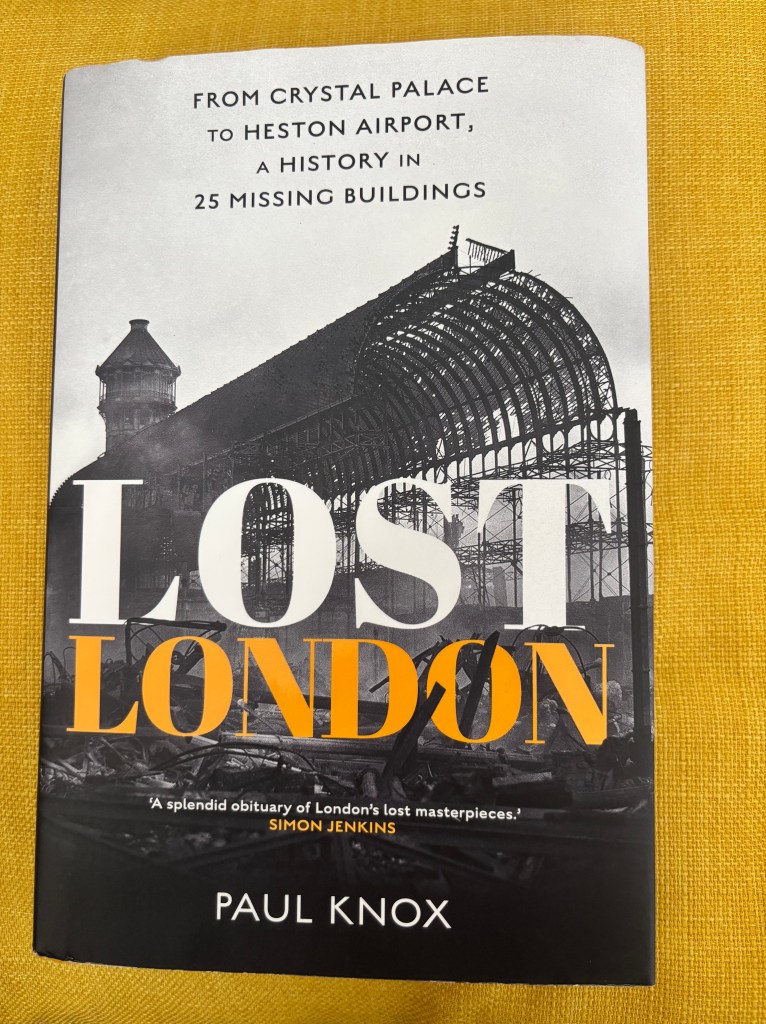
Paul Knox, a British-born academic working in the United States, tells the story of twenty-five of London’s lost buildings. Some are probably quite well known to a wide audience, like Crystal Palace and the Army & Navy Club. Others are wonderful surprises, even to those of us born and raised in London. Two stood out for me as especially intersting. The first was the train station in Waterloo, now long abandoned, that was used exclusively to take corpses and mourners from London to the huge burial ground in Brookwood. The second was Columbia Market. This vast, elaborate, Gothic structure, was constructed in Bethnal Green and was the brainchild of do-gooding philanthropists determined to eradicate the chaotic, unsanitary, but much-loved street markets of East London. The idea failed within a few years and the remarkable building was eventually torn down.
Lost London is a book that ought to appeal to anyone who loves urban history or architectural history, but most of all to anyone who loves London, a city changing constantly and conserving carefully, a city filled with built treasures (old and new), and a place of endless fascination to those of us who know and love it.