Dooneen

There have been several times in my reading life when the well worn refrain “fiction is dead” has been a popular and critically fashionable point of view. It’s heard a lot less these days, partly because sales of fiction are very high, driven at least in part by the popularity of genres like fantasy and romance, but also because of the number of new and distinctive writers stretching the boundaries of what fiction can be. Coming across for the first time a novelist experimenting with the form and approaching the art of storytelling in a fresh and challenging way remains one of the great joys of reading.

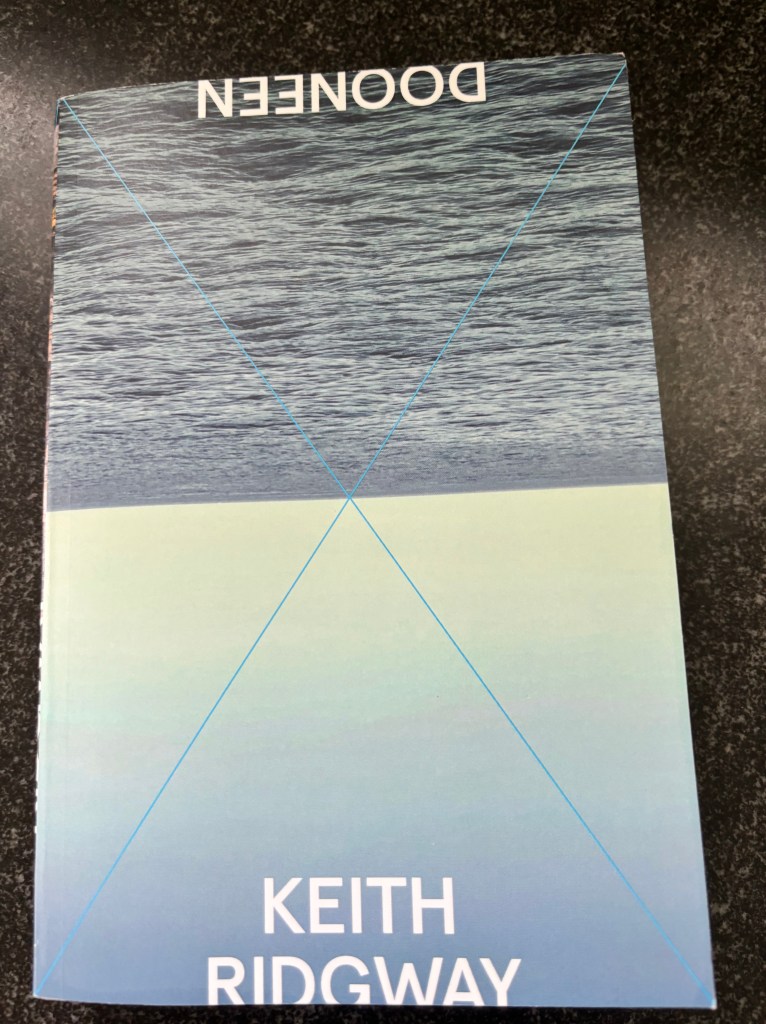
I was in a bookshop in Kent, CT recently and spotted a newly published paperback called Dooneen by an Irish writer I had never heard of, Keith Ridgway. The unusual cover art caught my eye and, turning to the back, I discovered that Ridgway had won several prestigious awards for some of his previous novels. I bought it, along with Colson Whitehead’s latest (Cool Machine), intending to add it to my summer reading pile.

Bartholomew Port, known to everyone as Mew, steps into bushes in a London park and emerges, dirtier and more disheveled, from bushes in a park in Dublin. Mew is back in a city he knows well to speak at a festival, but finds Dublin to be old and new, familiar and strange, all at the same time. Cars and all motorized vehicles are no longer permitted, and have been replaced by carts. “Clickers” (moving sidewalks) are the norm, though some are not working. It’s a place in turmoil. Popular insurrection is brewing. Revolution is in the air. Protestors and conspirators are everywhere, meeting in secret and in small groups, fearful of state-sponsored crackdowns and violence. Mew finds himself drawn into their mysterious underground world and led around a sinister and ominous city.

Those who love Irish literature will hear, as Mew makes his way around Dublin, echoes of Leopold Bloom in Ulysses and will find the playfulness of James Joyce and Samuel Beckett on almost every page. But there’s darkness in Dooneen and in its portrayal of a city on the edge of popular revolt. There’s also tenderness as Mew attempts to reconnect with his great love, Mootie. This is a quirky, unclassifiable novel. Part homage to a much loved city, part love story, part political satire, and part fantastical odyssey; Dooneen is a reminder of how provocative and engaging fiction can be, and how relevant it remains.

The Ghostwriter

I didn’t enjoy reading The Ghostwriter, a mystery novel written by Julie Clark. I cared nothing for the protagonist (a ghostwriter commissioned by her estranged father, a celebrated novelist, to write a memoir about the infamous murders of his brother and sister decades earlier). The plot felt contrived and unbelievable, the prose flat, and the disjointed structure irritating. All of this was apparent quite early, so why did I persevere? Because the novel was a gift from a family member. Not reading it or abandoning it half-read would have been unconscionably rude. Those near and dear to me know what books mean to me and the outsized role they play in my life. An act of such kindness and thoughtfulness – someone walking into a bookstore and taking the time to choose a title they think I would enjoy (even if on this occasion they got it wrong) – means a lot to me.