A Great Victorian Friendship

On a recent visit to Kelmscott House, William Morris’s former home in Hammersmith, I picked up the text of a lecture given in 2012 to the William Morris Society by Fiona MacCarthy, the great biographer of Morris and Edward Burne-Jones. Although little more than thirty pages, the lecture gives an interesting account of the two men and their long friendship. From their first meeting as undergraduates at Oxford they formed a working and emotional bond that was to last their lifetimes. So much about them was different. Different social backgrounds, different temperaments, and ultimately different paths, but they were united by a vision of the place that art and craft ought to have in the lives of everyone. Their friendship led to an extraordinary creative collaboration that left a deep mark on the arts and crafts of the late 19th century and gave the world works of profound beauty and meaning.

MacCarthy went on to write wonderful, full-length biographies of both men. Her lecture might whet the appetite of those interested in learning more about these visionary figures of the 19th century.

The Bridge

When I read A Long Winter in March this year (a novella that had first been published in 2005), I had no idea that a sequel was in the works. The Bridge picks up the story of Miguel and his father who live in a remote part of the Pyrenees. They have sold their old farm and moved to the house to which Miguel’s mother had been returning the day she died. The opening of a new bridge is set to transform the isolated villages, opening them to the wider world for good or for ill.

The novella is written in the spare and elliptical style for which Colm Toibin is celebrated. There is hardly a wasted word. The desolation of Miguel’s life and his acceptance of his fate are brilliantly conveyed in a short novel that opens up worlds of experience and emotion. The Bridge is a remarkable achievement.

Homework

Geoff Dyer is a year older than me. He was born and raised in Cheltenham, less than a hundred miles from London where I grew up. His delightful memoir of childhood, Homework, describes a world that in many respects has vanished, though not from the memories of those who were children in England in the 1960s and 1970s. The pleasures evoked by the book for Dyer’s contemporaries, like me, are a lot to do with recognition and memory. Airfix models, Action Man, the arrival of the first color televisions, playing football in the school playground, discovering one’s tastes in music and books, horrible food: these things were important parts of our lives in much the same way that memoirs in forty years will feature social media, mobile phones, and the launch of Netflix.

Dyer is very good at poking fun at his parents, his wider family, his friends, and himself, but it’s all done in such an affectionate, tolerant and forgiving way. In fact, it’s the tone of Homework that lingers long after the final page is turned, not just the stories and the personal memories that surface because of them. He recalls his childhood with just the right balance of affection, nostalgia, and embarrassment. He’s never cruel or sentimental and knows how fortunate he is to have loving (though never demonstrative and occasionally infuriating) parents and to have been raised in a safe and comfortable place. Homework is also very funny, at least to those of us who grew up at the same time.

Lost London

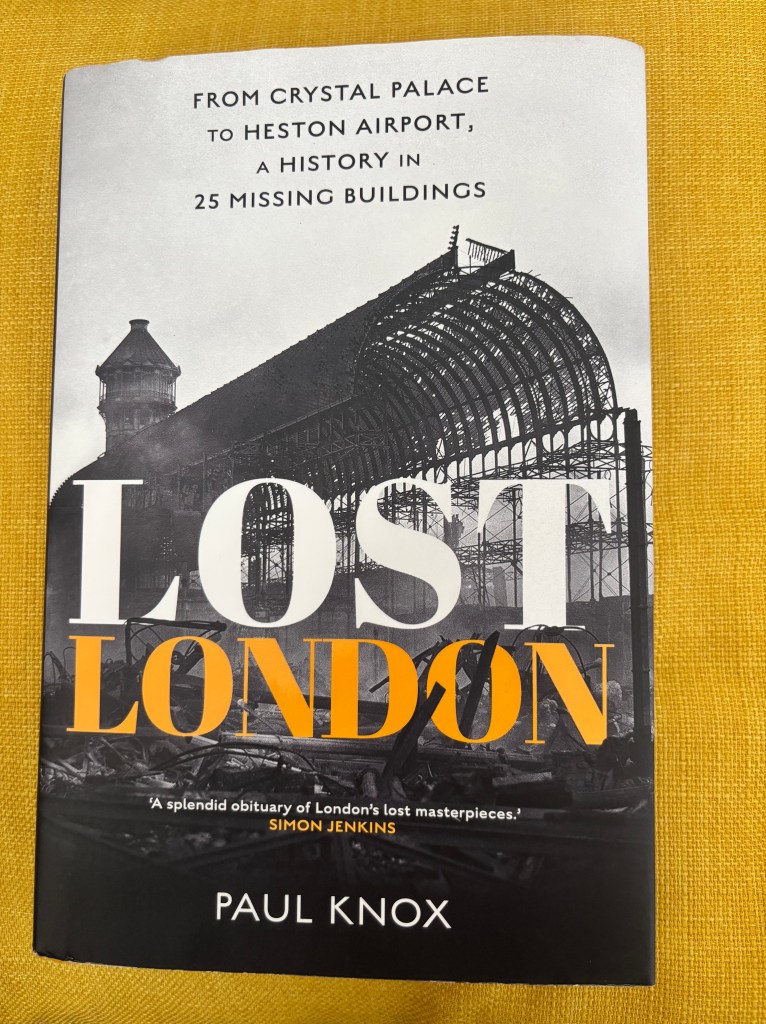
Somewhere between five and seven thousand buildings are demolished in London every year. Most of those torn down and replaced will not be mourned or even remembered. They are little more than the casualties of a city going about the never-ending business of change. Some buildings, however, qualify as “lost”. Buildings of such importance, whether especially beautiful, interesting, or unusual, that their loss through fire, war or, more often, the carelessness and greed of city developers and planners is remembered or regretted for generations. Fourteen churches built by Sir Christopher Wren after the Great Fire of London were demolished in the second half of the 19th century, many of them for no better reason than money was needed to build churches in the so-called godless suburbs while congregations in the capital dwindled. (A further fifteen were destroyed in the German bombardments of the Second World War). The losses are not just churches, but private homes, civic buildings, offices and industrial buildings; all erased in the name of progress and often repented in the years that follow. The careless destruction of significant buildings throughout the UK led in previous generations to the creation of conservation groups whose work has undoubtedly saved treasures from the wrecking ball and helped raise awareness of the importance of balancing the new and the old, progress and preservation, in the life of a great city.

Paul Knox, a British-born academic working in the United States, tells the story of twenty-five of London’s lost buildings. Some are probably quite well known to a wide audience, like Crystal Palace and the Army & Navy Club. Others are wonderful surprises, even to those of us born and raised in London. Two stood out for me as especially intersting. The first was the train station in Waterloo, now long abandoned, that was used exclusively to take corpses and mourners from London to the huge burial ground in Brookwood. The second was Columbia Market. This vast, elaborate, Gothic structure, was constructed in Bethnal Green and was the brainchild of do-gooding philanthropists determined to eradicate the chaotic, unsanitary, but much-loved street markets of East London. The idea failed within a few years and the remarkable building was eventually torn down.

Lost London is a book that ought to appeal to anyone who loves urban history or architectural history, but most of all to anyone who loves London, a city changing constantly and conserving carefully, a city filled with built treasures (old and new), and a place of endless fascination to those of us who know and love it.