Parisian Lives

Image result for deirdre bair parisian lives

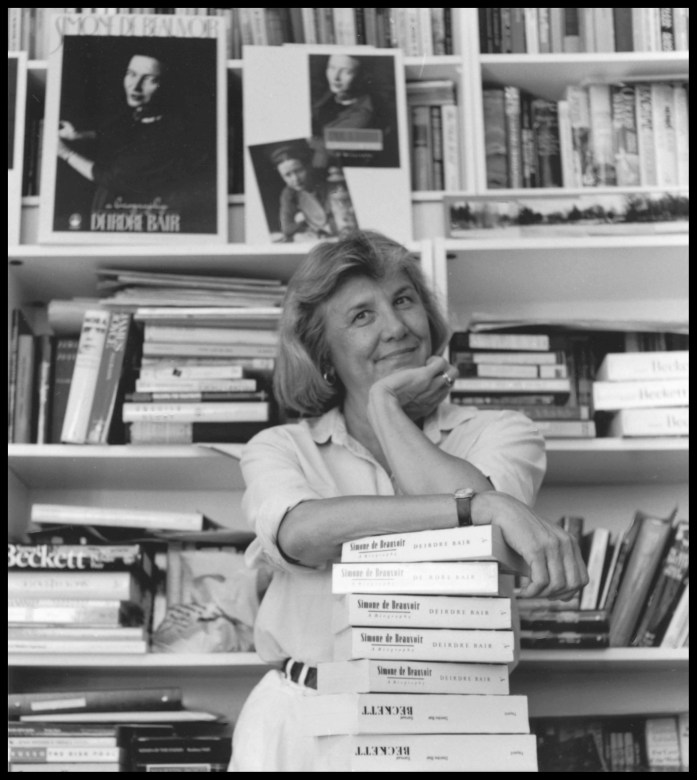
So many of the best scholarly biographies I’ve read have been written by women that it never occurred to me that this was an area of scholarship which until relatively recently was dominated by men. I can thank Deirdre Bair for setting me straight on that point. When she started work on her award-winning biography of Samuel Beckett in 1970, she met a degree of resistance and prejudice from male scholars that today takes one’s breath away. Parisian Lives is Bair’s memoir of her experiences of writing the lives of two giants of the literary world, Samuel Beckett and Simone de Beauvoir, and what a story it is.

I’ve read many accounts of Beckett’s life. He was clearly not only one of the greatest writers of the 20th century, but also a sincerely good and kind man.  Stories of his generosity are legion. Despite all of that, the prevailing impression of him as some kind of “secular saint”, fostered by his large and loyal coterie of friends, doesn’t tell the whole story.  Beckett could be and occasionally was difficult, manipulative, and suspicious, and he was far more concerned about his posthumous legacy than he wanted anyone to believe. These facets of his character are properly exposed in Bair’s otherwise affectionate account of her interactions with him in the 1970s. He may have had flaws, but a great writer and a great man emerges intact from this memoir.

De Beauvoir was a different beast entirely. She wasn’t far from the end of her life by the time Bair met her and she comes across as a much diminished figure in this memoir, admired globally as an icon of the feminist movement but drained by age of the intellectual power she once wielded.

There’s a third important person at the center of this mostly gentle story: Deirdre Bair herself. As much an account of the challenges of being a woman scholar in the 1970s and 1980s as it is about pursuing Beckett and De Beauvoir, Parisian Lives feels sometimes overly defensive and score-settling in its tone, but she can hardly be blamed. She achieved a lot against the odds and was often badly treated by men who ought to have known and behaved a lot better.

Image result for deirdre bair parisian lives

Last year’s reading

A year ago I made a resolution to read more. I succeeded. I completed thirty-eight books in 2019, twelve more than in the previous year. Looking back on what I read last year, the most pleasing thing was the exceptionally high quality of pretty much every book I chose. There was only one outright dud, The Flight Portfolio (which I abandoned early on). Everything else was a delight to read.

Just as in previous years, I read more fiction than non-fiction in 2019, but not overwhelmingly so. The fourteen non-fiction titles I finished included my “book of the year”, Say Nothing by Patrick Radden Keefe. I read a lot about art and that surprises me because it wasn’t a particular intention of mine at the beginning of the year. It just happened somehow.

I read and occasionally re-read some wonderful novels. Hold my feet to the flames and force me to choose my favorite story of 2019 and I’ll probably go for Late in the Day by Tessa Hadley,  but Sarah Moss’s Ghost Wall, A Month in the Country by J.L. Carr, and Reunion by Fred Uhlman were other highlights of the year.

Looking at the pile of books waiting to be read, 2020, or the next few months in any case, is shaping up to be much like 2019. I can’t wait to get started.

Image result for reading books

A Month in Siena

Image result for a month in siena

It’s strange how particular themes keep repeating themselves in the books I have read recently, even though on the face of it the books themselves are very different one from another. The idea, for example, that looking at a work of art should open up the landscape of one’s mind or that the process of traveling to unfamiliar places should provoke a corresponding interior journey.  These are motifs that have come up time and again in books I have been reading this year. Is it nothing more than coincidence? Or am I somehow subconsciously looking to read the same book over and over again or picking books that illuminate from different vantage points very basic questions about why we travel and why we look at art?

In A Month in Siena, Hisham Matar, a Pulitzer prize-winning writer with Libyan heritage and with deep roots in London and New York, travels to Italy to immerse himself in the School of Sienese painting which flourished in the thirteenth, fourteenth, and fifteenth centuries. He writes about his encounters with eight masterworks from the School, painted by Duccio, Ambrogio Lorenzetti, and others. The works under Matar’s scrutiny and through his telling become doorways to the city of Siena, to its ancient traditions, to some of its residents, to the author himself, and to the wider world.

Matar has written a small gem of a book.  His curiosity, intelligence, and humanity not only illuminate a lovely and profound account of his time in Siena. Those same qualities are trustworthy pointers to how to live as we enter a new year.

Image result for a month in siena

The Sacrament

The hideous abuse of children by Catholic clergymen and its concealment by the Church’s authorities continue to appall the world. One scandal has followed another, leaving many innocent believers with their faith in tatters and asking how their belief in an all-loving God can be sustained in the face of such systematic evil.  Olav Olafsson’s latest novel, The Sacrament, approaches the question through the experiences of a nun sent to Iceland by The Vatican to investigate allegations of abuse in a Catholic school. The mission she’s given pulls her from the quiet, sequestered life of a convent in France, a life marked by simple routine, a life lived in a community, a chapel and a rose garden. Her visits to Iceland, separated by decades, bring her into touch not simply with individual and institutional evil. She’s also forced to confront her past and the terrible decisions she made as a young student in Paris, choosing security, fear, and shame over the possibility of love.

The Sacrament isn’t a perfect novel, but its accomplishments are significant. The atmosphere it creates through simple storytelling is striking and long-lasting. Olafsson creates a world in which one voice, clear but uncertain, speaks for the tens of thousands left voiceless by the cruelty and ambition of the powerful few.

Image result for olafsson the sacrament

Self-Portrait

Image result for celia paul artist

I read all two hundred pages of Celia Paul’s autobiography on a recent flight from London to New York. Sunshine flooding into the cabin from the south was perfect for studying the extraordinary paintings that punctuate the story of her life.  It’s a story with a simple enough arc: from her childhood days in Kerala where her father was an Anglican missionary, to boarding school in Devon and her studies at The Slade, and onto her quiet career as an artist in London.

Love is the steady pulse of her story. Love for her parents and her four sisters, and for her son Frank, the child born from her relatively brief but intense relationship with Lucien Freud. And, most of all, love for painting, the work to which she has committed her life and of which she writes with such intensity and passion.

Reviews of Self-Portrait have tended inevitably to focus on the affair with Freud, which began when Paul was in her late teens. That’s a shame.  His often-shabby behavior, his neglect and infidelities, make for good headlines, but nothing should distract us from Paul’s outstanding work and the fervent commitment that has fueled it. She’s a wonderful painter and I hope this book will bring her the many new admirers she deserves.

Image result for celia paul paintings

The Pursuit of Art

Image result for jenny saville art

Martin Gayford is my kind of art critic. His work is serious, but never pretentious, arcane, or inaccessible.  He wants to share with readers his love of art and his admiration of artists. He believes not only that art changes us, but that we change art by how and where we encounter it.  As someone who has grown increasingly dissatisfied by the experience of visiting traditional galleries and museums, I found Gayford’s appetite for searching out art in unusual settings and out-of-the-way places infectious. I finished reading his “travels, encounters, and revelations” (the subtitle of this book) a little more informed about the likes of Gerhard Richter, Anselm Kiefer, and Gilbert & George, and a little more determined to seek out art in my travels.

This is the third book by Gayford I’ve read and it follows on from Modernists and Mavericks which I read earlier this year. I’m looking forward to the history of pictures he has co-written with David Hockney.

The River Capture

It’s nearly four years since I read Mary Costello’s first novel, Academy Street. It was a very striking and accomplished début and I recall thinking at the time how much I was looking forward to seeing how she would develop as a writer. Now comes The River Capture and more evidence of how skilled and sensitive a storyteller Costello is becoming.

The story is set in and around Ardboe House, a once grand but now faded home overlooking the fertile fields and ancient woods of County Waterford. Ardboe is the down-at-heel demesne of Luke O’Brien, an erstwhile schoolteacher taking a leave of absence from Belvedere College, the famous Jesuit school where James Joyce was once a pupil. Joyce is a continual presence and influence in Luke’s imagination; a hero, saint, and exemplar all at once.

Luke, living alone in the once-grand house, has memories instead of family, and literary heroes instead of friends. A solitary and lonely life that looks set to take root and become permanent is upended one day when a young woman knocks on the door …

The structure of the novel is peculiar. The first and longest section is a conventionally told story which then, for the final one hundred pages or so, shifts into a series of questions addressed to Luke (by the author? By Luke himself?). This move, itself a very Joycean conceit and reminiscent of parts of Ulysses, was a trick I found quite jarring and had the effect of distancing me from Luke’s emotional life, which itself had been so brilliantly rendered in the first half of the book. Deployed more briefly the change in style could have worked brilliantly, but the longer it was extended the more dissatisfying it became.

Leaving that to one side, I have a feeling this lyrical, sporadically brilliant, and flawed novel will stay in my mind for a long time.

Image result for mary costello the river capture

The Benefit of Hindsight

The tenth novel of the Serailler series by Susan Hill (and my second of the year) has arrived.  The previous one, which I read back in August, had been a disappointing dip in form, so I was hoping for something of a re-bound.

Image result for benefit of hindsight susan hill

This one is an oddity and I’m still puzzled by it. The novel comes to an end quite abruptly with the crimes at the center of the story unsolved and their perpetrators unidentified and unpunished. There’s also a completely extraneous plot line. It’s as if the author has lost interest in the mystery genre per se and is happiest focusing on the domestic life of Serailler and his family. Engrossing as that is, this series is now starting to feel unbalanced and to lose direction. Susan Hill is far too fine a writer to produce a bad novel, but she seems at a loss to know what to do with the series. These novels have many admirers, so it would be a shame to see them discontinued, but there’s a clear need for a re-boot.


The Past

Image result for tessa hadley the past

Tessa Hadley’s most recent novel, Late in the Day, made a big impression on me when I read it earlier this year, so much so that I knew I would want to track down and read her earlier books as soon as I could.  I found two, The Past and London Train, when browsing in Hatchards in St. Pancras and snapped them up.  Having just finished The Past, published first in 2015, I’m very happy to say it is at least as good as Late in the Day. It’s thrilling to discover not just an exceptional talent but a writer who does brilliantly all the things I want from a novel.

Four middle-age siblings come together for a three-week vacation in their grandparents’ dilapidated but much-loved house set deep in the English countryside.  Family meals, trips to the beach, and walks in the fields punctuate days in which intense emotions, rivalries, and tensions are the undercurrent.  The past is never absent. No one leaves unchanged.

I have a hunch that British readers might just get that little bit more from Hadley’s novels. There’s something quintessentially English about Hadley’s books and she’s certainly writing within what I think is a recognizable English tradition, joining the likes of Anita Brookner,  A.S. Byatt, and Margaret Drabble.  That is, by the way, very high praise indeed in my mind. Hadley’s is certainly not the type of fiction that appeals to everyone and at a superficial level there may seem something archaic about stories set in that milieu of the self-aware, slightly agonized English upper middle class. That shouldn’t deter anyone (from anywhere). Like all very good novelists, Hadley’s preoccupations are the things that should matter to all of us.

Inland

Téa Obreht’s latest novel is no easy read. Its lyrical, dense prose forced me to read carefully and slowly. I found myself able to concentrate only in short, intense bursts, after which I had to put it aside each time until I was ready to tackle it again.  Needless to say, it took me quite some time to complete. Was it worth the effort? Yes, I think so.

Inland is set in the Arizona Territory of 1893, a harsh, drought-choked place. The novel re-imagines the classic myth of the American West from two perspectives: the first a tough, haunted frontierswoman called Nora and the other an immigrant outlaw by the name of Lurie. Not a great deal happens.  This isn’t a novel you read for the plot, but what little plot there is serves as a necessary reminder of something that’s forgotten too easily and too frequently today: that America was crafted by a multitude of people born in every corner of the world, and by women just as much as by men.  America is as much an idea as it is a country. Obreht’s novel testifies powerfully to how the country was made from hard, unforgiving materials and the idea realized because of the sacrifices of tough and determined people, women and men whose descendants find themselves too often disparaged and overlooked today.

America is a place that tells and re-tells a small number of stories about itself constantly.  Those stories are what help to unite hundreds of millions of people who have little else to bond them.  Much of the time it doesn’t seem to matter whether the stories are true or not. That’s not the point; it’s the telling and re-telling that matters, the effect not the truth. The stories have been distorted by politicians since the country was founded. Stories and myths matter.  They have consequences. Obreht understands that.

Image result for tea obreht inland