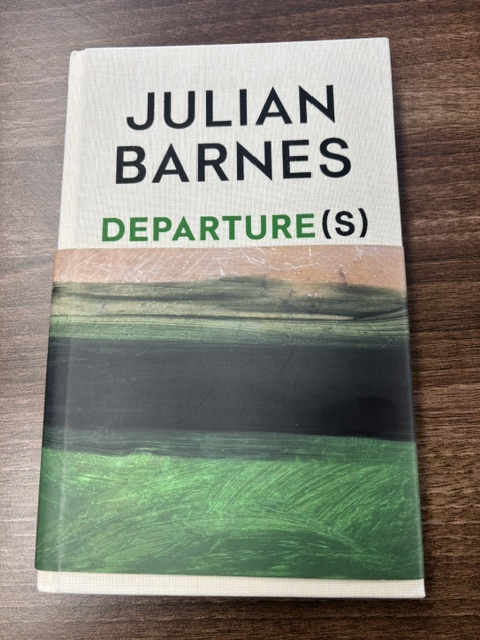
Memories, and especially their unreliability, seem to be one of the favorite concerns of literary novelists. Time and again I read novels in which the author reminds the reader that memory is a creative act, that memories are often inventions and fabrications, that the past is a slippery thing to retrieve, that our motives for recalling and retelling stories from our past are rarely pure, and so on and so on. It’s the center of Julian Barnes’s latest and possibly final book, Departure(s).
Is Departure(s) a novel or a memoir? Its narrator is someone called Julian Barnes. We’re told by this narrator that he is a Booker Prize-winning novelist who lives in London, a widower who learns at the start of the COVID pandemic that he has been diagnosed with a form of blood cancer. Google Julian Barnes and you will find all of this true, so what makes Departure(s) a novel? I’m not sure but it’s an interesting conceit which the author uses to confront the purpose of storytelling, fiction versus fact, the differences (and similarities) between remembering and re-telling, and much more. If this sounds a little dry, it isn’t. Barnes is having great fun here. Departure(s) is in my view one of the most approachable and endearing novels he has written. If it really is his last, I for one will be sorry.