Hans Ulrich Obrist is a celebrated curator and gallery director. He is currently Artistic Director of the Serpentine Galleries in London. His professional success, at least on the basis of this autobiography, seems to owe as much to determination, drive, hard work, and imagination as it does to any formal training in art history or curation. All very commendable, not least because I imagine the world in which he operates is very competitive.
His professional life has been an interesting one so far (he is only 57), filled with encounters with many of the world’s greatest artists. He has thought deeply about exhibition making and the role of curators in the artistic process. Life in Progress is the story of those experiences and thoughts. Unfortunately, Obrist is no writer. The prose here is flat and lifeless, and the effect of that is occasionally to render a life filled with achievement and insight as something bland and trite. Surely he could, like many others, have found a ghost writer or collaborator. It would have been a far better book if he had.
A few years have passed since I last read one of Denise Mina’s novels. Her most recent book, The Good Liar, appeared on a number of those “Best Books of The Year” lists that newspapers like to put out every December, so I was pleased when it showed up, neatly wrapped, under the Christmas tree. I devoured it in a few sittings in that quiet spell between Christmas and New Year.
The dilemma at the heart of the book is a simple enough one. To what lengths would you go to avoid admitting you were wrong? Would the fear of shame or the loss of reputation be enough for you to stay silent even if that silence led to a terrible injustice? That’s essentially the conundrum faced by Claudia O’Sheil, the central character in The Good Liar. O’Sheil is a forensic scientist and an expert in blood spatter analysis, a technique that proves central to some gruesome killings among London’s elite.
Mina is a very accomplished storyteller and has achieved the commercial success to prove it. In The Good Liar she is in a comfortable groove and in complete control of the plot and characterization. It’s all carried off with confidence and poise, but I had a sense of the author coasting. There is nothing wrong with that, particularly when the end result is a novel as entertaining as this, but Mina is capable of more.
It’s that time again. The time when a 900-page novel from Robert Galbraith (aka J. K. Rowling) lands with an audible thud. A novel with a mind-twistingly convoluted plot and scores of characters and with an update on the “will they, won’t they” romance between London’s two best known private detectives, Cormoran and Robin. (Stop reading here if any of this requires explanation).
I suspect Rowling/Galbraith might have a slightly unhealthy interest in secret societies. Previous novels in the Strike series have featured dark dealings in a religious cult and in the more shadowy parts of the online gaming community. (She also seems fascinated by the English upper classes and the clubs where they congregate). For The Hallmarked Man we’re in the company of the Freemasons. A mutilated corpse is found in the vault of a London antiques dealer that specializes in the sale of masonic silverware. Strike’s newest client, a well known chef working in a fancy members’ club, is convinced the body is that of her missing partner. As he starts to investigate the identity of the victim, Strike discovers quickly that it’s not quite as clear as his client thinks and that powerful interests don’t want him interfering.
Loyal readers of the series will recognize all of this. Whether they will welcome it, I’m less sure. For my own part, I started to lose interest half way through and I am finding the meandering, slow advancing, and intricate plots a little bit tiresome. Perhaps someone with influence could have a quiet word with the author and suggest she picks up the pace a little. The Strike franchise, entertaining and successful as it is, might lose even some of its most dedicated followers if she doesn’t.
I read “true crime” books very rarely. In fact, I can only think of a few. Capote’s In Cold Blood, of course, and one or two others. My aversion to the genre is simple enough to explain. Many such books, at least in my experience, are badly written and are motivated by a ghoulish and sometimes prurient interest in the misfortune and misery of others. They are, more often than not, the literary equivalent of slowing down to watch a car accident.
This House of Grief is something very different. It is mostly an account of the trial of Robert Farquharson who stood accused of the murder of his three sons on Father’s Day, 2005. The crime and the trial captivated Australian society at the time, but I was entirely unaware of them, and of the book (first published in 2014), until I started to get interested in its author, Helen Garner. Garner recently won the Baillie Gifford prize for her diaries, How to end a Story, and it was those that led me to look at her earlier work. On a visit to The Brick Lane Bookshop in London, This House of Grief was displayed prominently and I snapped it up. I am glad I did.
I think the book has become a classic for several reasons. As an account of the drama that can unfold in a courtroom, it is hard to imagine anything better. Garner has a very sharp eye for the peculiarities of human behavior and the trials gave her a great opportunity to train it on the lawyers, spectators, and witnesses. It is also a deeply disturbing report of the depths of wickedness into which a person might descend. It is a story that could have been recounted in a sensational and vulgar way, but in Garner’s hands it is all done with such humanity. This House of Grief is a truly brilliant and compassionate piece of reporting. Garner’s award winning diaries are now top of my Christmas reading wish list.
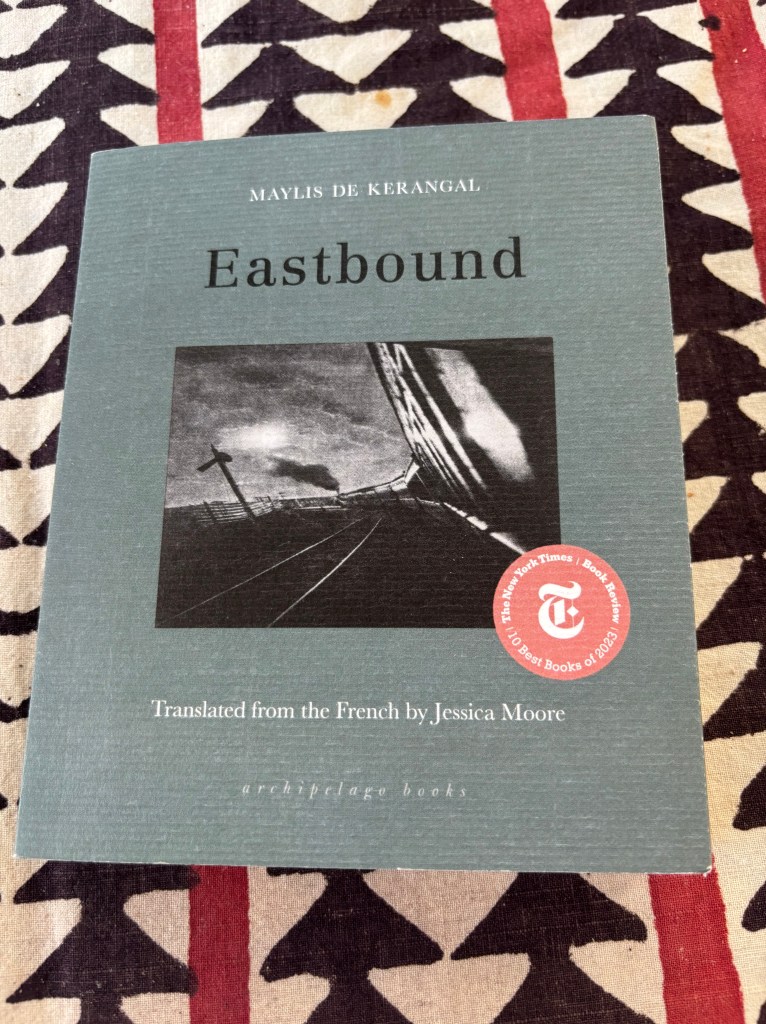
Most books are published in a relatively small number of standard sizes. While there are good reasons for that, titles published in unusual formats or with distinctive designs have a good chance of standing out among the thousands of similar looking books stocked by the average bookstore. Imaginative publishers know that. Browsing one evening recently in a fairly undistinguished chain bookshop in a Massachusetts mall, my eye was caught by a small, almost square paperback called Eastbound by Maylis de Kerangal. No doubt it was the unusual format and pared down, minimalist design that made me pick it off the shelf.
Eastbound features Aliocha, a young Russian conscript on his way to report for compulsory military service in Siberia. Traveling on the Trans-Siberian Express, Aliocha is so frightened of what lies at the end of the long journey that he is determined to abscond. On the train he meets Helene, a French tourist traveling in first class, and sees an opportunity to escape.
It may seem an implausible tale, but the author (Maylis de Kerangal) creates such an intense and dreamlike atmosphere on board the cramped and claustrophobic train moving relentlessly towards the frozen wastelands of Siberia that it hardly seems to matter. This is a novella about shared humanity, people’s destinies and fates and how they intertwine in the least likely of circumstances. Fevered and almost surreal, Eastbound may be short but it sticks in the memory.
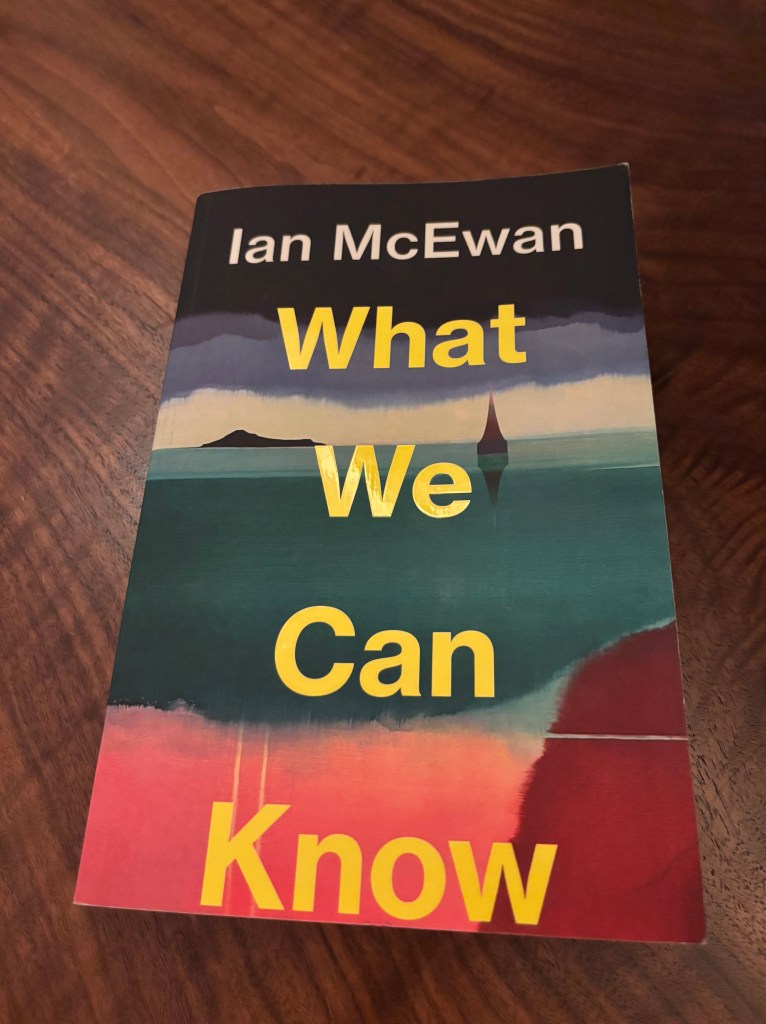
What can we really know about the past, even in a world in which almost everything – every email, every photograph, every recording – is preserved? What can we ever know about the figures of history, the writers, the artists, the politicians and so on? Do all those biographies that scrutinize every detail of a life ever capture what the living, breathing, and thinking person was truly like ? Do biographers and academics ever get close to the objects of their examination? And what does all that uncovering of the past teach us about the present? Perhaps instead of trawling through archives and reading books and manuscripts, we might learn more about today by imagining a future world and looking back at the present from that vantage point. What we can know is about what we can know. It’s about trying to understand what we can ever really understand, about the past and the present. That is vital because if we can really see clearly, if we can really understand, and if we can really know, from that understanding and knowledge perhaps we might start to value, protect, and preserve what is valuable and meaningful, and stop destroying what really matters before it is too late.
What we can know is is that unusual thing, a novel of ideas. It’s a wonderful accomplishment and to my mind one of the best things McEwan has written for a long time. The story is set in 2119 in Britain, a country which by that time is an archipelago, much of its earlier landmass having been left uninhabitable by rising sea levels. Tom Metcalfe is an academic and his research centers on a poem, written in 2014 and recited at a famous dinner party. No written copy of the poem has ever been found, making it that rarest of things, an unpreserved masterpiece known only by its reputation and by the memories of those who heard it spoken aloud on one occasion more than a century in the past. For Tom the effort to discover the whereabouts of this unread poem is his life’s mission. No spoilers here!
McEwan’s probing intelligence is one of the features I most associate with him and in his least successful novels it can be on full display unleavened by emotional insight. In What we can know the balance is almost perfect. It’s certainly a clever and thought-provoking story, but it also has tenderness, wit, and compassion.
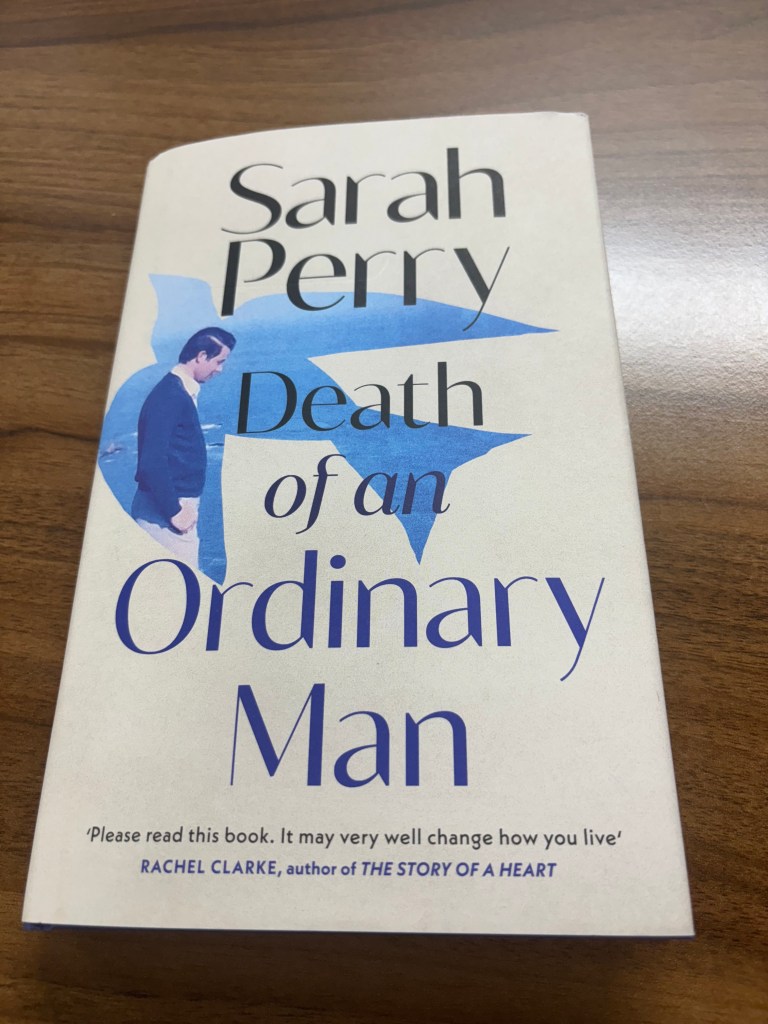
Another beautifully written and important book about death and fathers. Death of an Ordinary Man is a memoir, but it comes from the hands of a celebrated and prize winning English novelist, Sarah Perry, who brings to this deeply felt and moving account of the death of her much loved father-in-law an artist’s particular sensitivity and insight. It may be a story about death, but it’s also about illness, the care of the dying and ultimately about love and faith. It may be very particular, but it is also universal. And as the blurb on the cover says, “Please read this book. It may very well change how you live“. This unforgettable book deserves to win every prize available. I have not read anything as deeply moving for a very long time.
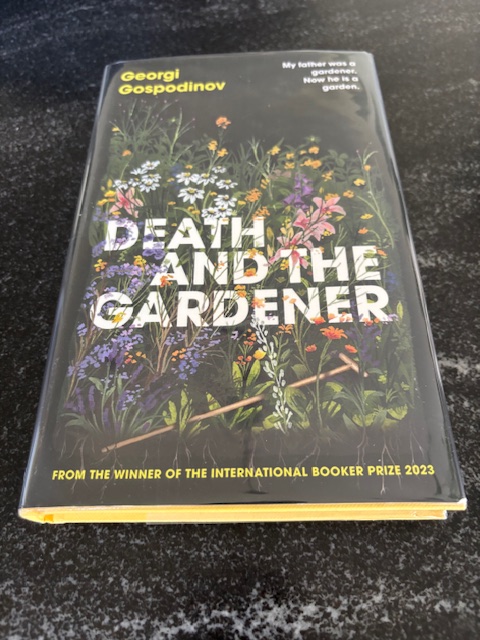
I have the impression that fewer novels are written about fathers and fatherhood than mothers and motherhood. That may simply reflect my reading choices and experience. Anyone who loved their father and lost him to illness is likely to be moved deeply by Death and the Gardener, the most recent novel from the Bulgarian writer (and winner of the International Booker prize in 2023), Georgi Gospodinov.
The book reads like a memoir. The narrator is a celebrated Bulgarian writer and his story is told with the apparently unflinching candor that one normally associates with journals or autobiographies. His account weaves memories of his father with a description of the old man’s illness, treatment, and death, all told in a style marked by simple directness with flashes of real tenderness. It’s one of those books that you find yourself wanting to read more slowly, more carefully, going back over particular sentences and paragraphs to embed them firmly in your memory and experience.
In remembering his father, and telling those remembrances, the narrator creates a eulogy and a memorial that will outlast the father and the son. And Gospodinov, in creating the story, creates a eulogy and memorial for every father that was loved and lost, so that perhaps the sons still living might realize and cherish what they had and what will never return. “We will never be as safe as we once were in our father’s arms“.
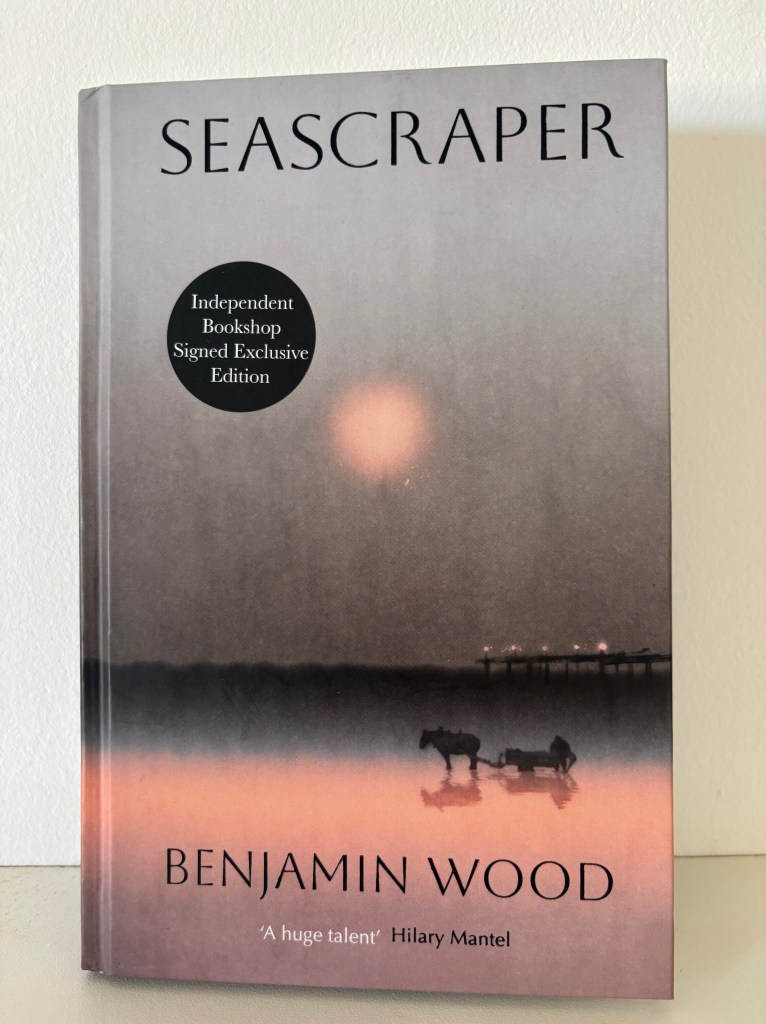
Thomas Flett is a shanker. Every morning at low tide he takes his horse and wagon to the beach, scrapes the sand and the shallow waters for shrimp, and delivers his haul for sale in the nearby town. He does it reluctantly and even resentfully, dreaming all the while of the folk music he would like to write and perform. Thomas lives with his mother in a rundown cottage. Money is scarce, so he conceals his ambitions from her, hiding his guitar and everything of his inner life. Work is hard, leaving him little or no time to follow his dreams, until one day, without warning, an American film director shows up scouting for suitable locations for his new project.
Disappointed and disillusioned young men, tied to labors they loathe, tethered by poverty, and dreaming of other lives are something of a literary staple. Think of Thomas Hardy, for example. Seascraper is firmly within that tradition. That in no way is intended to diminish Benjamin Wood’s achievement here. His tale is a memorable and poignant one, and he writes with great feeling for the frustrations of daily life and especially of thwarted ambition. In spite of that, Seascraper for me didn’t quite come off. It’s filled with atmosphere and the character of Thomas is written with subtlety and insight, but minor characters feel sketched rather than fully drawn. Nevertheless, this is a fine novel and one I’m pleased to have read.
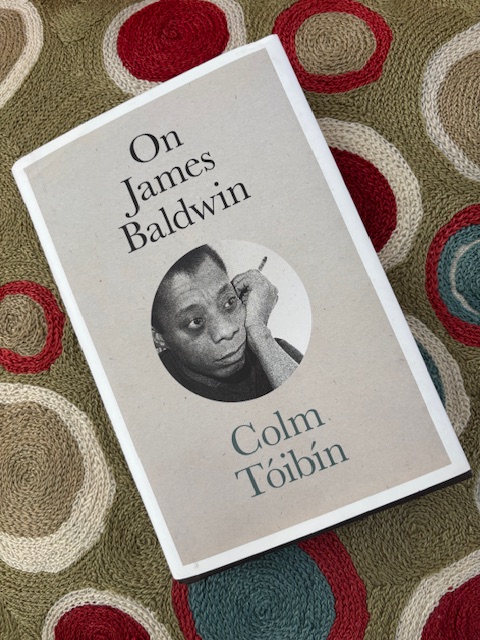
When I heard that Colm Toibin, one of my favorite writers, had written a book about James Baldwin, I was intrigued. I saw the obvious biographical similarities between the two. Both of them gay men, both with experience of living and writing in adopted homelands (Baldwin in France, Toibin in the US), and both touched deeply in different ways by the religious traditions in which they were raised. Intrigued and enthused I might have been, but I was also a little concerned that the book might demand a deep knowledge of Baldwin’s work (something I don’t have), and might be academic or dry (it’s published by a university press). I need not have worried. No doubt I would have got more from On James Baldwin if I had read more of Baldwin’s work or if I knew better books such as Giovanni’s Room, but this is as much a book about Toibin as it is about Baldwin. It’s also one that draws insightful parallels with the work of other notable emigre writers such as James Joyce, Ernest Hemingway, and Henry James. Best of all, it made me want to read more James Baldwin, and I guess that’s mission accomplished!