Reading This Year And Next

2016 wasn’t a great year for reading.  Having said back in January that I would follow my nose when it came to choosing books, it turned out my nose wasn’t always reliable.  Looking back on the reviews written for this blog, I find I simply chose too many books that proved to be disappointing and mediocre.  Ho hum.  I hope for more discernment next year.

Just as I expected, fiction dominated, accounting for 80% of everything I read.  Several good novels are on the list – Addlands by Tom Bullough and Helen Dunmore’s Exposure, for example – and one very good one (Mothering Sunday), but many were fodder, entirely forgettable.  Biography was more rewarding in 2016 with outstanding accounts of the lives of Ted Hughes and Kenneth Clark among my favorites of the year.

A truly great book changes you forever, altering your perspective and outlook or moving you intensely. I was privileged to read one of those in 2016, Night by Elie Wiesel.  That, without question, was my book of the year.

Now it’s time for some reading resolutions for 2017.  Braver choices.  More unknown and young writers, voices from other worlds. Maybe it’s the year for some of the great authors of the past whom I’ve wholly or largely neglected: Thomas Mann, Evelyn Waugh, Tolstoy, Katherine Mansfield, or Virginia Woolf?  Isn’t it finally time to read Proust?  Less fiction, and especially contemporary fiction, more biography, history, and poetry.  Watch this space!

top-10-psychology-books-elearning-professional-read

Paris: Le 12eme

Exploring an unfamiliar neighborhood is one of my favorite things to do when I travel.  All the better if it’s a neighborhood that draws few other visitors.  I spent a little time recently in the 12th arondissement of Paris, a district with few attractions on a typical tourist’s “must-see” list.  It has the Bois de Vincennes, L’Opéra de Bastille, and not much else, but I had a wonderful few hours threading my way through the mostly quiet streets of a mostly residential neighborhood.  On a chilly Wednesday evening in late November, many of the locals were sensibly holed up in small, unassuming bars and brasseries.  Others were checking out the cute, artisan stores in Le Viaduc des Arts.

viaduc-des-arts-7cd9d

If, like me, you find yourself getting hungry and thirsty wandering around Le 12eme, I recommend two places very highly.  Chez Habibi on Rue Traversière is one of those perfect, tiny wine bars that only Paris produces, and to round off your evening, head to Maguey on Rue de Charenton and check out their “mystery menu”.  You won’t be disappointed.

Therese Raquin

therese-raquin1

When Zola’s Thérèse Raquin was first published in 1868, it was an immediate succès de scandale.  It’s not difficult to see why.  Its account of lust, betrayal, murder, and madness had all the ingredients for popular success, but it was its explicit portrayal of female sexuality that drove the censorious French critics and readers to outrage and condemnation.

It’s a straightforward enough, though somewhat lurid, read.  There’s nothing subtle about it.  In fact, its relentlessly grim and sombre tone left me feeling somewhat smothered by darkness and longing for even a glimmer of light.  I read the novel in English, in a translation by Leonard Tancock first published in the early 1960s that in part reminded me of the sensational and excessively dramatic language used in penny dreadfuls.  I’d be interested to see if this is muted in a more recent translation or whether it reflects faithfully Zola’s original.

This year’s travels

34ce8e86ecb69ca417379ab9c90ad64d

It proved to be a busy year.  Fourteen countries visited in twelve months, some of them on multiple occasions: UK (five times), Japan (twice), United Arab Emirates (twice), Jordan (twice), India (three visits), Germany, France, Netherlands, Spain, St. Lucia, Belgium, Australia, New Zealand, and South Korea.  Somehow I managed to touch down in four countries in a single day: New Zealand, Australia, Singapore, and Japan, a milestone for me that I never want to repeat or recommend to anyone else.

What will I always remember from 2016?  Walking completely alone in the chilly, early morning hours through the ruins at Petra.  Exploring the temples of Kyoto and an unforgettable kaiseki dinner.  The road from Queenstown to Glenorchy.  The quiet streets of Segovia.  I’ll never forget my first-time visits to Jordan and New Zealand, two beautiful countries where I couldn’t have been welcomed more warmly, countries I already want to re-visit, countries I want to share with others. Not all the delights were international.  My first sight of Fallingwater – just a few hours drive from my home – was unforgettable.

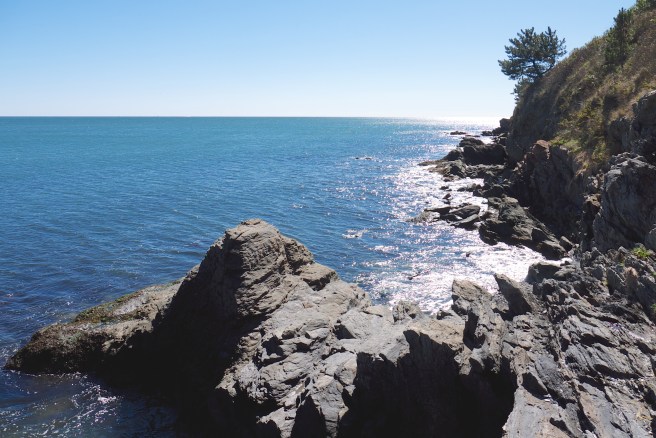
Don’t believe the clichés or the cynics.  It’s not a small world. It’s not a homogeneous world.  It’s a huge, diverse, gorgeous, thrilling, and humbling world, and here are a few pictures I took in 2016 to prove it!

DSC_0063DSC_1410IMG_1498

A Handful Of Dust

Other than the unforgettable TV adaptation of Brideshead Revisited, I knew almost nothing about Evelyn Waugh’s novels before picking up a copy of A Handful of Dust in the Amsterdam branch of Waterstone’s recently.  I had thought for some time that I should do something about this gap in my reading, but two things deterred me.  First, by all accounts Waugh was a horrible man; a cruel, snobbish misogynist.  I’m not sure why this should matter, but it certainly influenced me. Second, I’d absorbed the impression (from where I’ve no clue) that his novels were little more than period pieces; brittle, superficial accounts of a society long past.

5071
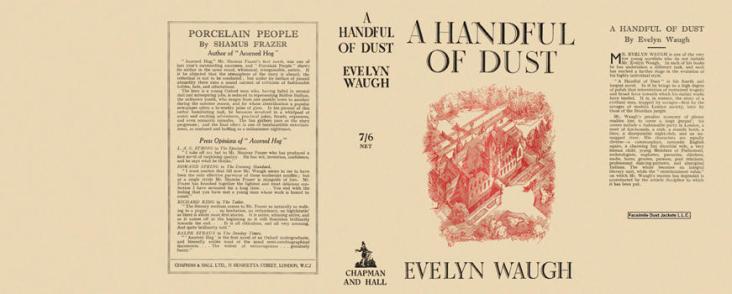
The dust jacket of the first edition of A Handful Of Dust, published by Chapman & Hall, 1934

It’s easy enough to read A Handful Of Dust as a light comedy or social satire, a biting critique of the feckless, bored, and immoral upper classes of the interwar years, but it’s much more than that. However bitter and caustic its tone, there is at the heart of the book a real sense of sadness.  Tony and Brenda, trapped by their addiction to wealth, social status, conventional good manners and routine, occasionally touching sentimentality but always incapable of reaching and expressing genuine, deep feelings, are terrifying reminders of what can happen to the aimless and lightly rooted, however privileged their circumstances.  Published in 1934, it’s very much a novel for today.

Amsterdam

SONY DSC

I spent a lot of time in Amsterdam in the early 1990s, looking for office space and staff for a start-up with which I was involved in those days.  I got to know the city quite well at that time and grew to love it, and my affection has only increased.  I returned recently on a sunny, crisp autumn day after a gap of two or three years and found that I fell into a familiar and soothing groove that I must have dug twenty years ago: buying my newspaper at the Athenaeum Nieuwscentrum, reading it over breakfast at Koffiehuis de Hoek, strolling aimlessly along the canals towards Jordaan, followed by a browse in the market around the Noorderkerk and lunch in one of the city’s unique “brown cafés”.

Nothing important has changed.  The people of Amsterdam are as warm and welcoming as ever, eager to stop and talk (in flawless English, of course).  Ambling along the narrow canal side streets is as hazardous as it always was, thanks to the hordes of cyclists that weave carelessly and silently just inches from your shoulder.  Best of all, Amsterdam still has that gentle counter-culture, that wafer-thin layer of conformity, beneath which the uniquely Dutch “take us or leave us” attitude persists and thrives, and that combination of proud independence and openness to the world that seems to me to represent the best of the European ideal.  It was wonderful to be back.


The Geneva Trap

More “flight fodder” from Stella Rimington, my third this year and a gift from a friendly publisher.  It’s hard to explain the appeal of these novels.  The plots are barely credible, the characters are little more than ciphers, and the writing has all the subtlety of a sledgehammer.  Nevertheless, they’re engaging and entertaining enough, perfect distractions on long-haul flights when something more serious just won’t do.

mi5_crest_and_logotype-svg

Kenneth Clark

5913

Kenneth Clark, art historian and administrator, critic and connoisseur, expert and populist, isn’t a widely known figure today, especially outside the UK.  Yet in the late 1960s, his 13-part TV series, Civilisation, made him a household name and Britain’s best-known public intellectual.  His early education seemed to predict a career as an art historian and academic, but his appointment at aged 27 to the position of Keeper of Fine Art at the Ashmolean Museum in Oxford and, at the remarkably early age of 30, as Director of The National Gallery, set him on a path as a curator and arts administrator.

His life and career were driven by a number of profoundly held and sincere beliefs: that art and artists matter, that government should play an important role in nurturing the arts, that he had a duty to public service and that his life’s vocation should be to promote, encourage, protect, and sustain them. So many of Britain’s finest artists – Henry Moore, Victor Pasmore, John Piper, Graham Sutherland, and scores  more – were supported by Clark at critical points in their careers, most notably during the Second World War.  Throughout his life, Clark looked for new ways to bring art into the lives of the British people and he was very successful doing so.  He also had great influence as a taste maker, populist, and educator, and through his dedicated committee work steered the direction of many of Britain’s most important cultural institutions.

It has been my experience that few biographers write well.  James Stourton, the author of Kenneth Clark: Life, Art, and Civilisation, is an exception.  He writes elegantly, precisely, and sometimes beautifully.  He focuses quite properly on Clark’s career and achievements, touching only lightly and uncensoriosly on his colorful private life, but leaves us overall with a very convincing and balanced portrait of a remarkable, important, and complex man.

Public libraries

I must have been four or five years old when my mother started taking me to the local public library.  A pattern developed in those early visits.  She would sit and read the newspaper or a magazine while I wandered around the shelves, collecting an armful of books to borrow, treasures for the week ahead.  On one occasion she lost me in the library.  Increasingly panicked, she asked the staff and borrowers to help search for me.  I was found safe and well a little later sitting in the chief librarian’s office.  The story goes – and I’ve been hearing it consistently from my mother for more than fifty years – that I asked for a job.  The librarian was kind enough to treat the precocious boy with greater seriousness than he deserved and gave him an application form.

indianapolislibrarylearningcurve

A lifelong love of reading, books, and libraries was born in that small, modest, public library in London.  A journey was started in those days, a journey into other people’s imaginations and my own, and into other worlds near and far.  The journey has never ended.  I cannot begin to describe the part books have played in my life, how they have shaped who I am.  Neither can I express my gratitude to public librarians who were my earliest navigators around the printed world.

It’s rare for me these days to visit a public library, though there’s an excellent one in the village where I live.  My reading tastes have settled and the reading paths I now follow are mostly well-trodden and familiar to me.  Although I’ve less need of expert guides, you’ll never convince me that public libraries are obsolete.  They’re no less essential than they ever were.  In fact, they’re more important, and will be for just as long as there are curious, hungry explorers like that little boy I was more than fifty years ago.

I discovered me in the library.  I went to find me in the library.  Ray Bradbury.

Newport, RI

Early October proved to be the perfect time to make my first visit to Newport.  The weather was cooperative: warm, cloudless days ideal for walking and exploring.  I was delighted by the old part of the town and its streets of 18th century houses and good public buildings.  Newport’s glory, however, is its cliff walk of three and a half miles, which offers lovely views of the ocean.

cliff_walk_newport

The many hideous mansions that line the walk  – bloated monuments to the hubris, self-importance, and poor taste of the 19th century plutocrats who built them – don’t spoil the experience.  If you love architecture, you can safely ignore these mostly horrible pastiches of European grandeur and take instead a stroll down Spring Street, where you’ll find several perfect expressions of the 18th century vernacular style.