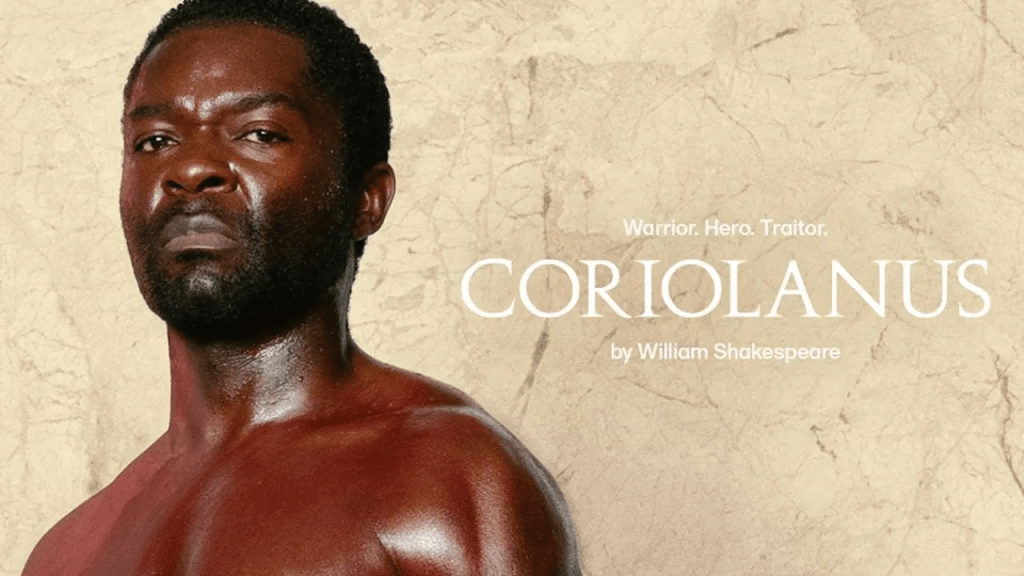
Coriolanus

I have seen several remarkable performances of Coriolanus. Two stand out in my memory. Ian McKellen took on the role at The National Theatre in 1984. I remember it as a blood-soaked staging, and the picture below seems to confirm that.

More than fifteen years later, I saw Ralph Fiennes play the part of the arrogant Roman in a darker, more psychologically intense staging at (I think) the Gainsborough Studios in London. It has always been one of my favorite Shakespeare plays, so I was excited to head back to The National Theatre recently to see how David Oyelowo would interpret the role. The production was still in preview, so the cast was still working out the kinks. (Oyelowo forgot his lines at one point, but recovered after a nerve-racking moment). Overall, it struck me as a cinematic, polished, and slightly flashy staging. It felt a little muddled in design terms. Generals brief their battlefield commanders via cell phones and video calls while soldiers fight with swords and shields. The action moves from sleek, expensive, hotel-style interiors to unadorned public spaces staged like a museum. Performances were generally very strong.

Coriolanus is very much a play for our times. Politicians inflated with hubris and boastfulness, pretending to care for the people when it suits, but otherwise deeply contemptuous of them, and fickle, easily. manipulated electors. Does any of that sound familiar or urgently relevant to our times?

Henry Moore: Shadows on the Wall

Henry Moore first attracted significant public attention during the Second World War when the drawings he made of Londoners sheltering from the Blitz in tube stations were first published. Although Moore’s reputation today rests mainly on his monumental sculptures, those intimate drawings of men, women, and children taking refuge in such claustrophobic conditions remain powerful and affecting. The Courtauld in London has displayed some of this work in a small exhibition called Shadows on the Wall.

The premise of the exhibition is Moore’s fascination with those confining walls, ceilings, and tunnels – architectural elements that he explored further in his well-known drawings of the Yorkshire coal mines and that were far more than simple backdrops for the human figures he represented. It’s an interesting idea. Looking closely at the drawings, the fusion of the human and the architectural becomes more pronounced.

The engrossing exhibition in London ends soon, but a catalog authored by Penelope Curtis and others is available.

Cork City Musings

Even Cork’s greatest admirer would struggle to say the city is a pretty one. The dominant theme is one of grayness. Gray buildings under skies that are often that particular gray that signals rain. It can all seem a little grim at times in the city center, somewhat neglected and shabby. But whatever it might lack in prettiness, Cork has character, charm, and energy in abundance.

For decades the city has been little more than the beginning of my frequent trips further west, but recently I had the opportunity to spend a couple of days there, and I enjoyed it very much. The food scene is vibrant (highlights included Goldie and Nano Nagle Cafe), and there is, of course, no shortage of historic pubs. Sin E for traditional music, The Oval, Mutton Lane, and Arthur Maynes for unique atmosphere and craic in general. The Crawford Art Gallery is an unmissable spot and I was delighted to visit before it closes for major restoration work. Tempting as it might be to skip the city en route to the glories and splendors of West Cork, that would be a mistake. Linger a little and let it work its magic.

On This Holy Island

Oliver Smith had long dreamed about completing the camino, the ancient pilgrims’ walk to Santiago de Compostela. The pandemic put the realization of that particular longing on hold. He started to think about focusing his interest in pilgrimage in a different way, reflecting instead on the pathways and destinations, ancient and modern, to be found closer to home, and planning an adventure across the sacred landscape of his native Britain. On This Holy Island is the result.

Some of the places that featured in his journey are familiar to almost every Briton. Stonehenge, Glastonbury, Avebury, Lindisfarne, and the White Horse at Uffington – these are places we learn about at school (even if we never get to visit them or understand their significance). But the history of pilgrimage in Britain encompasses a much broader topography, physical, emotional, and spiritual.

Smith writes with a self-deprecating charm and a light touch. This isn’t some dry, heavy thesis about the nature and meaning of pilgrimage. It’s a fact-filled, anecdote-filled travelogue, a book of encounters and conversations as much as wanderings and destinations.

Valencia

More than twenty-five years have passed since I was last in Valencia. I remember very little of that first visit. Only the busy central market with its food sellers has stayed in my memory, so the few days I spent there in the warm, late May sunshine had the feel of a first encounter.

Although the city as a whole is spread out over a wide area, the historical centre of Valencia with its narrow streets can easily be walked in a day and is kind to pedestrians. Relatively few cars intrude and one gets the sense of a city organized intelligently and sensitively with the needs of both residents and visitors in mind. Its manageable size and its undeniable prettiness have put the city on the destination lists of “city break” tourists, so expect large numbers in the warmer months. They tend to concentrate around the major historical sites (the Cathedral and central market, for example) and larger squares, but should you wish to avoid the crowds it’s easy enough to do so by walking into the charming residential areas just outside the centre. Early mornings, as the Valencians are getting about their business and while most visitors are still sleeping, are the best time to enjoy the historic centre.

My favorite places? The Iglesia San Juan del Hospital, founded in the 13th century and reputedly the oldest church in the city, is wonderful, and all the more so for being tucked away on a narrow street. The Centro del Carmen de Cultura Contemporanea (CCCC) is housed in a 13th century convent and is home to a changing program of contemporary art exhibitions. Go early and enjoy the calm of its cloisters, and don’t forget to have paella (but only for lunch, never for dinner).

Fondation Louis Vuitton

Nearly ten years have passed since the Fondation Louis Vuitton opened its beautiful gallery in the Bois de Boulogne. I have been meaning to visit for almost as long. An opportunity arose recently when I was in Paris for the Olympics, so I hopped on the subway to Les Sablons one sunny Sunday morning, having purchased the obligatory ticket for timed entry. The building, designed by Frank Gehry, is next to Le Jardin d’Acclimatation and no more than a 10-minute walk from the metro station.

Two exhibitions offered further incentives for me to visit (Matisse: The Red Studio and Ellsworth Kelly: Shapes and Colors), but the building itself and the permanent collections make the trip worthwhile in themselves. The space is magnificent, filled with light and movement, imposing and spectacular but never overshadowing the works inside. It is simply unmissable for anyone who appreciates contemporary architecture and is surely one of the great public buildings of the 21st century.

After leaving the gallery, wander into Le Jardin. After all that high-minded art and architecture, don’t miss lunch at La Terrasse.

Paula Modersohn-Becker

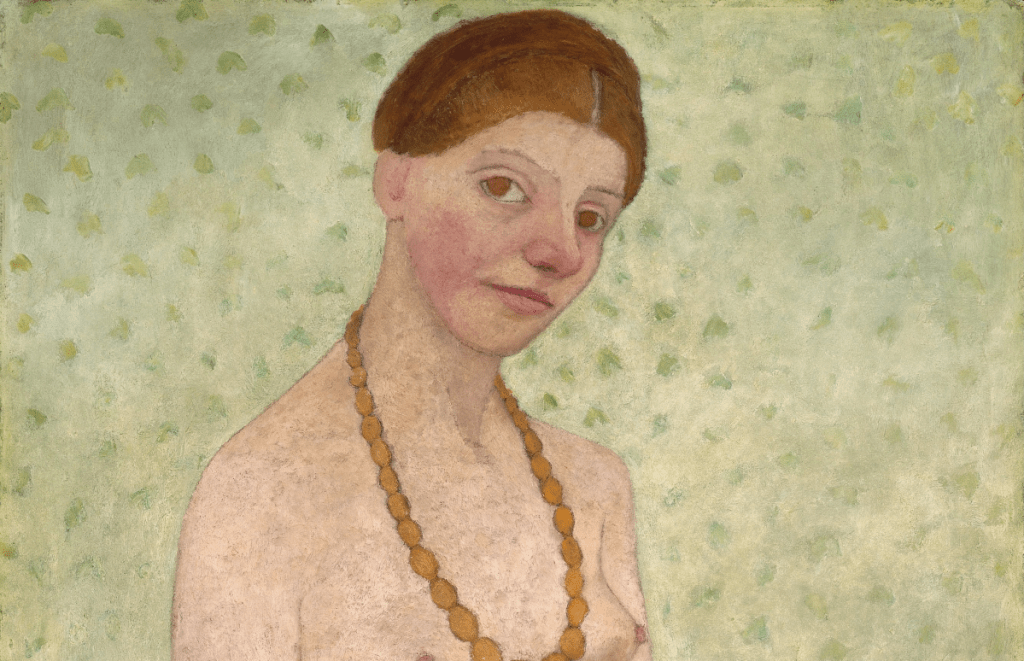
My visit to the Neue Galerie was a revelation. How is it possible that I had never heard of Paula Modersohn-Becker (1876-1907)? Yes, the history of art has been written by men and the exclusion of women from the canon has been well documented. Yes, she died at the age of 31. Yes, her work is in very few collections outside Germany. But I’m still amazed that so wonderful a painter had somehow never come to my attention.

The exhibition in New York comprised four small rooms of (mostly) paintings. Her career might have been short (she died from a pulmonary embolism just a few days after giving birth to the child she had longed to have), but Modersohn-Becker was prolific in the few years she was active. Portraits and self portraits dominate the show, paintings that show the influence of contemporaries like Gauguin, masters she admired like Cezanne, and even African art. On this evidence, one can only imagine what extraordinary work lay ahead if she had lived longer.

This exhibition heads to the Art Institute of Chicago in the autumn, after which most of these beautiful paintings will go back to Bremen and into private collections. See it now if you can.

The Anonymous Venetian

The Anonymous Venetian (called Dressed for Death in the US edition) is the third book in Donna Leon’s Brunetti series. It begins, just like the earlier stories, with the discovery of a corpse. On this occasion, the victim, a man dressed in women’s clothes, has been brutally attacked and left on waste ground near a slaughterhouse on the outskirts of Venice. It’s outside Brunetti’s jurisdiction, but the summer is here and the other detectives are enjoying their vacations.

Working within the tight constraints of the genre and with the limitations that a series inevitably imposes, Donna Leon has a serious intention here, to uncover the conservatism of Italian society and how its judgements on sexual behavior further victimize the victims of crime. Brunetti has his prejudices, neatly exposed and confronted here by his more humane and sympathetic wife, Paola.

The novel shares too many similarities with its immediate predecessors. It was probably a mistake to read the first three novels in the Brunetti series back-to-back. The flaws showed up too clearly, flaws that might have stayed hidden or been less obvious if I had allowed some time to elapse between the novels. I plan to read more in the series, but for now I need a break from the Venetian detective.

Death in a Strange Country

The second installment in Donna Leon’s Brunetti series follows closely the pattern set in the first. The plot is not the priority. An American soldier serving at an army base in Vicenza is stabbed and his body dumped in a canal in Venice. Brunetti is assigned to solve a case that looks at first like a mugging gone wrong, but he soon starts to uncover much darker criminal and political shenanigans. Leon’s heart is not really in the whodunnit part of all of this. Her interest is in the character of Brunetti and, perhaps to an even greater degree, in that of Venice itself, and it is already clear that’s going to be the great strength of this series. Just as in the earlier novel, the resolution of the mystery comes along very late in the story and the explanation of the crime is hurried and unsatisfying. That doesn’t matter very much. Brunetti and Venice are getting more interesting with every installment.

Paris 2024

The naysayers, cynics, and doom mongers got it wrong, as they often do. The Paris Olympics were a triumph. They city’s infrastructure held up well, the organization of the events was flawless, and fears about security proved largely groundless (apart from attacks on train lines just before the opening). Even the weather cooperated once the heavy rain that spoiled the opening ceremony passed through.

Paris was its usual elegant, stylish self, on show for the world to see. Away from the major venues (Trocadero, the Stade de France, Chatelet, and so on), the city felt quiet and even sleepy in parts. My favorite arrondissements, Montparnasse, St. Germain, and Le Marais, could be explored without crowds. With native Parisiens having escaped in huge numbers, but with almost all the restaurants and bars open for business, it was unlike any August I had ever spent in the city.

The spirit at the events I attended (soccer, tennis, athletics, and cycling) was inspiring and a perfect expression of what the Olympics stand for. Bravo to Paris, to France, and everyone involved in the organization of Les Jeux Olympiques.