At some point it would be good to take my time and wander around the Yucatan peninsula at my own pace, exploring the many Mayan archaeological sites for which it is famous. On a recent and very brief visit to the region I had to restrict myself to a single nearby treasure, Chichen Itza, the complex of Mayan ruins dominated by the massive step pyramid known as El Castillo. The city prospered between 600 and 1200 A.D. and even in today’s much diminished site it is obvious that it was built by a thriving civilization.
Chichen Itza’s proximity to the coastal resorts means it is often choked with tourists, so it is wise to pick the time of one’s visit carefully. It is also worth noting the large number of vendors surrounding the site that sell all sorts of tourist tat. Once inside the main site it is easy enough to ignore them, but prepare to be hassled on the way in and out.
I enjoyed the visit immensely. It provoked a determination to visit the region for a longer period and to learn more about Mayan civilization before I make my next trip.
Niall Williams’ latest novel is one of the finest I have read in a very long time. I rarely use the word, but I think it’s a masterpiece. The novel is beautifully crafted and practically every sentence is a joy to read. It is written with a lyricism that is so rare in contemporary fiction and with a sensitivity for language and for its nuances that feels like a skill from a bygone age. Who else writes like this today? Marilynne Robinson comes to mind, but few others.
Time of the Child is set in the fictional village of Faha in the west of Ireland. The time is December 1962. Electricity, televisions, and telephones came to the village just a few years earlier, but many of Faha’s residents are stuck in earlier times. They live in houses illuminated by candles and heated by peat fires. They work mostly on the land, and the rhythms of their lives are set by the changing seasons and by religious festivals. The priests have power. The church and the pubs are where people meet. If this sounds far-fetched, it isn’t. My childhood visits to rural Connemara and West Cork started in the mid-1960s, and Williams’ depiction of the place is faithful to what I saw and experienced.
A gift arrives in this isolated and timeless place. A newborn baby is abandoned in the village churchyard and discovered by a local boy. Thinking it dead, he takes it to the local doctor. What happens next is a mystery. Whether by Dr. Troy’s skill or the power of prayer, the baby girl is revived and given the name Noelle. No more about the plot. I do not want to spoil anyone’s enjoyment of the novel.
Time of the Child is everything I want in a novel. Exquisite lyrical prose, deep insight into what it is to be human and humane, into how to live alone and in community, and what it means to be open to the possibility of transformation and redemption.
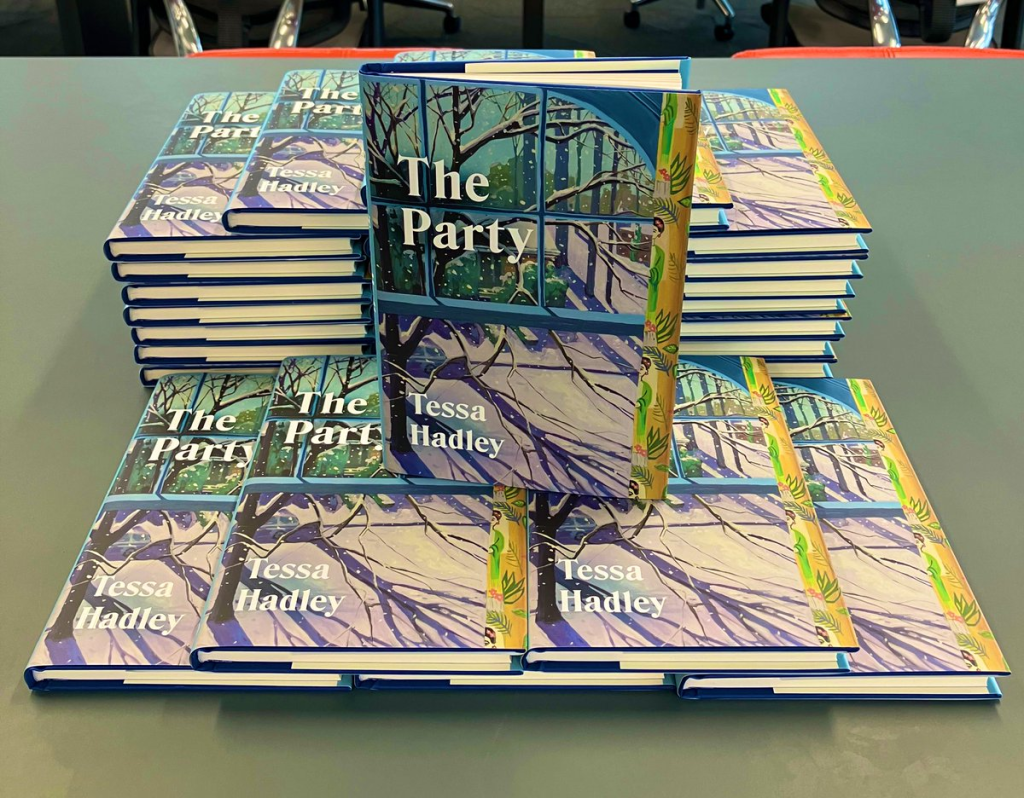
A new book from Tessa Hadley is always a treat, even a slim novella like The Party. It ought perhaps to have been called Two Parties because the story is bookended by two social events, attended by two sisters, Evelyn and Moira, both students. The first takes place in a Bristol pub shortly after the end of World War Two and the second, more of an ad hoc get-together, in a grand but faded house elsewhere in the city the following weekend.
How far can any of us really achieve the lives we want to have? What real influence do we have over the shape of our future? Can we realize the lives we want by sheer force of personality and determination, or are our futures mapped out for us by factors over which we have so little control such as class or gender constraints, real or perceived? These are the questions that interest Tessa Hadley, and she uses the sisters with their common upbringing and history as exemplars of two distinct perspectives. Not that Moira and Evelyn are simple cyphers. Not at all. Hadley is far too accomplished a writer for that, and Evelyn especially is a brilliantly realized character.
Does this all sound a little old-fashioned, like Anita Brookner or Barbara Pym for the 21st century? Perhaps, but don’t be put off. There is more inventiveness, daring, and insight in Hadley’s writing than some more experimental novelists can dream of realizing.
Only a very confident and self-assured author takes a familiar genre, in this case the spy novel, and uses it as a channel for ideas. A burden comes with that decision. Spy novels are traditionally plot-driven vehicles and readers of the genre expect pace, twists and turns, and action. So manipulating and subverting the classic espionage tale is all very well, but the ideas had better be worth the effort and at least some of the familiar features of the genre had better be respected. No one ought to buy Creation Lake expecting a conventional spy novel, and anyone who does will be disappointed. If that happens, some reviewers might be responsible. The Guardian critic talked about “a killer plot and expert pacing”. That’s downright misleading in my view.
Sadie Smith, the heroine and narrator of Rachel Kushner’s latest novel, is a spy working in the private sector and has an assignment to infiltrate a shadowy group in rural France suspected of planning acts of sabotage. Sadie is unscrupulous, a quality that might be considered an asset in her line of work. It has, however, got her into trouble in the past when, working for a spy agency in the US, she was found to have entrapped an innocent man and got fired as a result. Now in France, she has seduced an impressionable activist to gain entry to the suspected terrorist cell. This lack of a moral compass might be Sadie’s least unattractive quality. Her superficial pronouncements on everything from Europe and its culture (overrated) to Italian food (horrible), her glib philosophizing (“The truth of a person, under all the layers and guises, is a substance that is pure, and stubborn, and consistent”), her unassailable belief in the superiority of English (in other words American) culture marks her out as the worst kind of entitled, privileged, and semi-educated American who has everything, values little, and has earned nothing. Sadie hacks into the emails of Bruno Lacombe, the leader and guru of the protest group, and pokes fun at his tiresome ideas, but his silly intellectualizing about what we can learn from Neanderthals makes him look like a genius compared to Sadie and her moral vacuity.
I am surprised that Creation Lake was shortlisted for The Booker Prize. It’s a novel that’s executed with lots of confidence and it’s an enjoyable enough read, but I couldn’t shake off the feeling that there’s no substance or heart in the book. Rachel Kushner’s critical reputation seems to be growing with every new novel, but on the evidence of the two I have read (The Flamethrowers and Creation Lake), I don’t understand why.
It is believed that John Webster wrote The Duchess of Malfi in 1612 or 1613. That puts the play’s creation at around the same time as Shakespeare’s The Tempest or Henry VIII. It was performed very widely when it was first written and has continued to be staged ever since. I can recall seeing it in London decades ago, but only have the faintest memories of the production. It is easy to see why it might resonate with modern audiences given its preoccupation with misogyny, power politics, and with men’s efforts throughout history to control women. It’s not short of violence and gore, so that might also partly explain its continuing appeal.
The modern adaptation I saw staged recently in London may introduce a new generation to the play, though its insistence on 21st century English gave little or no flavor of how Webster’s original text sounded. The themes survived, but the poetry of the original was lost.
There is a new Tessa Hadley novel coming at the end of the month (The Party). Hearing that news while I was browsing in Hatchard’s recently prompted me to pick up an older collection of short stories, Married Love, first published in 2013. The cover includes a gushing quote from The Times‘s review, describing the collection as “unexpected, exhilarating, life-changing”. Married Love is none of those things. It’s an uneven collection that includes masterful stories and some that miss the mark. The best of them are a reminder of what a supremely accomplished writer Hadley is. I have pre-ordered The Party and will devour it once it arrives.
Is it appropriate to measure the greatness of a painter by the range of human feeling they elicit in the viewer or display on the canvas? Perhaps narrow and deep should be sufficient, picking at one feature of human existence over and over again, worrying relentlessly at a scab to burrow deeper to discover and uncover the real wound beneath the surface. The thought occurred to me walking around The National Portrait Gallery’s outstanding exhibition of Francis Bacon’s portraits, Francis Bacon: Human Presence.
Bacon understood despair and the awareness of futility. He knew something about the longing to accept and impose cruelty. Suffering, isolation, and pain are never far from the canvas. He detected such things in the artists and paintings he admired, in Velazquez, Picasso, and Van Gogh. He discovered over time his own language in paint to express such things. His greatness lies in that language. His reputation is growing all the time, eight decades after he made his first impact on the world, and his work reverberates even more powerfully now when so many experience the world as a threatening, ominous, and lonely place.
Where is the affection, tenderness, and love in Bacon’s world and work? An exhibition devoted to his portraits might reasonably be expected to be a useful starting point, perhaps in paintings of his friends (including Lucian Freud and Frank Auerbach) or lovers (Peter Lacy, George Dyer, and John Edwards). But Bacon’s grim inspection of the skull beneath the skin is abundant even here and the portraits are full of snarling, grimacing, and screaming faces, many of them distorted by injury and pain. Only in some of the later paintings, especially one of John Edwards, is some tenderness detectable. Did Bacon soften slightly in old age?
This was one of the most impressive and compelling exhibitions I have seen in recent years. An opportunity to see some really important pictures rarely on display (notably the double portrait of Freud and Auerbach which I had only see before in reproductions), and confirmation, if confirmation is needed, of what a great (and grim) artist Bacon was.
Sean O’Casey’s classic drama was first staged in Dublin in 1924. It had been written two years earlier when civil war was raging in Ireland. A hundred years on, Juno and The Paycock has become a staple of Irish theater, but is less frequently performed elsewhere. I have seen it on two or three occasions, once in London for sure decades ago and once in New York City more recently. It is a challenging piece to stage. In the wrong hands, the comedic parts can easily descend into caricature, the tragic parts can look maudlin, and the whole can come off as sentimental. When I learned that one of my favorite actors, Mark Rylance, was taking on a leading part in the play in a West End staging, I was keen to get a ticket but also a little apprehensive. O’Casey’s plays explore universal themes, but they are very explicitly Irish. How would decision to cast all three of the main parts to two English actors and one American play out?
It proved to be a problem (none of them could sustain a reliable or authentic Dublin accent throughout the performance I saw), but not the most serious problem. Act 1 was played for laughs, with Rylance (Captain Boyle) made up to look like Charlie Chaplin and hamming it up at every opportunity he was given. The audience loved the Vaudeville-style brilliance, but as the drama turned towards darkness and tragedy it proved impossible to pull it back from the brink of farce. The terrible sadness at the heart of Juno and The Paycock was never shown because the early humor proved too hard to resist and rein in.
It is a play about the places we find meaning, consolation, and redemption. Religion for some, politics for others, not to mention the distractions of alcohol and romance. For Juno, family is everything. Her tragedy is to be the only one in her family to realize that.
I can hear the bell of St. Anne’s, Limehouse tolling as I write. The church is preparing to celebrate its 300th anniversary, and every time I walk past it, I imagine what the local people must have thought back in the 1720s when this monumental structure started to take shape around them. Even today, with Canary Wharf’s glass and steel towers looming in the distance, St. Anne’s holds its place proudly, but three centuries ago it must have been nothing short of astounding.
I was inside St. Anne’s recently to see an exhibition of photographs taken by Helene Binet and displayed to mark a project to restore all of Nicholas Hawksmoor’s extraordinary London churches. Hawksmoor was the great beneficiary of Queen Anne’s so-called Fifty Churches Act of 1711. The grandiose project envisioned originally never came to full fruition. Only twelve churches were completed. Nevertheless, the vision gave us what many today call the Hawksmoor Six: St. Anne’s, Limehouse, St. Alfege in Greenwich, St. George-in-the-East, Christ Church, Spitalfields, St. Mary Woolnoth, and St. George’s, Bloomsbury. We can add the decommissioned church of St. Luke’s, Old Street, and the now demolished St John Horsleydown, but it’s the Six that most people know and that are the subject of the conservation effort.
As I strolled around looking at the huge, imposing photographs, and reading about the restoration appeal, I got talking to a volunteer who alerted me to a wonderful book by Mohsen Mostafavi and Helene Binet, Nicholas Hawksmoor: London Churches. Binet’s sharp black-and-white photographs steal the show here, but the floor plans and stylized outlines of each church are also rendered beautifully, and are accompanied by short essays. No book can do justice to the splendors of these remarkable and precious churches, but when I’m away from London I like to dip in to London Churches to remember them.
I have read many novels by Nicci French over the years, including the reliably excellent Frieda Klein series. They are dependable, plot-driven page turners, filled with the usual narrative twists and turns that the genre demands and with more or less believable characters. The latest standalone story, Has anyone seen Charlotte Salter?, checks all those boxes. A woman goes missing on the evening of her husband’s fiftieth birthday party, leaving behind her stunned and bewildered children. Thirty years pass without any trace of her. No body, no sightings. Just the mystery of her sudden, inexplicable disappearance and the hole it left in the lives of those who loved her. No plot spoilers here …
There is no way to deny the authors’ mastery of the genre. Years of experience are visible on every page. Having said that, my interest in the plot and characters started to flag at one point, and it took the introduction of a new character two-thirds of the way into the novel to revive it. Even then I turned the final page feeling that the denouement was rushed and unconvincing. An enjoyable, workmanlike performance from Nicci French, but not a classic.




 Miscellaneous Musings