Apollo Bay Days

We left Apollo Bay just as the influx of post-Christmas visitors arrived for the area’s peak holiday period. We had seen the town at its best – on warm, sunny days when the neighboring beaches were quiet and getting a dinner reservation was easy. The town is a good base from which to explore not just the shoreline but also some of the wonders inland. Don’t miss the lovely waterfalls (we went to Hopetoun Falls, a 40 minute drive from Apollo Bay, but there are several others) and Mait’s Rest, a spectacular boardwalk through ancient rain forest.

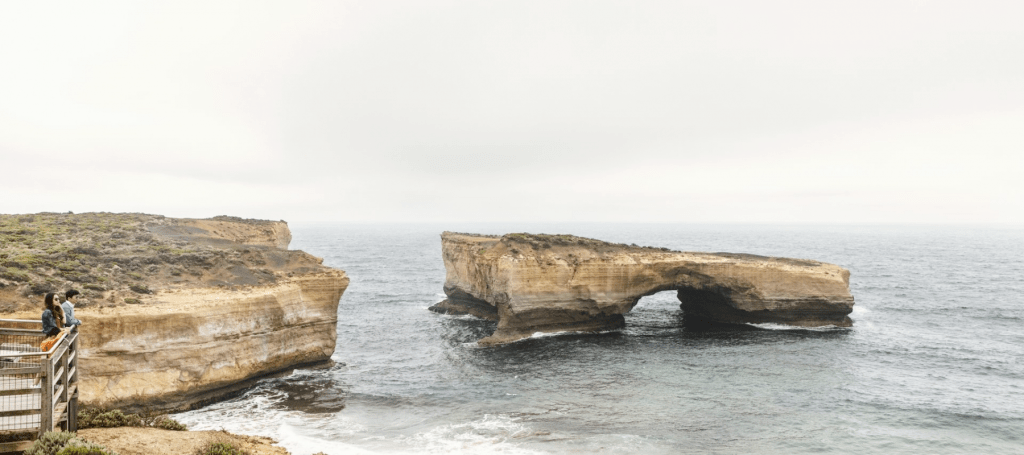
One attraction where it is impossible to avoid crowds is The Twelve Apostles, the spectacular limestone stacks near Port Campbell. Don’t be deterred. You’re very unlikely to be there alone, but nothing can take away from what has to be one of the most impressive pieces of coastline you will ever see. We assumed it would be quiet there on Christmas Day. We were wrong, but no matter. The Apostles are an unforgettable sight, as is London Bridge just a few miles away.

The Great Ocean Road

I recently spent a few days exploring part of The Great Ocean Road, basing myself first in Lorne and then in Apollo Bay. It has become in recent years one of the most popular destinations in Australia, and it’s not hard to understand why. The road hugs some of the most beautiful coastline one could ever hope to see, with wide, sandy beaches and water that attracts and challenges the world’s most accomplished surfers.

The road was built between 1919 and 1932 by some 3,000 soldiers returned from World War 1 and it is dedicated to those who died in that terrible conflict. I have heard it said that this makes it the world’s largest war memorial. Today, aside from the beauties of the coastline itself, the road is used as a starting-off point for exploring a large number of natural attractions, most notably The 12 Apostles, and by walkers, birdwatchers, and others keen to experience the extraordinary fauna and flora of the region. There are also plenty of restaurants, vineyards, breweries, and distilleries that showcase the region’s reputation as a gastronomic center.

Even when it is most busy, The Great Ocean Road is a spectacular place in which to spend a few days, a restful and gentle place in which to switch off and listen to the pounding waves and birdsong. Yes, it’s a road, but it’s a road that urges you to get out of your car, and walk, walk, walk …

Byron Bay

It seems churlish to complain about Byron Bay. It is, after all, a place of extravagant natural beauty, famed for its lovely coastline and picture-perfect beaches. The town, which has a year-round population of some ten thousand people, seems to me to cope quite well with the huge demands made by the two million visitors who visit those beaches every year.

And yet. Growing popularity has meant for Byron Bay what it has meant for other places, the inevitable creep of gentrification and the uniformity that always accompanies it. Locals are quick to say that property prices have risen far beyond the means of everyone except wealthy outsiders. The downtown is dominated by overpriced clothing stores, restaurants, and coffee shops, and by far too many upscale, global brands. Stroll around the town on a day you’re feeling a little sour and it can seem like Australia’s equivalent of the horrible Hamptons. You may be repulsed by the hordes of the young and over-privileged at play. If so, and you want something a little less pampered, head a few miles north to Brunswick Heads. The coastline is just as beautiful, the downtown is small and quaint, and the hippies not as affluent.

Birubi Beach

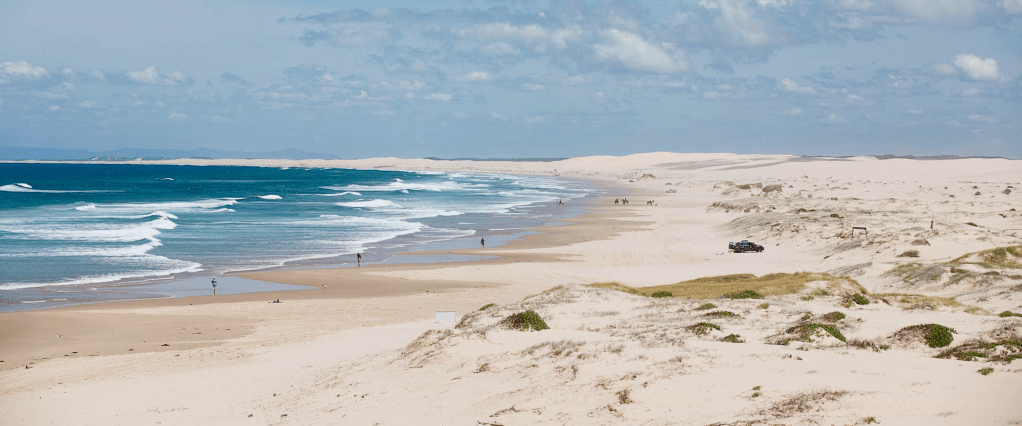
If you choose your moment carefully, or if you are just lucky, it is possible to walk for miles along Birubi Beach and see only the occasional surfer or dog walker. A Monday afternoon in early December at low tide would be my recommendation to anyone hoping to have to themselves one of the most spectacular and beautiful beaches I have ever seen. Park your car near the historic cemetery, follow the path to the rocks, and with a little clambering effort you will come to a beach of unblemished sand that stretches for nearly twenty miles. The depth of the beach at low tide is extraordinary, as are the huge dunes of pale yellow sand along its edge. This is the ancient land of the Worimi people and it is a place of great cultural and spiritual significance for them. Leave it just as you found it. Perfect, immaculate, ineffably beautiful.

A Guest at the Feast

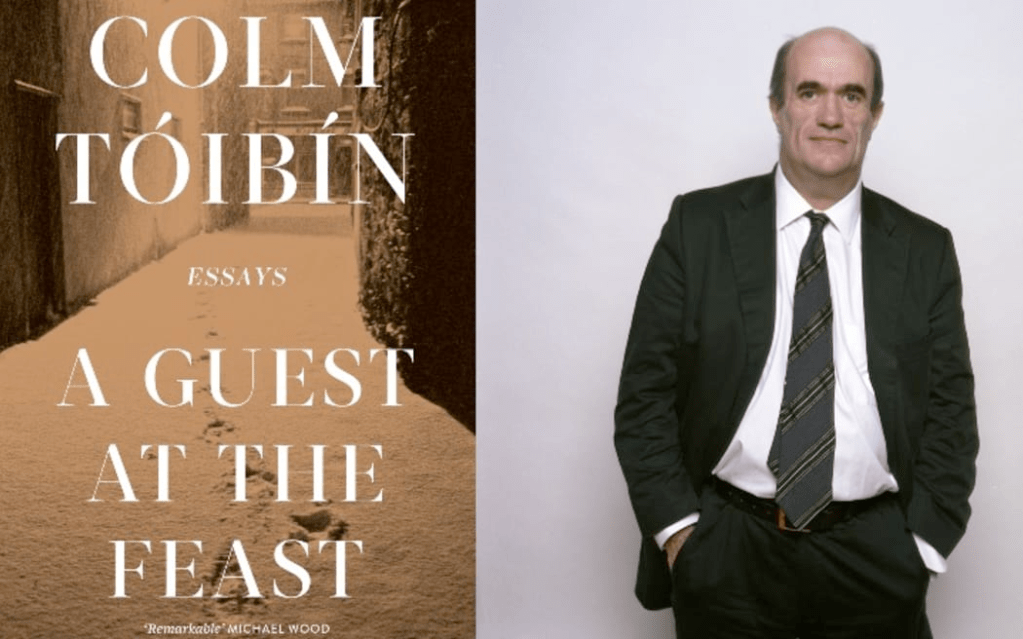
I never miss a new book by Colm Toibin. I had made a mental note to buy his latest when it was released in the US (January 2023), but I couldn’t resist it when I saw a paperback edition in the bookshop of The Art Gallery of New South Wales in Sydney recently, even though the price of books in Australia seem to me to so high as to constitute a scandal (but that’s a subject for a different day).

A Guest at the Feast is a collection of essays, some more than 20 years old and many first published in The London Review of Books. It could be argued that the publisher is somewhat shamelessly capitalizing on Toibin’s popularity, but no matter. I don’t subscribe to the LRB, so all of the essays here were new to me, and in any case I’d probably buy anything by Toibin that any enterprising publisher chose to put out.

The range of subjects covered in these essays is, at first glance, wide; the abuses perpetrated by Catholic priests in Ireland, the political engagement of the present Pope when he was a priest and bishop in Argentina, the writing of Marilynne Robinson. But the more I read, the more certain themes seemed to recur, especially the intersections of private morality and public and political life. Toibin seems to me to be a writer with a sharp eye for hypocrisy and for the adjustments and accommodations we all make to justify our behavior. But alongside his acuity he is also compassionate and forgiving, and that might explain in some degree the power of his work.

My favorites among these essays were the ones most personal. His account of being treated for cancer is both touching and hilarious and everything he writes about growing up in Wexford is beautiful. But I think the essay on Francis Stuart, an Irish novelist infamous for making broadcasts from Nazi Germany during the war, will stay in my memory the longest, not only for its fascinating account of an extraordinary life but also for its nuanced consideration of the complexities of human behavior.

Foster

Claire Keegan’s Small Things Like These was one of my favorite books last year. It was nominated for several awards and its success must have made it easy for Faber & Faber to decide to re-issue her earlier novella, Foster, which was first published back in 2010.

Scarcely eighty pages long, Foster tells the story of a young girl sent to stay with relatives on a farm in Ireland. She doesn’t know what to expect or when she will return home, but anxiety recedes when met by unfamiliar affection and kindness. Little or nothing happens by way of plot, but no one should be fooled by the surface simplicity of Foster. Something of real power and truth is found in its confines, and revelations of love, home, and family. It’s a perfect, tiny jewel.

Lessons

I have been reading Ian McEwan’s work since the late 1970s or early 1980s. Looking through my bookshelves I found a signed first edition of The Comfort of Strangers that I bought when it was published in England in 1981. I think I have read pretty much everything since then. Novels he has published in recent years have tended to be disappointing, lacking either the great sweep of works like Atonement or the affecting intimacy of The Child in Time. I had started to wonder if his interest had moved to places to which I had no desire to follow him, and then along came Lessons. It’s that unusual and, I suspect, unfashionable thing, a whole life story that follows its central character from his boyhood in the 1950s to old age in the Covid lock down.

Roland Baines has an ordinary, unremarkable life. He leaves school as soon as he can and drifts from job to job, finally settling into a routine of playing the piano in the restaurant of a London hotel and writing verses and epigrams for greeting cards. His life is not something he directs or shapes through the exercise of choice or will. It’s more a series of responses to events that happen to him. But two of those events are extraordinary by any measure. At the age of fourteen he starts a sexual relationship with his boarding school piano teacher, Miriam Cornell. Much later, his wife vanishes mysteriously, leaving him alone to raise their newborn son.

To what extent does anyone control their life? What influence do the great historical events really have on us? How much is determined by our parents, the circumstances of our birth and our upbringing? Is it the big choices we make, or the apparently trivial ones, that really matter in the long run? McEwan, perhaps with a compassion, indulgence, and wisdom that only comes with age, makes few judgements about Roland Baines and his remarkable (and unremarkable) life. And that’s just one of the things that makes Lessons so special.

Tokyo Year Zero

The dropping of atomic bombs on Nagasaki and Hiroshima in 1945 is familiar to everyone who knows anything about the Second World War. The firebombing of Tokyo on 10th March 1945 is much less well known in spite of the fact that it is regarded as the most destructive single air attack in human history and took the lives of between 100,000 and 125,000 people, mostly civilians.

David Peace’s novel, Tokyo Year Zero, the first in a trilogy, is set in Tokyo a year after the attack. It’s a city devastated and desperate, with many of its people hungry and homeless, and everyone living in the shadow of defeat and national shame. Gangs manage the black markets where essentials are available to the few who have money and influence. American soldiers control the city, while Chinese and Korean mobs fight for power. Conditions could hardly be worse, but someone is murdering young women and it’s Detective Minami’s job to find the perpetrator.

Much of the power of this novel comes from repetition, the same words and phrases used over and over again like the insistent, inescapable, and infuriating sound of a metronome. The tick, tick, tick of fear and despair that will not go away, of a restless mind that can find no peace. Turning the final page, it is the atmosphere of Tokyo Year Zero that stays with you. The heat, humidity, hunger, and hopelessness, plus the relentlessness of Minami’s quest and his determination to see things through to their conclusion, whatever terrible personal cost is exacted in the effort.

A word of advice. This is a novel whose power depends on concentrated attention. Reading a few pages and then putting it aside for a time is not the right way to approach Tokyo Year Zero. Give it sustained time and focus and it will leave a deep impression.

Return to Tokyo

I remember clearly where I was when I first realized that the coronavirus might change my life. On 10th February 2020 I had just started what I thought would be a routine business trip to Tokyo. News sources there were covering the outbreak of a highly infectious virus on a cruise ship quarantined off the coast of Japan. Friends in Tokyo were nervous, fearful that the mysterious virus we had been hearing about had spread beyond China. When I boarded my flight from Haneda four days later I was handed a mask for the ten-hour flight. On landing in London and making my way to Paris for a few days vacation, no one there seemed concerned, but I had been in Asia and I knew what was coming.

This week, more than two and a half years later, I returned to Tokyo. Getting into Japan these days is harder than it was. Visas are now required in advance and visitor numbers are controlled. Landing in Haneda I was struck by the stringent document checks. Once out of the airport, I stayed where I always stayed in the past (Ebisu), explored the neighborhoods I have grown to love (Hiroo, Daikanyama, and Nakmeguro), and had a week of meetings in familiar places. On the surface things looked much the same. For sure I saw a few shuttered storefronts in fancy Daikanyama, more mask-wearing on the streets, and routine temperature checks in official buildings, but first impressions seemed to suggest “business as usual”.

Now I’m not so sure. The Japanese seem not to have reached yet that point of collective complacency about the virus that I see in parts of the West or attained that collective determination to consign it to the past. Many are still unwilling to have face-to-face business meetings, especially with foreigners. Others will permit meetings in large, well ventilated offices, but decline (politely, of course) the lunches and dinners that in earlier times they would have been happy to have. There is a palpable nervousness. This is perhaps surprising given the relatively low mortality rate from Covid-19 in Japan compared to other countries. (Japan has recorded 34 deaths per 100,000 of population, far lower than the 318 deaths in the US or 304 in the UK). Maybe all that nervousness has provoked cautiousness that has saved lives? Or maybe the Japanese just believe in collective responsibility, an idea the West seems to think quaint and old-fashioned.

An exhibition I saw at The TOP Museum during my short visit – The Illumination of Life by Death: Memento Mori and Photography – offered a clue to what might being going on. Beautiful pictures taken by both Japanese masters (Araki, Kojima, and Tomatsu) and Western greats (such as Capa, Atget, and Arbus) capture, sometimes directly and sometimes obliquely, the imminence of death in life. The program notes remind visitors of other pandemics throughout history and how the tragedies and privations brought by the coronavirus serve to remind today’s world of something that was all too immediate for our ancestors, the briefness of life and the nearness, suddenness, and finality of death.

Eliot After The Waste Land

The second part of Robert Crawford’s two-volume biography of T.S. Eliot (the first volume, Young Eliot, appeared in 2015) opens in 1922 just after the publication of Eliot’s masterpiece, The Waste Land. We find him overworked, sick, and deeply unhappy. At the heart of his misery (and much of his sickness) is his loveless marriage to Vivien, his first wife. In a letter to John Middleton Murry Eliot writes: “In the last ten years [in other words since he married Vivien] – gradually, but deliberately – I have made myself into a machine. I have deliberately killed my senses in order to go on with the outward form of living“. The “machine” pressed ahead nevertheless, becoming a British citizen and a member of the Church of England, looking for solace in religion and work, both commercial and creative. The book follows Eliot over the course of the next forty years as honors and accolades are heaped on him and as he takes his place not only in the Establishment but also in the pantheon of the greatest writers of the 20th century. All the while it looks as if sustained personal happiness will elude him until, in the last few years of his life, he makes what proves to be a short but profoundly contented marriage.

Robert Crawford does a fine job tracing the roots of Eliot’s work back to his life. It’s fascinating to see how Eliot’s reading, his work as a publisher, his deepening Christian faith, and his turbulent personal life all influenced his poetic and dramatic output. But Eliot After The Waste Land is the biography of a man, not just of a celebrated writer, and that is a remarkable achievement in itself. Admired and liked by many, but fully known and understood by almost no one, Eliot is shown here in all his complexity and contradictions.

Eliot is a very challenging subject for a biographer. Although he was sociable and had a wide circle of friends and acquaintances, he hid much of his true character from almost everyone, preferring to control carefully what facets of his personality were displayed. Even in his decades-long correspondence with Emily Hale, much of which has been accessible to scholars only recently, you sense the care he devoted to managing how much of himself he revealed. Having said all that, I sense Robert Crawford has given us as convincing and as authoritative account of Eliot’s life, character, and work as we could reasonably expect to get, and who could ask more of a biographer than that?