Camino

An attitude worth fighting against as one gets older is underestimating the young.  Every generation, as it ages, should resist the temptation to think it understands what motivates young people and confront the tendency to simplify and generalize what matters to them.  Looking back today at the 1960s as the counterculture gathered momentum in places such as London and San Francisco, it’s hilarious to see how the middle-aged and elderly of the time missed the zeitgeist, misjudging completely the extraordinary creativity, energy, and commitment of the emerging generation.  The same risk is present right now: the lazy generalization that nothing more than consumerism, celebrity, and computer games motivate the young.

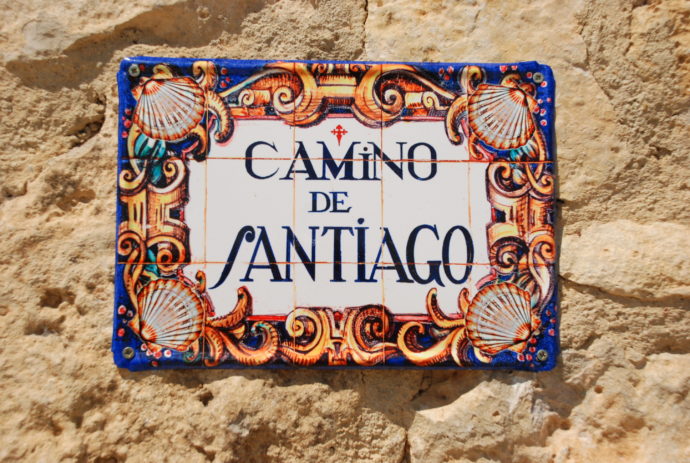
These thoughts were in part provoked by watching my own children react to political developments such as the Trump presidency and Brexit, but they intensified after spending a few days this month in Santiago de Compostela.  This small, beautiful city was crowded, as it often is, with those completing the Camino de Santiago, the ancient pilgrimage (it dates from the 9th century) that ends at the resting place of St. James the Great in the cathedral.  It’s estimated that as many as 300,000 people each year complete the Camino on foot or by bicycle, traveling hundreds of miles from their homes or from one of the traditional starting points in France, Portugal, or Spain.
DSC_0338-690x463

I’ve known for years about the Camino, but this was my first time visiting Santiago and seeing it for myself.  I’m not sure what I was expecting, but I was very surprised and impressed by the huge number of young people in their teens and twenties among the peregrinos.  What motivated them?  For some of them it must have been tied to a religious or more widely spiritual impulse.  Perhaps for others it was the opportunity to be part of something ancient, to test their own endurance, or simply strenuous exercise in a beautiful setting.  Whatever it is that explains why so many young people walked or cycled hundreds of miles and to join in this ancient tradition, it was impossible not to impressed by them, by their commitment, energy, and sense of purpose.

Uruena

The tiny town of Urueña (population 200) stands on a hill in the province of Castile and Léon, a couple of hours drive north of Madrid and a little way off the main highway.  Although it’s a pretty, picturesque place with its medieval walls, stone houses, and narrow streets, Urueña has one particular and very special distinction.  It’s a Villa del Libro, a town with an unusually high concentration of bookshops.  To be exact, Urueña has twelve – one bookshop for every sixteen inhabitants.

d311bffa37c3c40050c1ff42ec4f0f41

“Book towns” – magnets for bibliophiles like me – are nothing new.  You can find them in many countries around the world, though most are in Europe. They even have their own international organization.  Few are as charming as Urueña.  I loved my short stop there recently.

The Cies Islands

I spent my birthday on one of the Cíes Islands, Monteagudo.  The islands – three in total –  lie off the coast of Galicia in northwest Spain.  They’re celebrated for the beauty of their beaches and it’s not difficult to see why.  The main beach on Monteagudo has fine, white sand and stretches in a picturesque arc from the harbor.  Only the waters of the Atlantic, freezing cold even on a hot August day, spoil the idyll.

8b4a8a96314cf04b5cd7393e53827709--sea-islands

I usually get bored quickly on beaches, but I enjoyed my birthday on the Cíes Islands:  hanging out with the family, reading, and having tapas in a simple café overlooking the gorgeous beach.  An improvised birthday cake – a slice of tarta de Santiago – was the delicious finishing touch.

Three Days in Montreal

I was last in Montréal in 2008, so another trip was long overdue.  Something had happened in the intervening years that erased almost all the memories of that earlier visit.  I had very young kids with me at the time, so perhaps it was exhaustion.  On this occasion it was adults only, so I’m hoping this time the memories will stick.  If they do, I’ve a hunch some of them will be memories of the gastronomic kind, because we had some wonderful food, as you might expect in a city with such strong French influences.  Top of the pile was dinner at Damas, a restaurant in Outremont serving outstanding Syrian food.  The cuisine of the Middle East is one of my all-time favorites and it’s done superbly at Damas.  I can’t imagine I’ll ever forget the fattet mozat I had there – layers of lamb, rice, yoghurt, pita, and nuts, accompanied by an amazing Lebanese red wine (Chateau Kefraya, 2011).  Montréal has a vibrant Arab community and it was great to be among French-speaking Lebanese and Syrians enjoying the traditional dishes of the Middle East.

0822 wkd fine dining 3649

Not all my memories will be of food and wine.  I was very impressed by the city’s investment in its art and cultural history.  All over the city, even in its subway stations, I found publicly-funded artworks being installed and celebrated, and it was impossible to overlook the sense of civic pride in its artists and craftspeople.  The use of technology and social media to educate visitors about the city’s history is impressive, and I loved the Cité Mémoire app which allows users to trigger the projection of videos onto historic buildings and monuments at night (see below).  I loved my short visit to Montréal and look forward to going back.

13-Cite Memoire Projectionsfor91days.com.JPG

Musings about moving

Forty years ago.  That’s when it started.  London, Salzburg, Belgrade, Thessaloniki, Thassos, Istanbul, and back.  That’s when I first realized.  To experience the world, all I had to do was move.  To put one foot in front of the other, to get on a bus or a train.  That’s all it took.  Mozart’s birthplace, a deserted beach in the Aegean, Hagia Sophia.  The world and its wonders wouldn’t come to me, but with a little effort and and occasional discomfort I could reach them.  Everything was so accessible.  All I had to do was move.  Forty years, six continents, sixty-five countries, and millions of miles later, I’m still moving.  Now more than ever, I’m in thrall to the simple experiences of exploring, discovering, moving around.

wanderlust-wallpaper-1-desktop

Like almost everyone who travels, I have sometimes traveled to see something specific: a building, monument, or place.  Angkor Wat, Petra, Luxor.   This kind of traveling – let’s call it focused, functional tourism – has occasionally been rewarding.  It has also been hideous sometimes.  I remember particularly a horrible visit to the Parthenon a few years ago. Moving around the monument with hundreds of others, I felt I was part of something destructive.  Bruce Chatwin’s famous remark “Walking is a virtue, tourism is a deadly sin” felt right that morning.  I notice as I get older that I can arrive somewhere, for example a new city, and have no desire whatsoever to visit its “sights”.  That’s partly because I don’t like crowds and organized tours, but mostly because I don’t want my experiences to be defined by someone else’s checklists.  More than ever, mass tourism is about checking boxes, recording one’s presence with a tweet or selfie, and moving on to the next place on the itinerary.  The destructive impact of this type of “hit-and-run” traveling on fragile, precious places (Venice, the Great Barrier Reef, and so on) is incalculable, to the point that some governments, such as Iceland’s, are doing something that would have been inconceivable just a few years ago – discouraging tourists.  It’s not simply a question of the visible, physical damage that can be inflicted.  There’s also the less apparent, and therefore more insidious, impact of organizing the world and its environment to suit the needs of this type of tourist.  This can be seen in parts of Africa where entirely artificial environments are created, at the expense of naturally occurring habitats, to meet the Disney-esque expectations of those on safari holidays.

Much better (at least for me) is the wandering around, the serendipity, the follow-my-nose meandering, the sitting-and-watching that has led to so many unforgettable encounters with places and people.  That’s my particular strain of wanderlust, the itch that only moving can soothe, the kind of traveling I love.

Amazon’s (physical) bookstores

1000638_books_landing-page_hero_desktop

I was surprised and puzzled when Amazon announced it would open a number of traditional bookshops.   Having just visited one of the stores (in Lynnfield, MA), I’m no less puzzled.

Pretty much from the day it sold its first book online in 1995, Amazon.com has been the reliable bogeyman of the book industry.  Publishers admire its success grudgingly and reluctantly, but they also fear Amazon’s overwhelming dominance of the online bookselling market and the negotiating power it gives the company.  Other booksellers tend to have a less nuanced approach to their giant competitor: they simply loathe it.  Ask any independent bookshop owner to identify the greatest threat to their existence and you’ll get the same one-word answer every time: Amazon.

I think my own attitudes to Amazon are fairly typical of those who love books and bookstores, and those attitudes are riddled with inconsistency and hypocrisy.  I love the range it offers.  I like the prices.  Who doesn’t?  But I recognize that every time I buy a book from Amazon.com, I’m contributing to the demise of something I love and cherish: independent bookshops.

The Amazon bookstore in Lynnfield, which I’ve now visited several times, is innovative in one respect.  It makes extensive and very explicit use of the data acquired via Amazon.com about customer buying habits.  One section of the store is devoted to titles with the largest number of online reviews, another to what’s selling online to consumers in Massachusetts.  You get the idea: this is a store constantly reminding you that there’s a much better store somewhere else online.  This isn’t a bookshop promoting reading, authors, or books.  This is a bookshop promoting Amazon.   I don’t think Amazon is fooling anyone.  The Lynnfield store was practically empty on every occasion I visited it.  Unless these stores drive customers to Amazon.com – and you can be sure Amazon will be measuring that very carefully – maybe, just maybe they’re going to fail.  One thing’s for sure.  Local booksellers won’t be shedding any tears.


The Tidal Zone

img_1298

I wasn’t aware of Sarah Moss’s work until I came across The Tidal Zone when browsing in a bookshop in London.  It’s an impressive, well-received novel that’s likely to tug at the heart strings of any parent.  Adam Goldschmidt lives in a town in the Midlands of England with his wife, an overworked and stressed family doctor.  Adam, an occasional and very part-time university teacher, is the primary carer for his two daughters, Miriam and Rose.  He does all the things a stay-at-home parent does – cooks the meals, washes the clothes, tidies the house, arranges the birthday parties – while his wife makes the money.  His is a good, solid, secure and predictable middle class life.  Secure and predictable until teenage Miriam collapses at school, her heart temporarily stopped by exercise-induced anaphylaxis.  That’s all I’m prepared to divulge about the plot.  This is a spoiler-free zone.

This is a story about the fragility of daily life, the thinness of the shell that protects our happiness and the suddenness with which that shell can be cracked.  It’s also an intensely English, state-of-the-nation novel, a sharp satire on everything from the National Health Service to gender politics.  Although by no means perfect, The Tidal Zone portrays family life acutely and brilliantly: its joys and terrors, its compromises and treasures.

Two Helsinki chapels

Even the most ardent of city lovers sometimes needs a little peace and quiet, a place to reflect, or just a sanctuary from other people.  Parks can be good, but nothing beats churches and chapels.  It always surprises me that they’re so empty.  Perhaps people feel they’ll be obliged to pray when they enter, or could be accosted by some crazed evangelical minister determined to convert the innocent passer-by in need of a moment’s silence.  No matter.  The emptier the better in my view.

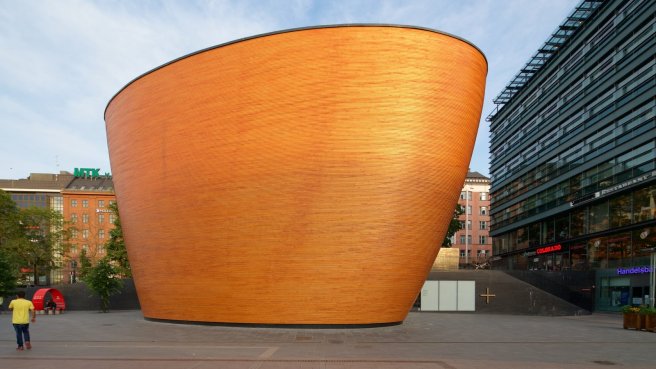
In Helsinki, residents and visitors looking to sit in silence have two very lovely havens, both of which I visited recently.  The first is Kamppi Chapel (pictured below) which opened in 2012.  I love the fact that the chapel is administered jointly by the city’s parishes and Helsinki’s Social Services Department.  It’s an extraordinary building.  Simple and beautiful, it resembles a huge wooden boat that washed up in one of the city’s busiest shopping areas.  It seems hardly possible that it has been open only five years.  It communicates that thing you find in ancient churches, the feeling that it has trapped within its walls the silence and sense of calm which its visitors are longing to absorb.

175503-Kamppi-Chapel

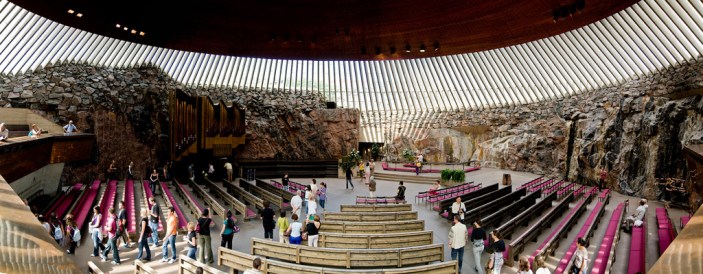
The second chapel I visited was Temppeliaukio Church, known to everyone (probably because Finnish is so hard to pronounce) as the Rock Church.  Excavated into solid rock and topped with a bronze dome, it was opened in 1969.  It has more of the trappings of a conventional church that Kamppi Chapel – altar, pews, organ, and so on – and is more explicitly Christian.  Bathed in light and the warm colors of the granite and wood, it’s a perfect place to sit for a few minutes.

4241456315_533bb740f5_b

Favorite bookshops: Little Tree (Athens)

cafe

A bookshop can become a favorite in an instant.  That’s all it takes – a fleeting moment and the perfect combination of circumstances.  Perhaps it’s lovely weather, a pretty setting, helpful staff, a chance discovery of a great book, even a memorable cup of tea.  When all the ingredients blend perfectly, you have it: that unforgettable place that immediately joins the list of your favorites.

All those ingredients came together recently on a sunny, warm afternoon in a quiet street in Athens, not far from the Acropolis.  I was doing what I like to do – wandering around, but not quite aimlessly.  I knew I wanted a place where I could sit, sip some tea, and watch the world go by.  A friend had recommended Little Tree some days previously, so it was a pleasure to stumble across it during my walk.  It had exactly what I wanted: a quiet patio, shaded by trees, where I could sit with a bunch of young Athenians enjoying coffee and tea.  I couldn’t resist the tea called Soul Euphoria (a combination of apple, chamomile, pineapple, hibiscus, and other ingredients I’ve now forgotten) and a slice of the best homemade lemon tart I’ve ever eaten.

Did I mention this was a bookshop?  Little Tree is, quite rightly, for the locals, and stocks  mostly Greek-language titles.  I found a couple of shelves of English books, mostly translations of classic Greek writers such as Giorgos Seferis.  It didn’t matter.  Great bookshops are about more than books.

London: Exmouth Market

exmouth2

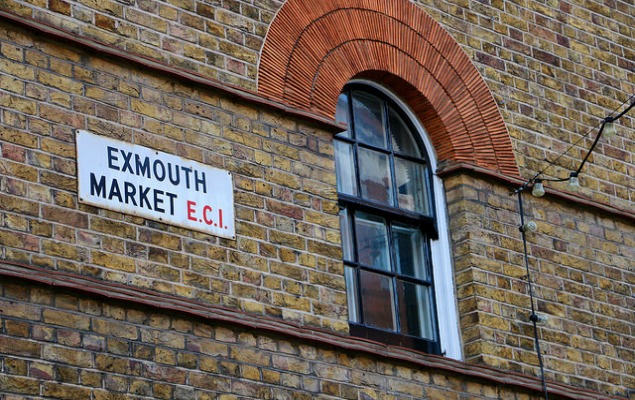
It’s hard to understand sometimes why particular neighborhoods become fashionable quite suddenly.  I might have predicted the renaissance of Bermondsey.  After all, it’s very central, close to the Thames, and has good transport links.  Its regeneration was overdue and, once the White Cube gallery opened on Bermondsey Street, unstoppable.  Exmouth Market’s emergence as a “go-to destination” is a little tougher to explain.  Although the area has a rich history and some good 19th century buildings (notably the Holy Redeemer Church), it wasn’t on anyone’s must-visit list until a few years ago.  It was, let’s be honest, scruffy and uninteresting.

Not any more.  For the past few years Exmouth Market has been a magnet for young Londoners, especially those looking for great food, bars, and cafés.  Moro, the internationally renowned Spanish restaurant, was a big part of that first push twenty years ago, and it continue to draw huge crowds.  Just as good, in my opinion, is its sister restaurant, Morito, which serves amazing, authentic tapas and which I visited recently for the first time.  Following Moro’s lead, scores of other restaurants and cafés have moved in, offering a huge variety of food and drink.  On a warm, sunny evening, the area has a wonderful atmosphere.  If you don’t know Clerkenwell and Exmouth Market, don’t miss them on your next trip to London.