A Life of My Own

There are many biographies on my bookshelves at home.  Most are of writers whose work I love.  It surprises me slightly that I should be able to remember the names of the biographers as easily as their subjects.  Norman Sherry’s account of the life of Graham Greene, for example, or Richard Ellman’s biographies of James Joyce and Oscar Wilde.  Autobiographies feature less, but I have a small collection of memoirs by those who kept the company of writers – publishers and editors mostly – and who became good writers themselves. The wonderful Diana Athill is the standout example in this category.

Autobiographies of biographers: now that’s a specialized genre.  Who, after all, would be interested in reading about the lives of those who devoted themselves to writing about the lives of others? Claire Tomalin is one of the finest literary biographers and over a long career has written brilliantly about subjects such as Pepys, Dickens, and Hardy.  Many of her books can be found on my shelves, but I don’t think it would have occurred to me to buy her autobiography, A Life of My Own, unless I’d read such a glowing review of it in The Financial Times.  After all, how interesting could the life of a biographer be?

Tomalin’s life, rich in friendships and in highly acclaimed work, has had more personal tragedy than most could bear.  Her husband, Nick Tomalin, a very well-known journalist, was killed in Israel in 1973 when a missile launched from Syria hit the car in which he was traveling.  One of their children died shortly after birth and another committed suicide in her teens.  All of this – tragedy, success, happiness – is presented in the book in a direct and matter-of-fact style that comes across at times as chilly and a little disengaged.  Tomalin is well aware of this.  “I have tried to be as truthful as possible, which has meant moving between the trivial and the tragic in a way that could seem callous.  But that is how life is.  Even when you are at the worst moments and would like to give all your attention to grief, you still have to clean the house and pay the bills; you may even enjoy your lunch”.

In her work Tomalin has enjoyed much success, most of it earned in a period and in a profession in which women were often overlooked.  Prizes for her books, prestigious appointments, and the top jobs in literary journalism all came her way and were all deserved, so it came as a surprise to read this modest insight into her distinguished life: “One thing I have learnt is that, while I used to think I was making individual choices, now, looking back, I see clearly that I was following trends and general patterns of behaviour which I was about as powerless to resist as a migrating bird or a salmon swimming upstream”.

Only in Tokyo …

There is a quiet, narrow street that runs alongside the train tracks close to Ebisu station.  It connects the crowded and busy neighborhood near the station to the more obviously upscale Ebisu Garden Place on top of the hill.  It’s home to a handful of modest restaurants, one of which, Osteria La Libera, is a particular favorite of mine.  It’s an easy place to miss and doesn’t do a great job advertising its presence.  Perhaps that’s just as well; it only seats fourteen people, four at the counter and ten at tables, so you’re likely to be disappointed when you show up.

I dropped by on an early November evening after buying too many books at Tsutaya’s store in Daikanyama, early enough to get a seat at the counter without waiting.  Unless you read Japanese (which I don’t), your only option is to put your faith in the sweet-natured waitresses.  “Salad.  Pasta with meat.  Barbera”.  That seemed to do the trick.  As I waited happily for my meal, immersed in the weekend edition of the Financial Times, a young and very beautiful woman, dressed in a silver grey kimono, obi, and zori, took her place, with much elegance and a little difficulty, on the bar stool next to mine.  She unfolded several paper napkins, placed them carefully into the various folds of the kimono to protect the silk fabric, and tucked into a hearty plate of pasta, all the time studying her phone.

A few minutes later, a couple, very obviously from Tokyo’s transsexual community, took their seats next to hers at the counter.  It’s hard to imagine a more diverse group but, within an hour, we were all laughing together, chatting with the waitresses and each other in very broken English and even more broken Italian.  Good wine consumed in sufficient quantities will dissolve most barriers, but I couldn’t imagine such a scene playing out in any other city.  Traditional and modern, conservative and funky – all side by side, all comfortable and easy. There’s just something about Tokyo.

0006096104E6_740x555y

Midwinter Break

There’s a handful of outstanding Irish writers whose business is the meticulous dissection of domestic relationships.  I’m thinking of the likes of John McGahern, William Trevor, Anne Enright, and Colm Toibin, writers whose work is acclaimed by critics and loved by readers and who practice quiet craft, not grand gestures.  To my mind, one of the very best of this group is Bernard MacLaverty.  Don’t feel bad if you’ve never heard of him.  In a writing career of forty years, MacLaverty has published only five novels and five collections of short stories.

Amsterdam-Winter

Midwinter Break is his first novel for sixteen years.  It tells the story of an apparently unremarkable and long-married couple, Gerry and Stella. Born in Northern Ireland but now living in quiet retirement in Scotland, the opening of the novel finds them preparing to set off on a short winter break.  The tensions between the couple are evident from the first page, but it’s only as they explore, separately and together, the cold streets of Amsterdam that the depth of the fault line between them starts to show.  Alcoholism has its grip on Gerry, driving Stella to contemplate the possibility of living the final years of her life alone.

Midwinter Break is that rare thing: a completely truthful account of old age and marriage – the compromises, stresses, and small betrayals, and, ultimately, the redemptive potential of love.

“Sitting beside Stella in this grey light seemed to Gerry such a privilege, such a wonderful thing to be doing, despite the nightmare of their surroundings.  He believed that everything and everybody in the world was worthy of notice but this person beside him was something beyond that.  To him her presence was as important as the world.  And the stars around it.  If she was an instance of the goodness in this world then passing through by her side was miracle enough.”


Notes On A Foreign Country

“I have always been struck, in America, by an emotional poverty so bottomless, and a terror of human life, of human touch, so deep, that virtually no American appears able to achieve any viable, organic connection between his public stance and his private life”.  James Baldwin.

In 2007, Suzy Hansen, a young journalist based in New York, won a writing scholarship that sends Americans to live overseas for up to two years.  She elected to move to Turkey.  She landed in Istanbul, wholly ignorant not only of the history of the Middle East but also of her own country.  Ten years on, with occasional side-trips to places such as Greece, Egypt, and Afghanistan, she’s still in Turkey.  Notes on a Foreign Country is the account of her journey.

The “foreign country” she discovers is America.  With her immersion into the politics, history, and culture of her adopted home comes a deeper, clearer, more truthful understanding of the place she was born.  Just as it has for so many expatriates (she writes very well about James Baldwin, for example), distance brings Hansen clarity and wisdom.

notesonaforeigncountry-480x270

Her exploration of Turkey becomes an exploration of America’s impact on that country and its people, and that in turn leads to her discovery of America’s terrible colonial legacy and its ruinous, devastating consequences for hundreds of millions of ordinary people in places such as Egypt, Greece, Iran, Vietnam, Cambodia, Nicaragua, Chile, Argentina, Cuba, Iraq, El Salvador, and many more.  It’s a very different story from the one usually told by America to Americans.

This is a truly significant book.  It matters.  It ought to be required reading for anyone who wants to understand why so much of the world is hostile to America.  I defy anyone, even those who consider themselves knowledgeable about America and its foreign policy since the beginning of the 20th century, to finish the book and claim their world-view hasn’t changed in some measure.

Storm King

We couldn’t have had a more perfect day for our first visit to Storm King.  The trees were alight with autumn color – yellow, gold, and red – and set against a cloudless blue sky.  We took advice and arrived before the crowds.  We followed a vague path, seeking out the work of familiar British sculptors first: Henry Moore, Barbara Hepworth, and Anthony Caro, then others we knew such as Richard Serra.  What mattered was being outside in the glorious fall colors, enjoying not just the artworks but the beautifully sculpted grounds with long grasses, trimmed meadows, and those stunning trees.

A4yspFyCUAA2zCP

The Golden House

10-Covers-low_670There was a time – the early part of his writing career – when I waited eagerly for every new novel by Salman Rushdie.  Midnight’s Children, Shame, The Satanic Verses: these were the books I recommended to all my friends in the 1980s.  I loved the exuberance, energy, and inventiveness of those early novels.  Then something happened.  I stopped loving Rushdie’s books.  I was reluctant to admit it at first, so I persevered.  It felt more and more like hard work. I found them too self-regarding, too self-conscious, too showy.  I couldn’t see what he was trying to do with all that brilliance.

With The Golden House, I feel to some extent that “my” Salman Rushdie is back.  The brilliance and “look at me” cleverness hasn’t gone away.  He still loves to cram as much life into a single sentence as most novelists manage in an entire book.  But, just as he did with The Satanic Verses, here he’s found a subject worthy of all that snap, crackle, and pop – the USA in the early 2000s or, more specifically, New York in the final years of the Obama presidency.  Rushdie moved to New York many years ago and The Golden House, like his earlier Fury,  is very much a meditation on the state of his adopted home town and country.

Like all his novels, this one is stuffed full of references to other books: the New Testament, ancient Greek classics, Hindu sacred writings, F. Scott Fitzgerald, P.G. Wodehouse, T.S. Eliot, and many, many more.  Unless he wants us to believe that his narrator is precociously well-read for a young wannabee movie director, it’s tough to shrug off the feeling that Rushdie can’t resist trying to impress us with his erudition.  The many allusions to the giants of cinema – Bergman, Altman, Kurosawa and others – are more forgivable, but it can all get a little wearing after a while.  Rushdie has never been one for “less is more”.  But, come to think of it, neither has New York, the ultimate “look at me” society.

This is by no means a perfect novel.  It’s too long and should have been pruned by an editor courageous enough to call Rushdie when he becomes a showy windbag.  But there’s a much bigger problem, for which I can’t blame the author.  America and New York in 2017 have become so grotesque that they stand beyond parody, beyond satire.  Maybe it’s simply too soon to write the definitive novel about the ascent of Trump and the shameful conditions that made it possible.

Jasper Johns

13BROADITEM2-master768

I remember when I first moved to New York many years ago feeling confused and uneasy about the American flag.  It seemed to be everywhere: on most suburban houses, in every public building, and in my kids’ classrooms.  Its ubiquity puzzled me at first.  Only later did I start to understand the powerful position the flag occupies in the stories that Americans tell themselves and the world all the time.  How do you unify more than 300 million people with roots in every country of the world?  How do you hold together a relatively new nation?  By telling stories over and over again, by promoting icons and symbols around which people with little else in common can congregate.  Stories are the glue that stops America fracturing under the pressure of so many conflicting expectations.

No American artist has thought about the flag more than Jasper Johns.  He has painted it time and time again in a career lasting more than sixty years.  When the Royal Academy in London announced its retrospective of his career, the first in the UK for more than forty years, I realized I couldn’t think of a single one of his paintings that wasn’t a representation of that flag.  Is there another contemporary painter so closely identified with a single image?

Good exhibitions should disrupt what you think you know about an artist and this one certainly does.  The flags prove to be a small part of his oeuvre and were concentrated in the earliest phase of his career (in the late 1950s).  I had no idea about the diversity of his work: the bronze sculptures and aluminum casts, the incorporation of household items (coat hangers, spoons, and string) into later canvases, and so on.

I know a lot more about Jasper Johns than I did (thank you, RA), but I keep thinking about those flags.  What this extraordinary artist made me realize was that the flag has no objective meaning.  It’s simply a colorful surface, an arrangement of shapes, onto which we project our own meanings and feelings.  It’s worth thinking about that for a moment in these days when flags and anthems are very much in the news, and it’s worth considering what can happen when those who are powerful, corrupt, and manipulative try to convince us that symbols can only have one, “true” meaning.

Sunday Morning Coming Down

This is the seventh outing for fictional psychotherapist-cum-detective, Frieda Klein, and I’ve been with her for every one so far.  Now that the series has reached Sunday, I wondered whether the authors (Sean French and Nicci Gerard, aka Nicci French) would bring it to a devastating climax, but they seem to be having too much fun or making too much money.  The final words of the novel (“Make me disappear”) might suggest we’re at the end of the road, but I don’t think so.  Surely we have to have the long-anticipated confrontation between Klein and her nemesis, Dean Reeve?

Like all the earlier titles, Sunday Morning Coming Down is a wonderfully compulsive read.  Of course, the plot is implausible and occasionally downright silly, but who cares?  Frieda and her friends, not to mention the unseen, menacing presence of Dean Reeve, are as entertaining as ever.  I’m already anticipating the next one, but there’s one thing that puzzles me.  Now that they’ve run out of days, what will the title be?

nicci-french

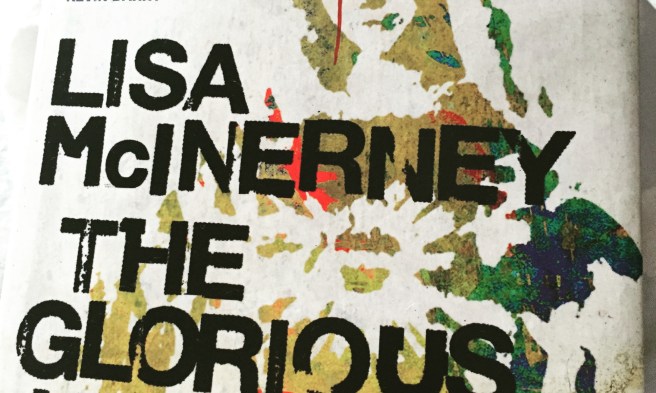
The Glorious Heresies

Whatever image first pops into your mind when you think of Ireland, I’m quite sure it isn’t the squalid underworld of pimps, addicts, and crazies that’s the setting of Lisa McInerney’s award-winning debut novel.  This isn’t the Ireland peddled to tourists – the Blarney Stone, Burren, and Book of Kells.  It’s the other Ireland: the one blighted by homelessness, poverty, petty and not-so-petty crime.

img_3914

Although first published more than two years ago, I was completely unaware of the novel until I spotted it in a bookshop recently.  It’s had its fair share of accolades and attracted some criticism for its searing exposure of a slice of Ireland some would prefer was kept under wraps.

It’s a familiar enough story: murder, prostitution, drug abuse, and much more in a decayed urban setting.  What sets this novel apart is not the plot or the setting.  It’s the black comedy that infuses every line, the vitality, and the author’s unmistakable affection for her grim characters that make it so memorable.  I’ve heard there’s a sequel in the works and I’m looking forward to it already.

The Woman on the Stairs

I almost tossed aside Bernhard Schlink’s latest novel.  Even now, having finished it, I’m not sure whether my persistence was a good thing or not.  It is, for the most part, a dull book.  The prose is generally flat and lifeless.  I felt nothing for its unnamed narrator, a buttoned-up, somewhat smug German lawyer, who finds himself embroiled in an unconvincing ménage à quatre with a celebrated painter, his muse, and the muse’s wealthy husband. But here’s something strange.  The final fifty or so pages – the denouement – are poignant and moving.  I can’t say they rescue the book.  They don’t, but I would have been sorry to have missed them.

maxresdefault