A Fishy Move

When the powers-that-be decided to relocate Tokyo’s famous fish market from Tsukiji to Toyosu last year, I wondered what would happen to the old location.  With Tsukiji neighboring pricey, glamorous Ginza, I assumed the narrow lanes would eventually be bulldozed to make way for more fancy stores and apartment buildings.  Maybe eventually, but it hasn’t happened yet.  When I checked out Tsukiji last week, both locals and tourists alike seem to have ignored the move of the world-renowned tuna auctions and continue to flock to the old neighborhood to buy vegetables and kitchenware and to eat sushi in those hole-in-the-wall places that continue to prosper. I’m relieved.  I’d been one of those visitors who had made the 5am pilgrimage a few years ago to watch the auctions and had been delighted by Tsukiji’s untidy streets and stores, so different from the order that prevails in other areas of Tokyo.  The auctions may have gone. Tsukiji’s charm hasn’t…. yet.

Image result for Tsukiji

1,600 Temples

Image result for kennin-ji temple ceiling

My last visit to Kyoto, little more than 24 hours squeezed in between business commitments in Tokyo, was back in 2016. Things were different this time. Three days with my family; an opportunity to explore this gorgeous city a little more fully, though still not nearly enough time to do justice to it. Getting to know Kyoto is a journey of many parts. Food, from the humble ramen shops to the exquisite kaiseki restaurants, the narrow streets of Gion with their tea shops and geisha, and, of course, the temples.  All 1,600 of them, from the smallest and most hidden to the grandest. These are the jewels of Kyoto. Two stood out for me on this visit.  First, Kennin-ji, founded in the thirteenth century and the oldest in Kyoto, with its gorgeous Zen gardens and stunning “twin dragon ceiling” painted by Koizumi Jensaku to mark the 800th anniversary of the temple’s foundation. Kennin-ji is easy to find at the far end of what is probably Gion’s most famous street, Hanami-koji, so it attracts plenty of visitors in peak seasons.  In contrast, Honen-in feels small, secluded, and private with its moss covered gateway and pretty paths. There were almost no other visitors the morning we were there, which only added to its allure and charm.

Temple hopping can make you hungry, so it’s just as well that Kyoto is a gastronome’s dream come true.  In whatever direction your tastes lead you – ramen, shabu-shabu, teppanyaki –  you’ll find hundreds of restaurants to satisfy every budget and longing and, if your experience is anything like ours, a warm welcome in every place.  A couple of beers in a tiny local’s bar on Hanamikoji-dori or the best paitan ramen you could hope to eat (in a small place on Shinbashi-dori) made for full stomachs and a few great memories of a truly wonderful city.

Ramen robbery

Image result for ushio jiru ramen

If you don’t read Japanese it can be a tricky business choosing a restaurant in a city like Tokyo.  Even in the lead-up to the 2020 Olympic Games, very few of the eating places have signs or menus in English.  Does that slightly intimidating entrance with the sliding door and noren lead to a cut-price ramen shop or a high-end, Michelin-starred kaiseki restaurant? Unless you want to eat somewhere that offers uncertain visitors photographs of the delights inside (and who wants to eat in those places?), sometimes you have no choice but to summon your courage, lift up the noren, and plunge inside without having a clue what awaits you. Those chefs who yell “irasshaimase” as you walk in are trying to be hospitable, but somehow end up adding to the uncertainty and stress.

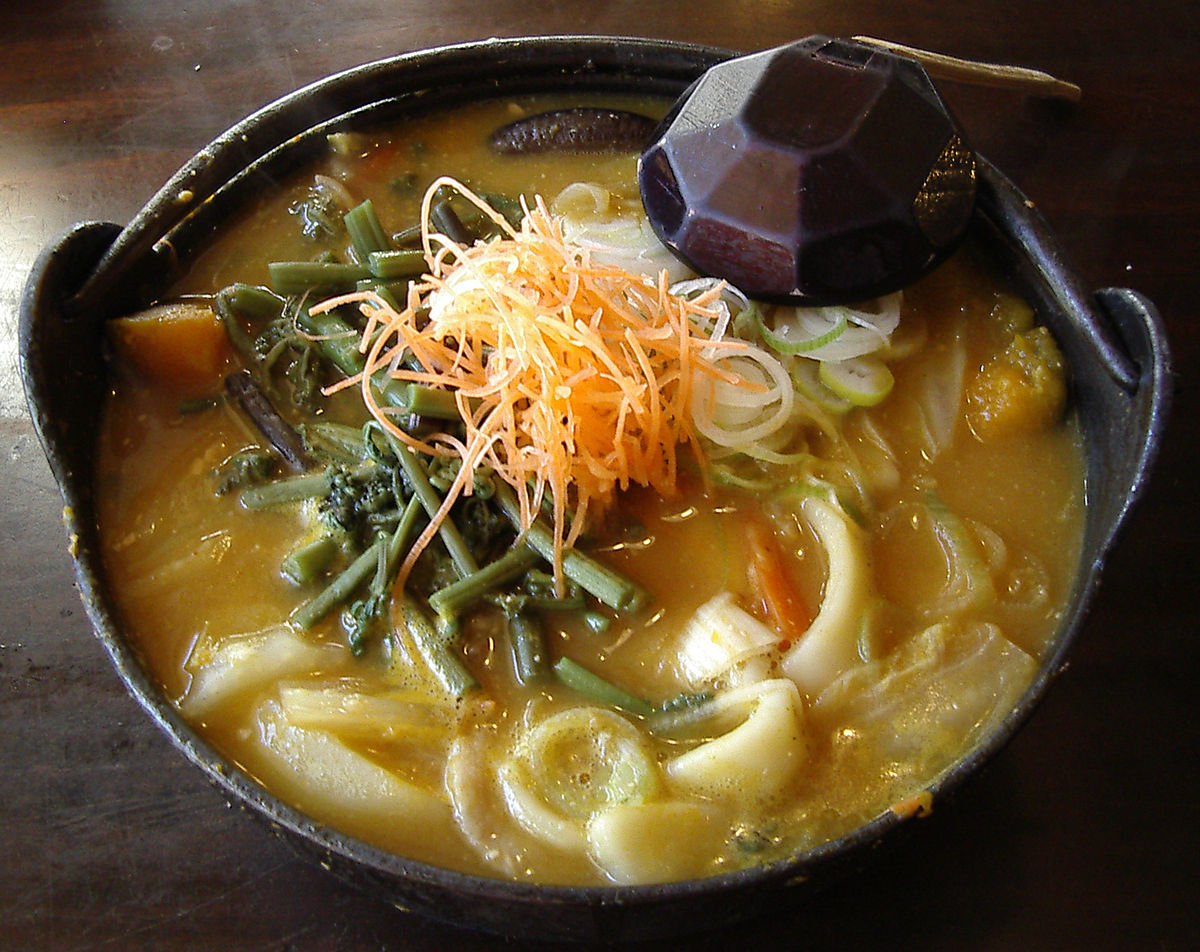
On a chilly February evening recently, I ducked under a low doorway and into a tiny place in Ebisu that offered little more than six seats at the counter.  I was the first to arrive, so I couldn’t glance at other people’s plates to get an idea of what was on offer. A quick glimpse over the counter and into the kitchen was no help either.  When it became clear to the two guys running this tiny place that a menu would be useless to me, a lengthy mime show ensued which ended a little later with a enormous bowl of steaming noodles sitting in a broth of hard clams that I later discovered is called ushiojiru. It was delicious, of course, and perfect for a winter evening, but there were two more surprises in store for me.  First, the restaurant accepted only cash (unusual in Tokyo).  Second, the ushiojiru was shockingly expensive. Flying blind and solo, I’d wandered into Suzuran, one of Tokyo’s most celebrated and costly ramen restaurants.  Amid their smiles and my blushes, I slipped outside to a local ATM, returning to pay, and eventually to disappear into the Tokyo night with a full stomach and an empty wallet.

Lethal White

Lethal White is the fourth outing for the fictional private detectives Cormoran Strike and Robin Ellacott and their creator Robert Galbraith (better known as J.K. Rowling).  It’s a very long and complex yarn – by far the most ambitious yet by Galbraith/Rowling – featuring a murdered politician, blackmail, and other kinds of nastiness.  It’s all great fun, not least because of the unlikely, bubbling romance between the two protagonists.  Always credible? No. But this is escapist storytelling at its best: absorbing, undemanding, and entirely seductive. What more needs to be said?

Image result for lethal white

Urban Musings

Image result for river thames at tower bridge

I visited recently a friend’s office in central London, an office with a stunning, 180-degree view of the Thames, looking out over the Tower of London, Tower Bridge, HMS Belfast and the Mayor of London’s headquarters.  After the meeting I took a stroll along that section of the riverbank between London and Tower bridges and was struck by the enormous investment that has been made in London and the sensitivity of the development that’s happened in recent years in one of the most historic cityscapes in the world.

It made me realize how important and difficult it is to get the balance right between, on the one hand, conservation and protection of historic buildings and, on the other, the development necessary to ensure the future prosperity of a city.  The architectural treasures of London are uniquely rich and play an out-sized role in the city’s psyche.  Londoners are, as a rule, very protective of ancient landmarks and politicians are rightly wary of any development that threatens them.  How different that is from a city like New York where historic buildings are bulldozed with barely a second’s thought to make way for the latest gleaming (and often ugly) office or apartment building.  Much more than buildings and history are lost when such insensitive development happens.  Also lost is that variety, that blend of the old and the new, that over time deepens and enriches the character of a city.  The evolution of a truly great and beautiful city is the work of generations, but it has to begin with a continuous commitment to getting the balance right.  It’s my view that New York City, for all its dynamism and energy, will never rank as one of the great cities of the world unless it puts some restrictions on its new construction and starts to take conservation seriously. You can’t and shouldn’t conserve everything.  Many undistinguished buildings have been rightly demolished, but a truly great city needs to be seen and planned as a single, organic entity and with a clear presiding vision.  Get it right, as city governments in places such as London, Shanghai, and Paris have, and the rewards are visible for centuries to come: fascinating, surprising, provocative urban tapestries made with old and new threads.

The effort required to make this happen grows, in my view, from a commitment to something called society.  It’s not easy to define but it springs from a particular perspective and a set of characteristics.  It starts with respect for yesterday, today, and tomorrow and an appropriate balance between them. It begins with a recognition that a city has to be for everyone.  Not just for the young or for the prosperous or for the able bodied, but also for the elderly inhabitants and visitors and those who find it difficult to get around, for the walkers and the cyclists as well as the car owners.  It demands costly investment in roads and sidewalks, bridges and tunnels, rivers and parks, and, of course, in transport.  The transformation in my lifetime of London’s tube network has been extraordinarily farsighted.  Londoners, of course, still complain, but they have an underground network that’s for the most part efficient, safe, and clean.  Other cities around the world can make similar claims.  Compare that to New York’s subway system: crumbling, dirty, and inaccessible to many of its residents.  Cities don’t work when individuals and individualism are valued at the expense of communities and societies.  It’s as simple, and as complicated, as that.

Incredible India

Image result for great india trucks

There’s a lot of pride in India these days.  Sit in a highway traffic jam for a little while and you’ll see trucks all around you, elaborately decorated and brightly colored, with the words Great India stenciled in large letters on their paintwork.  Signs from the tourist authority hanging down from bridges and lamp posts remind locals and visitors alike that they are in Incredible India.  Confidence is everywhere.

It was all very different back in 1979 when I visited for the first time.  India, vibrant and colorful though it seemed to me then, felt like a country overwhelmed by its own problems.  Forty years on, much has changed, especially in the cities, and India has become a global super power. But whenever I travel there with colleagues and friends seeing India for the first time, they’re shocked by the crumbling infrastructure, the chaotic traffic, the cows and stray dogs wandering in the city streets, the mounds of rubbish, and I realize that India’s progress, though extraordinary, isn’t always visible in the ways foreigners expect it to be.  In spite of its phenomenal development in recent decades, it remains a country with profound challenges to overcome: poverty, inequality, and illiteracy, all the more shocking because of the extraordinary advances visible in other areas of Indian society.  India does everything – even advancement – in its own unique way.

I’ve been lucky enough to return to India many, many times since that first visit four decades ago.  It’s a country I’ve grown to love and it’s one that fascinates and moves me perhaps more than any other.  It has a unique energy and culture and a deep, unaffected spirituality.  I have found in its people gracefulness, kindness, and hospitality in extraordinary measure. It’s a place that every day makes you challenge your expectations and question your assumptions and, above all, reminds you that there’s no single pattern for living.  India is incredible, indeed.


Ghost Wall

Sarah Moss has been acclaimed for several years but it’s fair to say that her work hasn’t yet broken through to the large audience it deserves.  Ghost Wall might just change all that. This is an unusually powerful novel, all the more so because the aggression and violence it exposes are uncovered by a quiet, understated, and exquisite prose.

Image result for ghost wall sarah moss

Seventeen year-old Silvie joins her parents, a group of students, and their professor at a summer camp in northern England that seeks to recreate the living conditions of Iron Age Britons.  Silvie’s father is no academic, but a bus driver, amateur historian, and enthusiastic admirer of the simpler lives of the ancients.  It becomes clear gradually that one of the features he admires particularly about Iron Age culture was its control of women, a control maintained by the physical and emotional cruelty imposed by men. Silvie’s story is book-ended by two extraordinary scenes – the opening imagining of ancient ritual sacrifice and the devastating conclusion – that capture perfectly and painfully the persistent cruelty women have suffered at the hands of men throughout history. I don’t want to make the novel sound like a tract or manifesto.  It isn’t.  It’s a sensitive evocation of an innocent young woman’s life lived under the shadow of blame and violence. Ghost Wall is an extraordinary achievement.

Jaipur Literature Festival

Anyone even slightly interested in the business of books knows that when publishers or booksellers get together there’s nothing they like to talk about more than “the reasons why no one reads books anymore”.  This is something that never changes.  Catastrophe is always just around the corner and some fiendish and irresistible foe is lurking, ready to make books a thing of the past and to transform reading into a quaint, old-fashioned pastime like Morris dancing.  The cause of the unavoidable disaster changes from time to time.  Radio, television, the Internet, video games: all at various times have been the harbingers of disaster.  Today’s trope is that we all have too little time and too many competing distractions to read anything longer than a tweet or a news headline.  Our diminishing attention span is the new thing that’s going to kill writing, reading, publishing, bookselling, libraries and just about everything else.  To quote Private Frazer in Dad’s Army (look it up if you’re not British), “We’re all doomed”.

Image result for jaipur literature festival

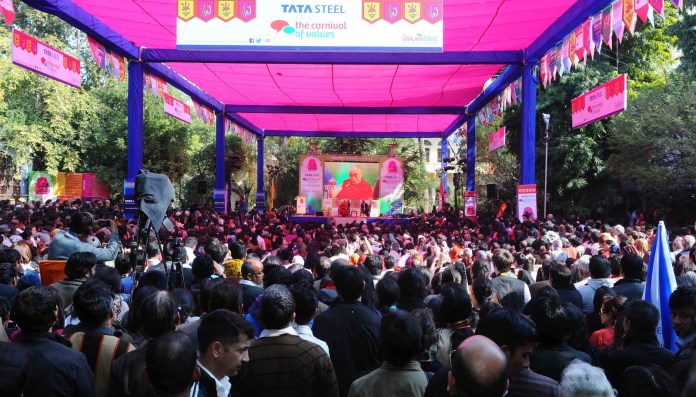
Having just been to the Jaipur Literature Festival, I’m here to tell you something: you can sleep easy because the love affair between readers and their books is as intense and as passionate as at any time in human history.  More than 500,000 people are expected to attend this year’s Festival and the numbers have grown year-on-year since it was first held back in 2008.  That’s half a million people coming together to listen to authors and talk about books. The Festival usually draws some of the world’s most famous writers and this year was no exception.  Germaine Greer, Ben Okri, Colson Whitehead, and many others talked about writing and books in front of huge audiences on the lawns of Diggi Palace in bright winter sunshine and an occasional hailstorm.  It was the most extraordinary and joyous celebration of storytelling and a reminder, if reminders were needed, of the timeless appeal and power of books.

The Trespasser

Image result for tana french books

The pleasure of reading The Trespasser has little to do with working out whodunnit.  The basic plot after all is straightforward enough: murdered woman, corrupt detectives trying to frame the obvious suspect, and justice finally served in a nice, tidy resolution.  No, the real fun – if you can call it fun – is seeing Detective Antoinette Conway prevail against the cozy male clique in the squad room determined to see a woman fail.  Tana French is brilliant at office politics and the crushing sexism of the police service.  Who could fail to root for Conway as she tries to outwit her scumbag colleagues, expose corruption, and solve the case all at the same time?  Sure, she’s a little too one dimensional to be completely believable, but who can resist the isolated underdog?

Winter Jazz in Harlem

If you walk east from Frederick Douglass Boulevard on West 132nd Street, you’ll pass a handsome brownstone that’s home to American Legion Post 398.  Take a few steps down from the street and through an inconspicuous door and you’ll find yourself in the bar and social club, a small, slightly shabby basement room. For nearly twenty years this modest setting has been the place where, every Sunday evening, one of Harlem’s last truly authentic jazz clubs has thrived.

There’s no charge to get in.  Just sign the book.  Grab a table if you’re early enough.  If not, take a spot near the bar.  Ten dollars gets you dinner: fried chicken, collard greens and potato salad served on Styrofoam plates. Beer – or liquor served in those tiny bottles you get on airplanes – is dangerously cheap by New York standards.  Then sit back , relax, and wait for the show to begin.  And what a show it was on the cold, January night I was there.  Live music rarely comes with this immediacy or intimacy.  This is how jazz should be made and heard,  in a tiny room with no stage to speak of and the small audience, mostly locals, veterans, or blow-ins like us, in touching distance of the musicians.

Image result for jazz american legion harlem