Self-Portrait

Image result for celia paul artist

I read all two hundred pages of Celia Paul’s autobiography on a recent flight from London to New York. Sunshine flooding into the cabin from the south was perfect for studying the extraordinary paintings that punctuate the story of her life.  It’s a story with a simple enough arc: from her childhood days in Kerala where her father was an Anglican missionary, to boarding school in Devon and her studies at The Slade, and onto her quiet career as an artist in London.

Love is the steady pulse of her story. Love for her parents and her four sisters, and for her son Frank, the child born from her relatively brief but intense relationship with Lucien Freud. And, most of all, love for painting, the work to which she has committed her life and of which she writes with such intensity and passion.

Reviews of Self-Portrait have tended inevitably to focus on the affair with Freud, which began when Paul was in her late teens. That’s a shame.  His often-shabby behavior, his neglect and infidelities, make for good headlines, but nothing should distract us from Paul’s outstanding work and the fervent commitment that has fueled it. She’s a wonderful painter and I hope this book will bring her the many new admirers she deserves.

Image result for celia paul paintings

The Pursuit of Art

Image result for jenny saville art

Martin Gayford is my kind of art critic. His work is serious, but never pretentious, arcane, or inaccessible.  He wants to share with readers his love of art and his admiration of artists. He believes not only that art changes us, but that we change art by how and where we encounter it.  As someone who has grown increasingly dissatisfied by the experience of visiting traditional galleries and museums, I found Gayford’s appetite for searching out art in unusual settings and out-of-the-way places infectious. I finished reading his “travels, encounters, and revelations” (the subtitle of this book) a little more informed about the likes of Gerhard Richter, Anselm Kiefer, and Gilbert & George, and a little more determined to seek out art in my travels.

This is the third book by Gayford I’ve read and it follows on from Modernists and Mavericks which I read earlier this year. I’m looking forward to the history of pictures he has co-written with David Hockney.

The River Capture

It’s nearly four years since I read Mary Costello’s first novel, Academy Street. It was a very striking and accomplished début and I recall thinking at the time how much I was looking forward to seeing how she would develop as a writer. Now comes The River Capture and more evidence of how skilled and sensitive a storyteller Costello is becoming.

The story is set in and around Ardboe House, a once grand but now faded home overlooking the fertile fields and ancient woods of County Waterford. Ardboe is the down-at-heel demesne of Luke O’Brien, an erstwhile schoolteacher taking a leave of absence from Belvedere College, the famous Jesuit school where James Joyce was once a pupil. Joyce is a continual presence and influence in Luke’s imagination; a hero, saint, and exemplar all at once.

Luke, living alone in the once-grand house, has memories instead of family, and literary heroes instead of friends. A solitary and lonely life that looks set to take root and become permanent is upended one day when a young woman knocks on the door …

The structure of the novel is peculiar. The first and longest section is a conventionally told story which then, for the final one hundred pages or so, shifts into a series of questions addressed to Luke (by the author? By Luke himself?). This move, itself a very Joycean conceit and reminiscent of parts of Ulysses, was a trick I found quite jarring and had the effect of distancing me from Luke’s emotional life, which itself had been so brilliantly rendered in the first half of the book. Deployed more briefly the change in style could have worked brilliantly, but the longer it was extended the more dissatisfying it became.

Leaving that to one side, I have a feeling this lyrical, sporadically brilliant, and flawed novel will stay in my mind for a long time.

Image result for mary costello the river capture

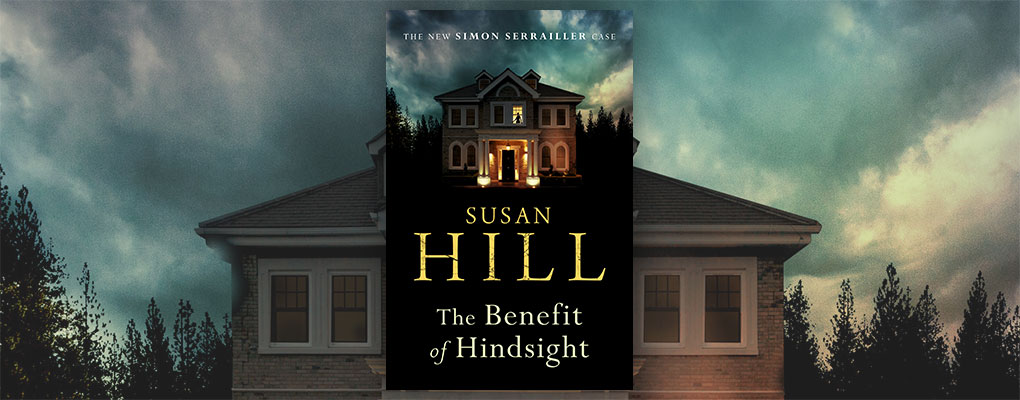
The Benefit of Hindsight

The tenth novel of the Serailler series by Susan Hill (and my second of the year) has arrived.  The previous one, which I read back in August, had been a disappointing dip in form, so I was hoping for something of a re-bound.

Image result for benefit of hindsight susan hill

This one is an oddity and I’m still puzzled by it. The novel comes to an end quite abruptly with the crimes at the center of the story unsolved and their perpetrators unidentified and unpunished. There’s also a completely extraneous plot line. It’s as if the author has lost interest in the mystery genre per se and is happiest focusing on the domestic life of Serailler and his family. Engrossing as that is, this series is now starting to feel unbalanced and to lose direction. Susan Hill is far too fine a writer to produce a bad novel, but she seems at a loss to know what to do with the series. These novels have many admirers, so it would be a shame to see them discontinued, but there’s a clear need for a re-boot.


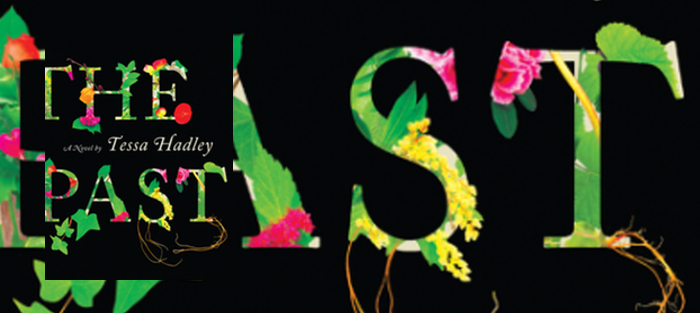
The Past

Image result for tessa hadley the past

Tessa Hadley’s most recent novel, Late in the Day, made a big impression on me when I read it earlier this year, so much so that I knew I would want to track down and read her earlier books as soon as I could.  I found two, The Past and London Train, when browsing in Hatchards in St. Pancras and snapped them up.  Having just finished The Past, published first in 2015, I’m very happy to say it is at least as good as Late in the Day. It’s thrilling to discover not just an exceptional talent but a writer who does brilliantly all the things I want from a novel.

Four middle-age siblings come together for a three-week vacation in their grandparents’ dilapidated but much-loved house set deep in the English countryside.  Family meals, trips to the beach, and walks in the fields punctuate days in which intense emotions, rivalries, and tensions are the undercurrent.  The past is never absent. No one leaves unchanged.

I have a hunch that British readers might just get that little bit more from Hadley’s novels. There’s something quintessentially English about Hadley’s books and she’s certainly writing within what I think is a recognizable English tradition, joining the likes of Anita Brookner,  A.S. Byatt, and Margaret Drabble.  That is, by the way, very high praise indeed in my mind. Hadley’s is certainly not the type of fiction that appeals to everyone and at a superficial level there may seem something archaic about stories set in that milieu of the self-aware, slightly agonized English upper middle class. That shouldn’t deter anyone (from anywhere). Like all very good novelists, Hadley’s preoccupations are the things that should matter to all of us.

Inland

Téa Obreht’s latest novel is no easy read. Its lyrical, dense prose forced me to read carefully and slowly. I found myself able to concentrate only in short, intense bursts, after which I had to put it aside each time until I was ready to tackle it again.  Needless to say, it took me quite some time to complete. Was it worth the effort? Yes, I think so.

Inland is set in the Arizona Territory of 1893, a harsh, drought-choked place. The novel re-imagines the classic myth of the American West from two perspectives: the first a tough, haunted frontierswoman called Nora and the other an immigrant outlaw by the name of Lurie. Not a great deal happens.  This isn’t a novel you read for the plot, but what little plot there is serves as a necessary reminder of something that’s forgotten too easily and too frequently today: that America was crafted by a multitude of people born in every corner of the world, and by women just as much as by men.  America is as much an idea as it is a country. Obreht’s novel testifies powerfully to how the country was made from hard, unforgiving materials and the idea realized because of the sacrifices of tough and determined people, women and men whose descendants find themselves too often disparaged and overlooked today.

America is a place that tells and re-tells a small number of stories about itself constantly.  Those stories are what help to unite hundreds of millions of people who have little else to bond them.  Much of the time it doesn’t seem to matter whether the stories are true or not. That’s not the point; it’s the telling and re-telling that matters, the effect not the truth. The stories have been distorted by politicians since the country was founded. Stories and myths matter.  They have consequences. Obreht understands that.

Image result for tea obreht inland

Peggy Guggenheim

Image result for ordovas peggy guggenheim

Peggy Guggenheim began to exhibit her celebrated art collection to the public as early as 1951, but initially only on a seasonal basis.  It wasn’t until after she died in 1979 that her home in Venice, the Palazzo Venier dei Leoni, was opened full-time to visitors.  I hadn’t realized until very recently that she had tried on previous occasions to open galleries but with limited success.  A small exhibition currently in London at Ordovas tells the story of a gallery she opened in Cork Street, Guggenheim Jeune, in 1938.  The venture survived only eighteen months, closing in December 1939.  It’s easy enough to understand the reasons why it failed.  Art lovers in London had more pressing concerns in those early days of the war. It’s also possible that the artists that Guggenheim patronized and promoted in those days were simply too radical for the collectors of the time.  Cocteau, Brancusi, Calder, Schwitters and the like must have seemed shockingly avant-garde in the late 1930s.

The Ordovas exhibition in London displays some of the Guggenheim Jeune catalogs from the period alongside a small number of paintings and sculptures by two artists loved and exhibited by Peggy Guggenheim in those early days, Jean Arp and Yves Tanguy.  I’m no great admirer of either, but even eighty years on it’s hard not to be impressed by Guggenheim’s vision and courage.  She wasn’t daunted by the failure of the London gallery. She decamped first to Paris and then to the south of France, buying vast quantities of contemporary art with her inheritance.  Her purchases, works by Picasso, Matisse, Dali, Klee, Magritte and other modern masters, became the core of the collection that eventually opened decades later in Venice and the permanent monument to an extraordinary collector and patron.

The Lying Room

Image result for nicci french lying room

I had been wading slowly and somewhat joylessly through a complex and dense novel (more about that later) when I decided I needed something different to read. Something lighter and more accessible, something that felt less like duty.  Nicci French (the husband and wife team responsible for, among other things, the Frieda Klein series of mystery novels) had just published a standalone story called The Lying Room.  That would do nicely, I thought, and I was right.

Neve Connolly shows up at her lover’s apartment in London only to find him brutally and recently murdered. She sets about cleaning and tidying the place with no other thought than to remove evidence of the affair, fearing what it would do to her family if it’s exposed. But Neve isn’t the only one with something to hide ….

Good mystery writers are no different from good writers working in any other genre. The best share a fascination with human behavior and motivation and are skilled at creating a fictional world in which to study such things.  Nicci French is especially good at ordinary relationships – spouses, partners, friends, siblings, and colleagues – and at understanding the tensions, complexities, loyalties and falsehoods that hold them together, whether out in the open or hidden below the surface. S/he is also exceptionally good at domestic detail; the family dinners and outings, the work meetings, and the college reunions. In other words, the commonplace. Parts of the plot of The Lying Room might stretch credulity, but never the characters.  They’re very well drawn and are entirely believable. The novel overall was a delight. Now it’s time to get back to the other one.


The Cockroach

Image result for mcewan cockroach

Just like tens of millions of other Britons, Ian McEwan is angry about Brexit. Anger, controlled and focused, is a necessary ingredient for good satire.  Neatly reversing Kafka’s famous story, McEwan’s latest book opens with a cockroach waking from sleep to discover it has been transformed into a man. And not just any man, but the Prime Minister of the United Kingdom of Great Britain and Northern Ireland tasked with delivering “Reversalism”.

Early reviews of the novella, many of them po-faced, seem to me to have missed the point entirely.  The Cockroach is satire, suffused with anger and hot from McEwan’s keyboard. It’s not subtle, but it’s not supposed to be. It’s occasionally very funny, but its purpose isn’t to make us laugh. It’s not “balanced”; it has no interest in demonstrating any understanding of, or sympathy for, the motives of those who support leaving the EU. McEwan’s fictional cockroaches are ruthless, cruel, vindictive and, most of all, completely without principle.  Any resemblance to actual cockroaches, living or dead, is entirely coincidental.

Jeita Grotto

Image result for jeita grotto

Very few tourists go to Lebanon, so it was hardly surprising that I was one of only a handful of visitors to Jeita Grotto recently.  The grotto (Jeita means “roaring water” in Aramaic) is on the outskirts of Beirut and comprises two separate but interconnected limestone caves. Access to the upper chamber is via a short cable car ride after which a specially constructed pedestrian walkway takes you to the cave. The lower chamber can only be explored by boat (and is sometimes inaccessible when the water levels rise).

I had read nothing about the grotto before my visit, so I was unprepared for its beauty and grandeur. Nature and time have crafted a unique monument, a vast limestone artwork, a living sculpture of fantastical shapes – all illuminated to show it at its finest. No pictures are allowed (cell phones and cameras have to be deposited at the entrance); a sensible policy that somehow enhances the natural silence of the place and deepens a visitor’s sense of wonder. (Other attractions ought to adopt this approach).

Jeita is a hidden, subterranean jewel, a place made all the more remote by Lebanon’s troubled recent history.  Don’t miss it if you find yourself in that part of the world.