The Art of Solitude

In Praise of Solitude - Los Angeles Review of Books

A great deal has been written in the past two years about how the pandemic, and especially the isolation it has demanded, has damaged the mental health of so many people. Forced to separate from others for long periods and to suspend many of the social rituals on which we depended previously, many have suffered greatly, not just from loneliness, but from depression and anxiety. Being alone is deeply troubling for many, and enforced solitude for long periods for those unprepared for it has led to sickness.

In the midst of this comes The Art of Solitude by Stephen Batchelor, a book the publisher calls a literary collage. The author, previously unknown to me, is a celebrated scholar of Buddhism and a former monk, someone who has sought the experience of being alone, learned from others who loved solitude, and thought deeply about its value. Batchelor’s book isn’t some dry, impartial thesis on the history of hermits or one of those sickly self-help manuals promoting the benefits of a solitary life. The Art of Solitude is something much more interesting. It’s a short and engaging set of reflections and observations about the experience of being alone and what that experience can teach us about living a good life with ourselves as individuals and with others. For me the most enjoyable part of the book was the weaving together of Batchelor’s personal journey with the wisdom of others who have engaged deeply with solitude. it’s an eclectic and fascinating bunch: Michel de Montaigne, the Buddha, Aldous Huxley, Agnes Martin, Vermeer, and more.

Some parts of Batchelor’s experience might alienate some readers. I’m thinking particularly of his exploration of the use of psychotropic drugs. No matter. He isn’t trying to convince or convert anyone and he’s certainly no crazy evangelist espousing one type of experience over another. The Art of Solitude is a sensitive, balanced, and nuanced account of one man’s personal experience of solitude and mindfulness. I learned a lot and can imagine returning to the book in the future.

It is easy in the world to live after the world’s opinion, it is easy in solitude to live after our own; but the great man/woman is he/she who in the midst of the crowd keeps with perfect sweetness the independence of solitude. (Emerson).

Last year’s reading

6 Business Books That Will Revolutionize Your Business and Change Your Life

Looking back at my reading in 2021 I see with some dismay that once again I read fewer titles than in the previous year. I offer in mitigation the excuse that some of the books – biographies of Bacon and Freud and especially the Channon letters – were very long. Reversing the trend of recent years, novels and stories dominated my reading last year (24) while non-fiction fell far behind (10).

It interests me that books about nature and biographies/memoirs made up almost all of the non-fiction pile. Some of them made a deep impression on me, but if forced to pick the best of the bunch I would have to choose the account of Ivor Gurney’s tragic and piteous life. I vowed this time last year to choose my novels more carefully and I think I succeeded. I read some wonderful fiction last year, with works by Kazuo Ishiguro, Niall Williams, and Francis Spufford standing out. It’s silly to try to pick one clear favorite, but MacLaverty’s latest collection and Ali Smith’s quartet stand out as especially memorable.

At my elbow is a small pile of ten books that will accompany me into 2022. I can’t wait to get started.

Small Things Like These

Small Things Like These by Claire Keegan | Audiobook | Audible.com

Discovering a new writer is still a thrill. I came across Claire Keegan and Small things like these when browsing the tables at McNally Jackson Books in SoHo recently. It’s a novella set in a small town in Ireland in the days leading to Christmas. It’s the 1980s but it could just as easily be the 1950s. The people work hard, go to Mass, respect and fear the Church. Hardship is familiar to many, and even those fortunate to be working are frugal, knowing how quickly fortunes can change.

Bill Furlong, the local coal merchant, is one of the blessed ones. A steady job, a loving wife, five dutiful daughters, Bill has much to be thankful for. But, entering his middle years, Bill is grappling with how to live a good life. Is it enough to count one’s blessings, walk a straight and steady path, work hard and care for his family? Or is a more active form of goodness required, taking risks to help a stranger and a stand against injustice?

On the evidence of this novella, Keegan is working within and adding to a tradition of storytelling very familiar to anyone who follows modern Irish literature, a tradition I associate with the likes of Enright, McGahern, and MacLaverty. Great writers all. I’m already looking forward to reading Keegan’s earlier works next year and keeping an eye out for new books by this talented writer.

Light Perpetual

Imagine a missile hitting a department store in London in 1944. Imagine the children shopping at that moment with their parents, those young, unlived lives obliterated in that second of heat and noise. It would make a good beginning to a story, wouldn’t it? But how much better would the story be if the tape, having moved forward just a little, could be re-wound and we instead imagine the missile falling a few seconds later or a hundred yards further on. What would happen to those same children twenty, thirty, fifty years later? What would the trajectory of a life have been if the trajectory of the missile had been slightly different? Imagine following those children’s lives knowing that they all grow from a common experience, the moment the bomb exploded (or didn’t explode), the moment the bomb fell on them (or fell safely somewhere else). Wouldn’t the story of their lives be so much more poignant in the knowledge that those lives came to maturity (or perhaps didn’t) because the beginning was ever so slightly different?

This is everyone’s experience. Turn left at the intersection instead of right. Leave the office an hour later or earlier. Buy the red scarf instead of the blue one. How is a life changed by a decision or by the accumulation of an infinite number of decisions? Light Perpetual follows the lives of six children extinguished by that V-2 rocket, lives saved and allowed to take their course over six decades of London history. Time passes. Everything ends. Whatever the choices you make (or don’t make).

The V2 attack on Woolworths – History of Sorts

Silverview

Although I’ve read many of his novels over the years and consider him a fine writer, I’ve never been one of those diehard fans that John Le Carré seemed to have in such large numbers. That has nothing to do with the fact that the spy story was his chosen genre. I’m a book snob in some respects, but not in that way. Le Carré was a brilliant novelist, not just a brilliant spy novelist, but I’ve never fully understood his appeal or the reverence he attracted.

Silverview was published after his death in December 2020. It will in some respects be familiar to anyone who has read one of his earlier books, set as it is among the cultured and well educated community of senior British spooks. It’s tightly plotted, meticulously constructed, and absorbing, just like all the Le Carré novels that came before it. But it also has something else – the feel, quite appropriately, of a valediction, a veteran’s farewell not just to the world of espionage, but to the craft of storytelling at which he had labored so skillfully for nearly sixty years.

Spy author John le Carre's final, elegiac novel released posthumously | The  Star

April in Spain

April in Spain by John Banville, Read by John Lee ‹ Literary Hub

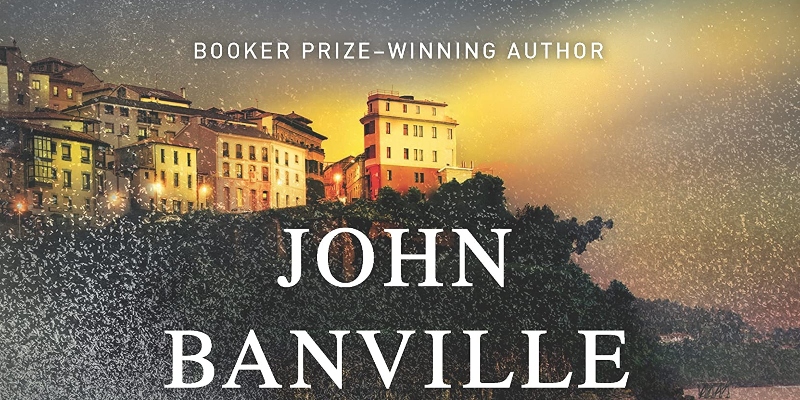
Dr. Quirke, a booze-sodden curmudgeon who happens to be Ireland’s state pathologist, is taking a vacation with his new wife in San Sebastian when he comes across a young woman he’s certain is an old friend of his daughter. But how is that possible? The young woman had been murdered by her brother in Ireland some time earlier, her body never found. A phone call to Dublin brings Quirke’s daughter to Spain, accompanied by one of Ireland’s finest, Inspector Strafford ….

A story that in the hands of a lesser writer might be a pleasing crime yarn is elevated by the beauty and elegance of John Banville’s prose. Anyone looking for something engrossing and somewhat comforting (well, as comforting as a story about murder, incest, and corruption can be) to read during the holidays could do worse than curl up for a couple of days with April in Spain. Something tells me we have a series in the making here.

The Fell

Is it too soon to write novels about the pandemic? Nearly two years have passed since we started to hear reports of a mysterious virus in China, a virus that has now taken more than 5 million lives around the globe. As I write, the world is still in the grip of COVID-19. Just yesterday 4,600 people died. Do we need to wait until its full horror is behind us to properly reflect on what this meant for us? Sarah Moss, a storyteller I’ve discovered quite recently and admire greatly, doesn’t think so. The Fell is set in a small English village at the time of the most stringent lock-down. Kate, a single mother, furloughed from her job, no longer able to sing in her local folk group, is growing increasingly cabin-fevered, stuck inside day after day with her teenage son. One evening, unable to bear it a moment longer, she heads out on to her beloved fells for a quick walk. Surely no one can object to that. Surely no harm can come of it …

Presented as a sequence of interior monologues (Kate’s, her son’s, their neighbor’s), The Fell records the simple and difficult confrontations – with mortality, with meaning, with life itself – that the pandemic has provoked and focused in all of us lucky enough not to have been struck down by it. There will be much more to say about these terrible times in the years ahead, but for now Moss has captured with simple directness and poignancy one moment in one life in a time none of us will ever forget.

About — Rocky Mountain Rescue Group

Harlem Shuffle

Colson Whitehead's 'Harlem Shuffle' offers fast-moving heist caper,  recreation of bygone New York - oregonlive.com

Prize-winning novelists aren’t always great storytellers. With little effort I can think of several, many of them garlanded with the most prestigious awards, who don’t even seem to care very much about the business of crafting a compelling story. However strange that might seem, it’s a topic for a different day because my short post today is a small celebration of a writer who tells wonderful stories and who, along the way, has attracted more awards than most. Colson Whitehead is perhaps best known for The Underground Railroad, though The Nickel Boys was my introduction to his work. That harrowing story stayed with me long after I turned the final page, so I’ve been eager to see what he would do next.

Harlem Shuffle is a much less grim book than its immediate predecessor and seems to have been crafted more explicitly as entertainment. I’m in no way suggesting that it’s light or trivial. Far from it. In fact, the story it tells of one man’s attempt to pull himself free of an upbringing marked by poverty and neglect and to create a stable and conventional family life is an important and moving one. But the serious intent has an entertaining wrapper, a caper set in Harlem in the late 1950s and early 1960s.

Whitehead has range. There’s no doubt about that. And he writes here with real tenderness, affection, and humor. But Harlem Shuffle isn’t perfect. The problem for me was the central character, Ray Carney – the good man trying hard, but not always hard enough, to live the straight, law abiding life. For me he never rose off the page as a fully formed person, and that ultimately made the difference between what could have been a great novel and what proved to be an enjoyable story.

Dweller in Shadows

The battle of the Somme facts: when, how long did the WW1 battle last, how  many were killed? - HistoryExtra

Anyone growing up in England, at least anyone from my own generation, knows something of the poets of the First World War. Rupert Brooke, Siegfried Sassoon, and Wilfred Owen all featured in the curriculum when I was a schoolboy. I don’t remember if Ivor Gurney’s work was covered, but I certainly became aware of his poems in my university days and, much later, his music.

Much of Gurney’s life was blighted by mental illness. He first suffered a nervous breakdown while a student at the Royal College of Music, but his condition was much exacerbated by his exposure to the horrors of trench warfare in 1916 and 1917. He fought at Ypres and at the Battle of the Somme, and was shot and gassed. Returning home from the front, he got some support from friends and patrons, but his condition was sufficiently serious for him to seek what proved to be fairly rudimentary treatment in a series of asylums. He died in 1937 in a public asylum in Dartford.

Gurney got some recognition in his lifetime for his poems and songs and was admired by many of his more celebrated peers like Vaughan Williams. Nevertheless, it was only after his death that his work started to be appreciated properly. With Dweller in Shadows, Kate Kennedy might enhance his reputation even further. She has written a compassionate, insightful, and thoughtful account of the life and work of a brilliant and troubled man. My hope is that her biography brings a wider audience to the poetry and music of someone who was at least the equal of his much more famous contemporaries.

Henry ‘Chips’ Channon: The Diaries 1938-43

Henry 'Chips' Channon: The Diaries 1918-1938, edited by Simon Heffer review  — snobbery, gossip and Hitler worship | Saturday Review | The Times

The first volume of Channon’s diaries, which I read earlier this year, weighed in at a massive 1,000 pages and covered twenty years. He clearly got more loquacious in his middle years because the second volume is even longer and covers only six years. He can perhaps be forgiven because those were momentous times for England, Europe, and the world, and Channon had a ring-side seat.

On the evidence of these diaries, Channon in middle age was much the same as he was in his younger years: a snob, a social climber, a casual anti-Semite, and a very poor judge of people and situations. But something in the background in the early diaries comes to the fore in these middle years – a certain bitterness and melancholy. Expressions of joy and delight are much fewer. Was it the crisis in his marriage, his failure to achieve high office, separation from his beloved son, or the depressive effect of the war years? Some mixture of all of these things is the most likely explanation, but Channon here looks more lonely, more bitter, and more isolated than ever. His growing sexual feelings for other men, especially for Peter Coats, offer little comfort.

The diaries covering 1938 to 1943 are engrossing but somewhat frustrating. Chamberlain’s appeasement of Hitler and his last years in office are described brilliantly. Channon, pro-appeasement, pro-Chamberlain, pro-German, and pro-Franco is, as usual, wrong about almost everything, and his antipathy to Churchill and Halifax is enough to ensure he’s banished to the political sidelines when he longed for the powerful role he thought he deserved. Momentous events like the evacuation of Dunkirk are dismissed in a single line while routine and often dull politicking gets excessive attention. He’s further from the center of royal and political intrigue than he was a few years earlier, a consequence, I suspect, of his growing unpopularity and declining influence. As the war progresses, we find Channon with fewer political allies and disconnected from the fashionable society that had dominated his life in the happier times of the 1920s and 1930s. Middle-age has arrived and with it a more nuanced appreciation of life’s gifts and disappointments, all recorded with Channon’s customary honesty.