
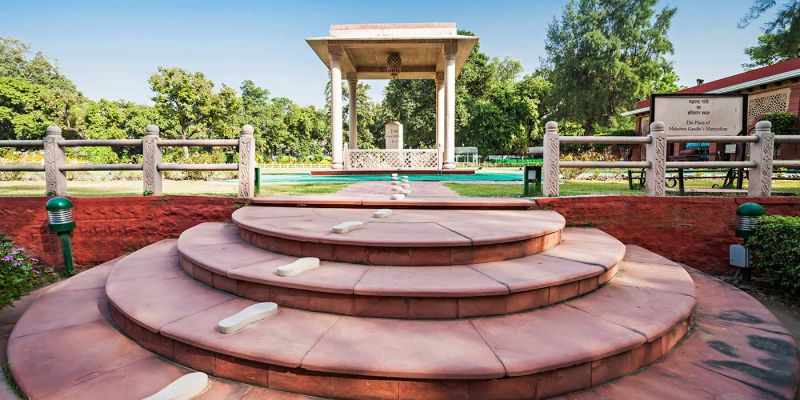
It seemed right to visit Gandhi Smriti. I had been before, but at times when the world had been less volatile, less dangerous, and less polarized. Now, when the voices of conflict and separateness are drowning out messages of peace and unity, it felt like an appropriate time to connect with the Mahatma’s message of non-violence in the place in which he died in 1948. There were almost no other visitors. 104 degrees, the hottest time of the day, and Delhi’s tourists and residents alike were wisely staying out of the sun.
Old Birla House, as it used to be known, is where Gandhi spent the last 144 days of his life and where, on 30th January 1948, he was shot to death by Nathuram Godse. It has been turned into a simple, slightly old fashioned, but powerful memorial to someone venerated in Indian society and around the world. At its heart is the austere living quarters that Gandhi occupied in his final months and the path, marked by cut-outs of his footprints, to the place he was assassinated as he walked to his daily prayer site. Elsewhere in the house is a museum where his life and achievements are summarized. I learned something new on this visit, that one of my favorite photographers, the great Henri Cartier Bresson, was one of the last people to meet Gandhi before the assassination, just a few minutes before the shots were fired.
 Miscellaneous Musings