Les Tres Riches Heures

Some experiences really are once-in-a-lifetime experiences. About a year ago it was announced that in mid-2025 one of the rarest and most exquisite medieval manuscripts would go on display to the public. Les Tres Riches Heures du Duc de Berry is an illuminated book of hours (a book of prayers intended to be read at specific hours of the day) first created between 1412 and 1416 for John, Duke of Berry, the brother of King Charles V of France. The manuscript, believed to be the work of the Limbourg brothers, was left unfinished because the brothers died, most likely victims of plague. Further work was done on the manuscript later in the 15th century by Barthelemy d’Eyck and Jean Colombe.

The manuscript is very rarely displayed because of its fragility and has only been seen by the public twice since the end of the 19th century. Even scholars have been denied access since the 1980s and forced to rely on facsimiles. The need to repair its binding gave an opportunity to exhibit some of the unbound pages at the Chateau de Chantilly where it is usually housed, an event so rare that it was described as one of the cultural highlights of the century. Needless to say, art lovers, historians, and bibliophiles have descended on Chantilly in huge numbers since June, but by the time I arrived in mid-September the crowds had subsided and I was able to see the exhibited pages up close.

Twelve pages were on display the day I visited, each one representing a month of the year. It is hard to describe how vivid, rich, and elaborate the illumination is on these pages, as well as the perfection of the calligraphy. It is a credit not just to the artists, but also those charged with the care and conservation of this treasure, that the illustrations look as if they could have been painted yesterday, such is the depth and brilliance of the color.

Some works of art defy categorization. This precious manuscript, a priceless example of medieval art, is one of them. I feel privileged to have seen it.

The Aberlemno Stones

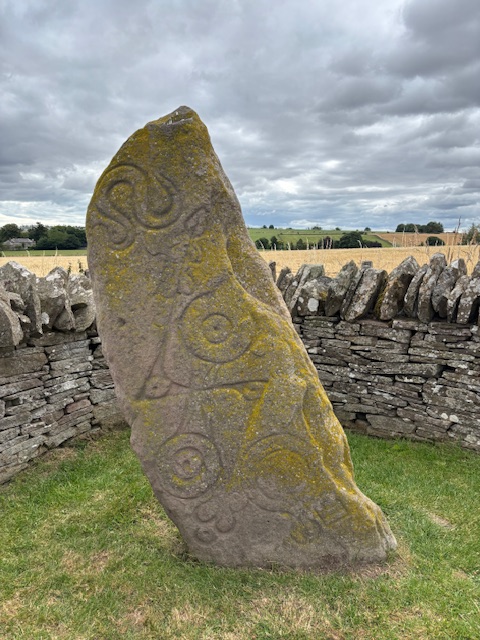
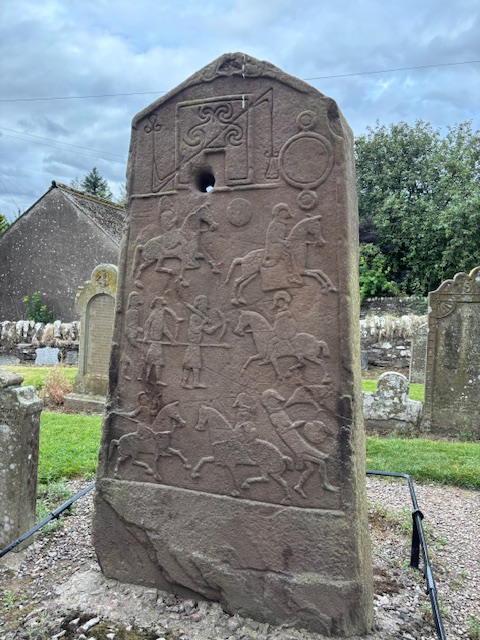
Relatively little is known about the Picts. They lived in what is now northern Scotland between 300 AD and 900 AD before gradually integrating with other tribes and kingdoms. They resisted the expansion of the Romans and earned the reputation of being fearsome warriors. They left behind a significant artistic legacy, and it was specifically their beautifully carved stones that drew me recently to the tiny village of Aberlemno in Angus. Normally one would find four stones in Aberlemno, three by the roadside and one in the churchyard, but a storm recently toppled and damaged Aberlemno 3, causing it to be removed from the site for inspection and repair.

Precise dating of the stones is, of course, difficult, but there seems to be consensus that the earliest could have been carved in the 6th century and that the most recent (Aberlemno 2, the one in the churchyard) is from around 850 AD. Aberlemno 1 is carved with mysterious Pictish symbols, including a serpent, a double disc and what appears to be a comb. It’s a powerful and confidently executed piece of work, but much simpler than Aberlemno 2. The stone in the churchyard feels like two distinct works. One side depicts Pictish symbols and figures in what looks like a battle, while the other side is a Celtic cross with beautiful and elaborate knotwork and keywork designs.

The stones, beautiful works of art though they are, are also extraordinary reminders of a long disappeared civilization. They have stood for all to see for more than 1.200 years, among a community, not hidden in a museum. I hope they are cared for and protected for generations to come because they testify to our persistent and enduring creativity.

Mussoorie

It must have been hard work administering an empire. The punishing heat of India drove the colonial masters to look for cooler places for temporary respite, and they found them in the north of the country in places like Simla, Darjeeling, Manali and Mussoorie. Few of those subjugated by the sahibs and memsahibs had the luxury of escape, but for the ruling class the hill stations were places of recuperation and recovery. Mussoorie was one of the first hill stations and was settled by the British in the 1820s. Today, there is plenty of evidence remaining of those days. Remnants of estates and houses can be seen from the roads, as well as churches built to serve the British community.

Interestingly, the term is still used quite extensively in India, and still designates those towns where people go to seek respite from the intense heat and the frenetic nature of Indian city life. When I was in Mussoorie recently, I didn’t see a single other Western visitor. Indian travelers, however, were there in large numbers, escaping a period of intense heat that had seen temperatures in New Delhi exceed 40 degrees centigrade.

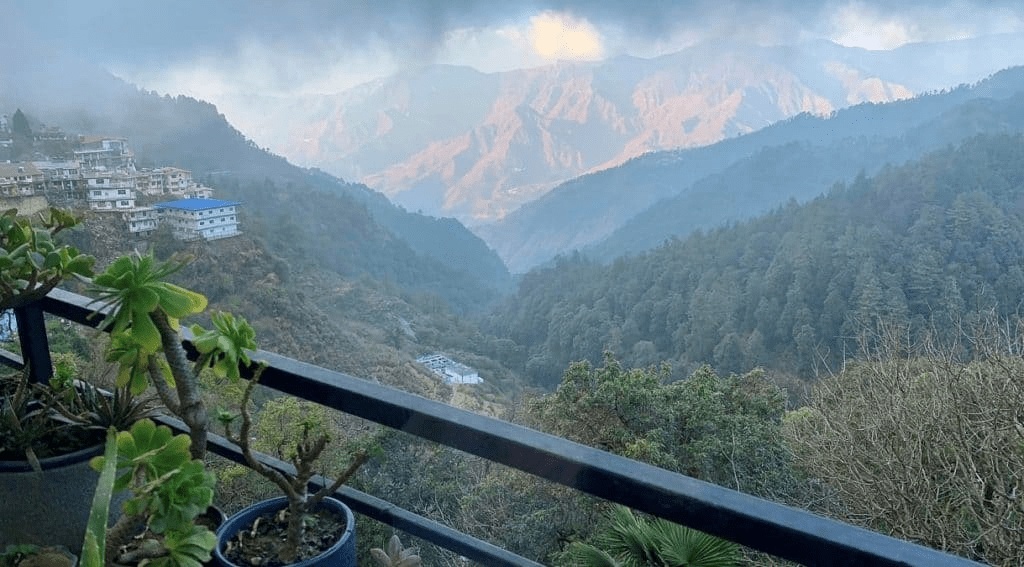
It is a place of extraordinary natural beauty. The Garhwal foothills of the Himalayas reach 7,000 feet here. I found myself entirely captivated by them, spending hours looking at them from different angles, in different lights, and at different times of the day. It’s a wonderful place for walking and hiking, and the relatively benign climate encourages those things. There is also culture here. The area is important in the history of Tibetans because the Dalai Llama settled for a year here in 1959 before moving the Tibetan government in exile more permanently to Dharamshala. A thriving monastery survives near Mussoorie with several thousand Tibetans living nearby.

Mussoorie, and the adjacent town of Landour, are unmissable for those who love mountains and, of course, those looking for a break from the intensity of India’s fascinating, but occasionally exhausting, cities.

Delhi to Mussoorie

Mussoorie is only 200 miles or so from New Delhi, so why does the trip take seven hours by car? The answer will become clear….

On the first part of the journey, a modern and efficient highway takes you, without interruption, from the urban sprawl of New Delhi to the urban sprawl of Ghaziabad. This is the capital city’s commuter belt and it now extends almost as far as Meerut. Anyone falling asleep for an hour after leaving Delhi will miss nothing, but it starts to get a lot more interesting at that point. The next stretch, moving north through Saharanpur and Biharigarh, sees India’s countryside assert itself. This is a place where fields of sugar cane stretch for miles, but it’s certainly not some rural idyll. Scores of brick making factories, their huge chimneys spewing filthy smoke into the sky, make sure of that. Hundreds of dhabas line both sides of the highway, catering for the hungry hordes heading in both directions. Progress slows at this point because India’s highways have a habit of stopping abruptly, giving way to smaller and slower roads. Often, and somewhat frustratingly, a new and as yet unopened stretch of highway, appears on the horizon, promising a speedier trip for future travelers but not today’s. An accident can close the highway entirely, as it did for me, forcing a long and fascinating detour through small villages.

A few miles south of Dehradun things really slow down, sometimes to little more than walking pace as the winding, sometimes treacherous road narrows and makes the climb to Uttarakhand’s capital. Looking to the left, travelers see an elevated, empty, and yes, unopened, highway stretching into the distance. Once in Dehradun, it’s wise to sit back, relax, and enjoy the sights and sounds of the busy city. There’s no alternative. The journey north from here cuts directly across the city and that itself takes a minimum of an hour.

The traveler’s expectation of what constitutes progress is well and truly re-educated by this point, and that’s just as well because what follows next requires patience and a strong stomach. From Dehradun, it’s probably only twenty miles to Mussoorie, but the ride can take anything up to two hours. These are steep mountain roads with hairpin bends, clogged with buses, cars, trucks, and the motorcycles and Vespa-style scooters that Indians love. I came to see the mountains, so I could hardly complain. Needless to say, the views are beautiful. Choose your cliche. Stunningly, breathtakingly, heart stoppingly wonderful.

Mussoorie sits high on the mountain, at approximately 7,500 feet. By the time one gets there, every foot and mile has been felt. But such is the magic and beauty of this place, stepping out of the car after seven uninterrupted hours, everything that came before, every slow mile and every traffic jam, is forgotten.

Back to the Local

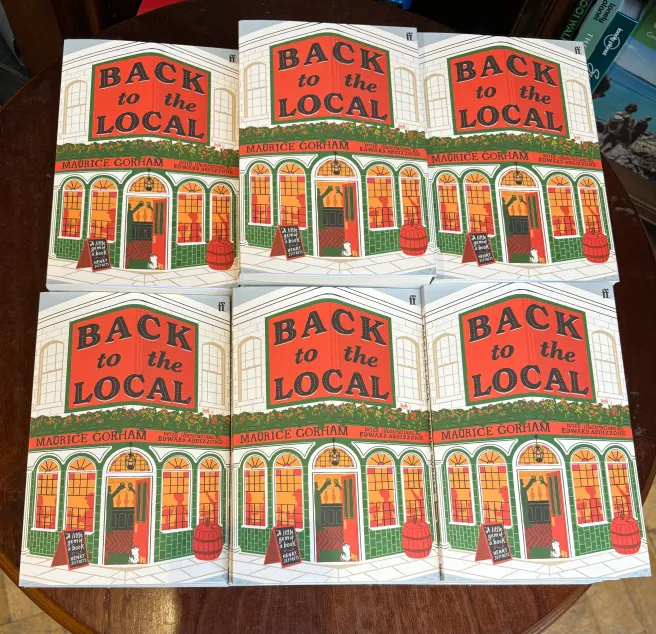
It was clever of Faber & Faber to re-publish Maurice Gorham’s delightful book on London’s pubs. Back to the Local was first published in 1949 (with its illustrations by Edward Ardizzone) and even then had a whiff of nostalgia about it. Gorham mourned the destruction of some of his favorite pubs in World War Two and complained about the changing habits that had led to the modernization and gentrification of others, all the while celebrating what he loved and wanted to see preserved. It’s fun to wonder what he would make of things seventy-five years on.

Londoners love their pubs and tend to be sentimental about them. Every generation discovers them and bemoans the changes they see. For myself, I celebrate the survival of the true neighborhood local. Even today there are more of them than one might think. Of course, like everyone, I deplore the trends that some others might cherish – the sports bars, the themed pubs, the fake “historical” pubs, and so on. Gorham’s little book is a fun reminder that preferences and prejudices are what being a London pub lover is all about. If one pub is not to your liking, move on to one of the other 3,500 that London has to offer.

Chichen Itza

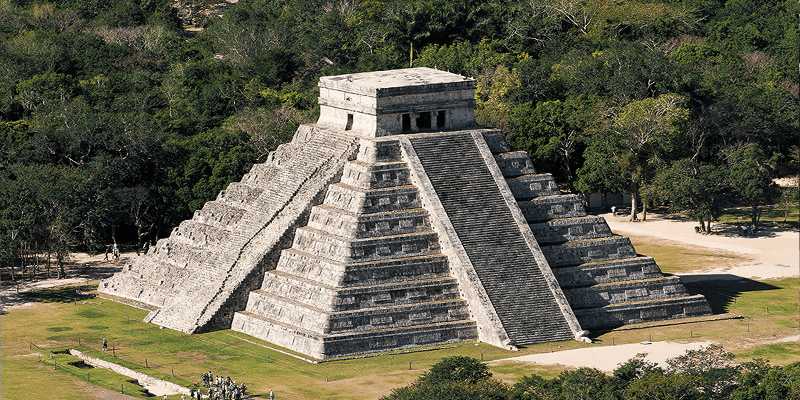
At some point it would be good to take my time and wander around the Yucatan peninsula at my own pace, exploring the many Mayan archaeological sites for which it is famous. On a recent and very brief visit to the region I had to restrict myself to a single nearby treasure, Chichen Itza, the complex of Mayan ruins dominated by the massive step pyramid known as El Castillo. The city prospered between 600 and 1200 A.D. and even in today’s much diminished site it is obvious that it was built by a thriving civilization.

Chichen Itza’s proximity to the coastal resorts means it is often choked with tourists, so it is wise to pick the time of one’s visit carefully. It is also worth noting the large number of vendors surrounding the site that sell all sorts of tourist tat. Once inside the main site it is easy enough to ignore them, but prepare to be hassled on the way in and out.

I enjoyed the visit immensely. It provoked a determination to visit the region for a longer period and to learn more about Mayan civilization before I make my next trip.

Cork City Musings

Even Cork’s greatest admirer would struggle to say the city is a pretty one. The dominant theme is one of grayness. Gray buildings under skies that are often that particular gray that signals rain. It can all seem a little grim at times in the city center, somewhat neglected and shabby. But whatever it might lack in prettiness, Cork has character, charm, and energy in abundance.

For decades the city has been little more than the beginning of my frequent trips further west, but recently I had the opportunity to spend a couple of days there, and I enjoyed it very much. The food scene is vibrant (highlights included Goldie and Nano Nagle Cafe), and there is, of course, no shortage of historic pubs. Sin E for traditional music, The Oval, Mutton Lane, and Arthur Maynes for unique atmosphere and craic in general. The Crawford Art Gallery is an unmissable spot and I was delighted to visit before it closes for major restoration work. Tempting as it might be to skip the city en route to the glories and splendors of West Cork, that would be a mistake. Linger a little and let it work its magic.