Let me go mad in my own way

Claire teaches literature at a university in the west of Ireland. She has left her life in London and, after the deaths of her parents and the end of her relationship to Tom, has moved back to where she grew up. Whatever she’s escaping from or whatever she’s hoping to find, it’s all put in jeopardy when Tom moves into a friend’s cottage nearby ….

I bought my copy of Elaine Feeney’s latest novel on the strength of an earlier one I had read and enjoyed (How to Build a Boat) which had been longlisted for the Booker Prize. I had high hopes but turned the final page with a little disappointment.

There is some exceptional writing in the novel. The Christmas meal hosted by Claire for her friends and family, the childhood flashback when a horse is injured, and especially the harrowing visit of the Black and Tans are rendered so vividly and persuasively. The problem is with the whole, not individual parts. At no point did I care much or at all about Claire’s emotional attachment to Tom or the anguish and joy it provoked. Without that, what was supposed to be the heart of the story didn’t move or engage me at all and I was left occasionally admiring but never immersed.

The Healy Pass

The devastating famine that struck Ireland in the mid-1840s shamed the British government into devising initiatives to try to alleviate some of the worst of the suffering. These included poorly devised and managed job creation schemes such as building roads in rural areas. One such road, built in 1847 to make it easier for travelers to move between Cork and Kerry, became known as The Healy Pass. It was named after a Bantry-born politician and the first Governor General of the Irish Free State, Timothy Michael Healy (1855-1931), who petitioned for its construction. A plaque in Bantry’s town center marks his contribution.

The Healy Pass cuts through the Caha mountains on the Beara Peninsula. It offers beautiful views of the Cork-Kerry countryside as well as a few nervous moments to inexperienced drivers! Fine weather is rare in these parts, but on a good day there is nothing better than pulling into one of the parking spots and walking over the hills to the road’s highest elevations. The going was boggy last week when I was there, and the sky stayed clear for only a few minutes before the inevitable rain showers started, but who cares in a place of such extraordinary beauty?

I’ve been traveling to these parts since I was a boy, often using Bantry or nearby Glengarriff as my base. It’s a region with something for everyone. Unbeatable scenery, outstanding walking, hiking, and fishing, a rich cultural scene, great food – West Cork has it all.

Intermezzo

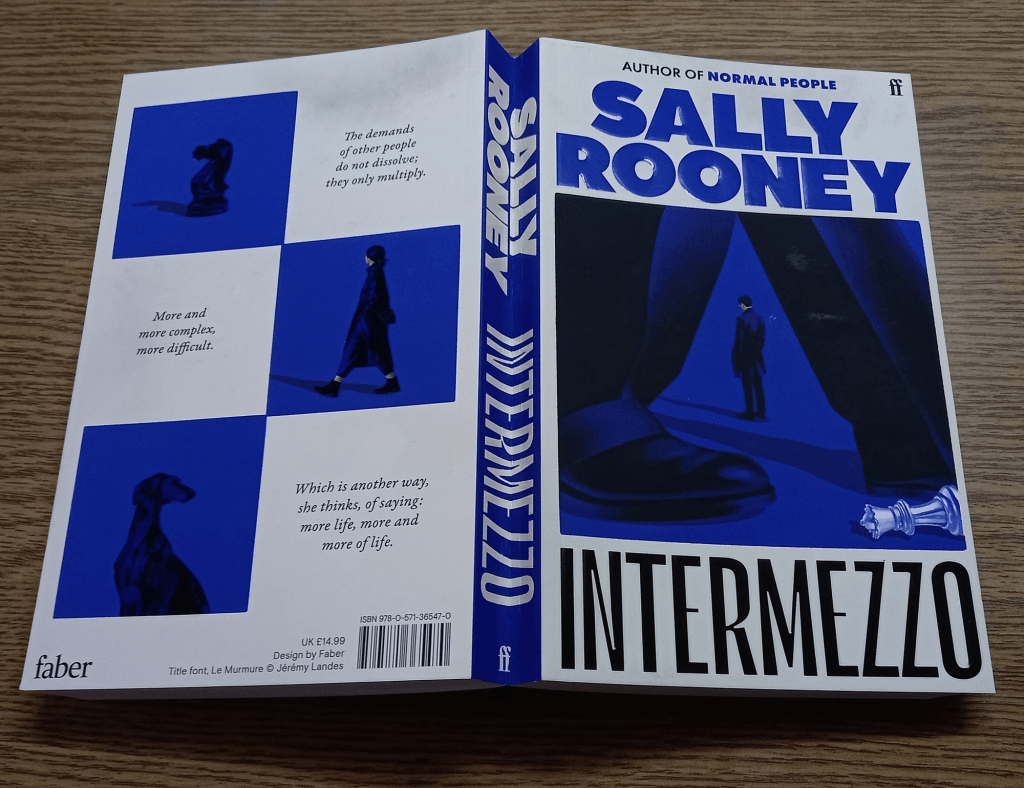
I finally got around to reading a novel by Sally Rooney. There is no obvious explanation of why it took me so long. Huge sales, well received TV adaptations, and all the critical plaudits a young novelist could hope to attract turned Rooney into a literary sensation quite some time ago. I caught up with everyone else just recently and completed her most recent book, Intermezzo. It’s very good.

Intermezzo tells the tale of two very different brothers. Peter, the eldest, is a successful lawyer in Dublin. Socially fluent, accomplished, and intellectual, he’s a conventional success story, at least on the surface. Closer inspection reveals the flaws. The insecurities, the grief following his father’s recent death, and the inability to settle, are masked by drug taking, but he’s not fooling anyone. Ivan, ten years younger, is a competitive chess player, once expected to get to the very top, but now plagued by doubts. He’s socially inept, shy, and nerdy. Each is offered the prospect of salvation through the love of good women (two good women in Peter’s case).

Not much happens by way of a plot. The brilliance of this novel lies in the exposure of Peter’s and Ivan’s interior lives and their troubled relationship. I can’t remember when I was last so impressed by a novelist’s skill at dialogue, or by the uncovering of those interior monologues we all deploy to make sense of our own and others’ experience. It’s all so utterly convincing. The climax of the novel is deeply impressive – truthful and authentic. Strange to say, but I now feel slightly reluctant to read Rooney’s earlier books in case they are not as good as Intermezzo.

Heart, be at peace

Novelists who choose to narrate a story using multiple voices set themselves a very difficult challenge. Making a handful of characters sound distinctive and recognizable is tricky enough, but deploying a chorus of twenty-one voices to tell a story pushes the skills of the writer, and the tolerance of the reader, to the absolute limit. Donal Ryan is clearly a very accomplished writer (some earlier work won prizes), but on the evidence of Heart, be at peace, he just bit off more than he could chew.

I didn’t feel this way in the early stages of the novel. In some of the initial chapters, the voices seemed distinct and some of them struck powerful and poignant notes, but as the novel progressed it all melded confusingly into something of an amorphous blob, a soup where few of the ingredients could be identified reliably from the others.

The Ireland portrayed by Ryan here is a gritty and edgy place. There is little sense of ease. People are troubled and their emotions frayed, trying to make their way or just survive. Relationships are similarly uneasy. There is betrayal, jealousy, disappointment, and very little that’s simply loving and kind. My hunch is that Ryan has powerful stories to tell but has chosen the wrong way to tell them. This is a book where the whole is less than the sum of the parts.

The Drowned

The arrival of a new installment in John Banville’s highly successful Quirke/Strafford series gladdens my heart. The latest, The Drowned, which I think is the tenth, continues and extends a very popular franchise. Continuity matters to devotees of such series. Familiar characters (Quirke, the pathologist, and Strafford, the Inspector), a familiar setting (Dublin in the 1950s), and most of all a familiar atmosphere or ambiance, a world of looming menace, the immanence of illness and death, and the strategies we all deploy to make sense of it all while searching for happiness.

It is clear Banville understands very well how the success of such series depends on a balance of the familiar with the new. The Drowned sees one established character depart while the stage is set for the entrance of new ones. Established relationships shift into a different gear, all against the background of a fairly straightforward plot.

Banville is a wonderfully sensitive and skilled storyteller. The Drowned, like its predecessors in the series, is the sort of novel one wants to devour in a single sitting, perhaps sitting by the fire on a winter’s day, or on a long, comfortable train journey.

Cork City Musings

Even Cork’s greatest admirer would struggle to say the city is a pretty one. The dominant theme is one of grayness. Gray buildings under skies that are often that particular gray that signals rain. It can all seem a little grim at times in the city center, somewhat neglected and shabby. But whatever it might lack in prettiness, Cork has character, charm, and energy in abundance.

For decades the city has been little more than the beginning of my frequent trips further west, but recently I had the opportunity to spend a couple of days there, and I enjoyed it very much. The food scene is vibrant (highlights included Goldie and Nano Nagle Cafe), and there is, of course, no shortage of historic pubs. Sin E for traditional music, The Oval, Mutton Lane, and Arthur Maynes for unique atmosphere and craic in general. The Crawford Art Gallery is an unmissable spot and I was delighted to visit before it closes for major restoration work. Tempting as it might be to skip the city en route to the glories and splendors of West Cork, that would be a mistake. Linger a little and let it work its magic.