Mussoorie

It must have been hard work administering an empire. The punishing heat of India drove the colonial masters to look for cooler places for temporary respite, and they found them in the north of the country in places like Simla, Darjeeling, Manali and Mussoorie. Few of those subjugated by the sahibs and memsahibs had the luxury of escape, but for the ruling class the hill stations were places of recuperation and recovery. Mussoorie was one of the first hill stations and was settled by the British in the 1820s. Today, there is plenty of evidence remaining of those days. Remnants of estates and houses can be seen from the roads, as well as churches built to serve the British community.

Interestingly, the term is still used quite extensively in India, and still designates those towns where people go to seek respite from the intense heat and the frenetic nature of Indian city life. When I was in Mussoorie recently, I didn’t see a single other Western visitor. Indian travelers, however, were there in large numbers, escaping a period of intense heat that had seen temperatures in New Delhi exceed 40 degrees centigrade.

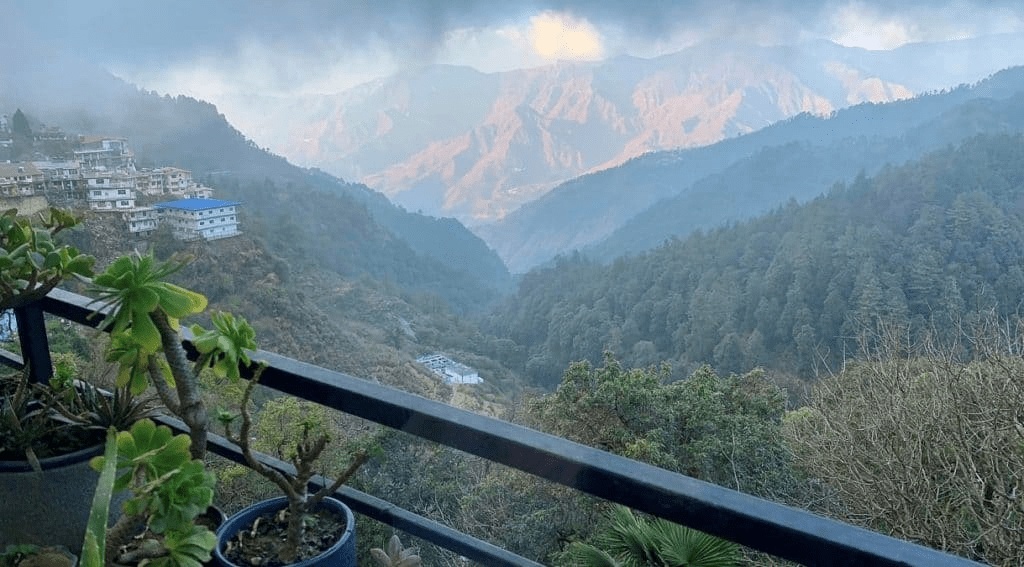
It is a place of extraordinary natural beauty. The Garhwal foothills of the Himalayas reach 7,000 feet here. I found myself entirely captivated by them, spending hours looking at them from different angles, in different lights, and at different times of the day. It’s a wonderful place for walking and hiking, and the relatively benign climate encourages those things. There is also culture here. The area is important in the history of Tibetans because the Dalai Llama settled for a year here in 1959 before moving the Tibetan government in exile more permanently to Dharamshala. A thriving monastery survives near Mussoorie with several thousand Tibetans living nearby.

Mussoorie, and the adjacent town of Landour, are unmissable for those who love mountains and, of course, those looking for a break from the intensity of India’s fascinating, but occasionally exhausting, cities.

Delhi to Mussoorie

Mussoorie is only 200 miles or so from New Delhi, so why does the trip take seven hours by car? The answer will become clear….

On the first part of the journey, a modern and efficient highway takes you, without interruption, from the urban sprawl of New Delhi to the urban sprawl of Ghaziabad. This is the capital city’s commuter belt and it now extends almost as far as Meerut. Anyone falling asleep for an hour after leaving Delhi will miss nothing, but it starts to get a lot more interesting at that point. The next stretch, moving north through Saharanpur and Biharigarh, sees India’s countryside assert itself. This is a place where fields of sugar cane stretch for miles, but it’s certainly not some rural idyll. Scores of brick making factories, their huge chimneys spewing filthy smoke into the sky, make sure of that. Hundreds of dhabas line both sides of the highway, catering for the hungry hordes heading in both directions. Progress slows at this point because India’s highways have a habit of stopping abruptly, giving way to smaller and slower roads. Often, and somewhat frustratingly, a new and as yet unopened stretch of highway, appears on the horizon, promising a speedier trip for future travelers but not today’s. An accident can close the highway entirely, as it did for me, forcing a long and fascinating detour through small villages.

A few miles south of Dehradun things really slow down, sometimes to little more than walking pace as the winding, sometimes treacherous road narrows and makes the climb to Uttarakhand’s capital. Looking to the left, travelers see an elevated, empty, and yes, unopened, highway stretching into the distance. Once in Dehradun, it’s wise to sit back, relax, and enjoy the sights and sounds of the busy city. There’s no alternative. The journey north from here cuts directly across the city and that itself takes a minimum of an hour.

The traveler’s expectation of what constitutes progress is well and truly re-educated by this point, and that’s just as well because what follows next requires patience and a strong stomach. From Dehradun, it’s probably only twenty miles to Mussoorie, but the ride can take anything up to two hours. These are steep mountain roads with hairpin bends, clogged with buses, cars, trucks, and the motorcycles and Vespa-style scooters that Indians love. I came to see the mountains, so I could hardly complain. Needless to say, the views are beautiful. Choose your cliche. Stunningly, breathtakingly, heart stoppingly wonderful.

Mussoorie sits high on the mountain, at approximately 7,500 feet. By the time one gets there, every foot and mile has been felt. But such is the magic and beauty of this place, stepping out of the car after seven uninterrupted hours, everything that came before, every slow mile and every traffic jam, is forgotten.

Gandhi Smriti

It seemed right to visit Gandhi Smriti. I had been before, but at times when the world had been less volatile, less dangerous, and less polarized. Now, when the voices of conflict and separateness are drowning out messages of peace and unity, it felt like an appropriate time to connect with the Mahatma’s message of non-violence in the place in which he died in 1948. There were almost no other visitors. 104 degrees, the hottest time of the day, and Delhi’s tourists and residents alike were wisely staying out of the sun.

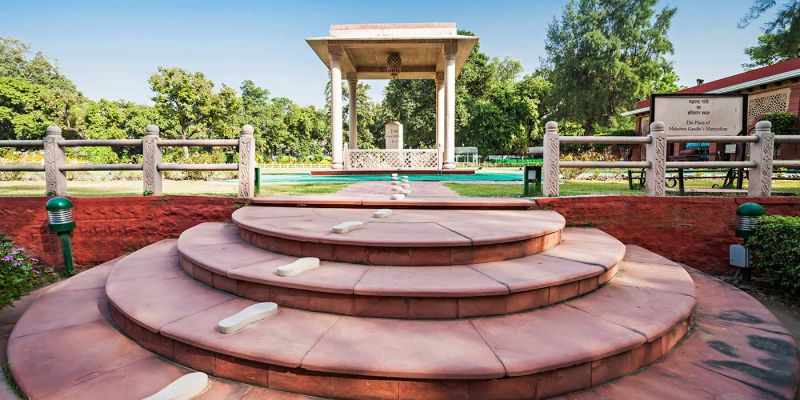
Old Birla House, as it used to be known, is where Gandhi spent the last 144 days of his life and where, on 30th January 1948, he was shot to death by Nathuram Godse. It has been turned into a simple, slightly old fashioned, but powerful memorial to someone venerated in Indian society and around the world. At its heart is the austere living quarters that Gandhi occupied in his final months and the path, marked by cut-outs of his footprints, to the place he was assassinated as he walked to his daily prayer site. Elsewhere in the house is a museum where his life and achievements are summarized. I learned something new on this visit, that one of my favorite photographers, the great Henri Cartier Bresson, was one of the last people to meet Gandhi before the assassination, just a few minutes before the shots were fired.