The Party

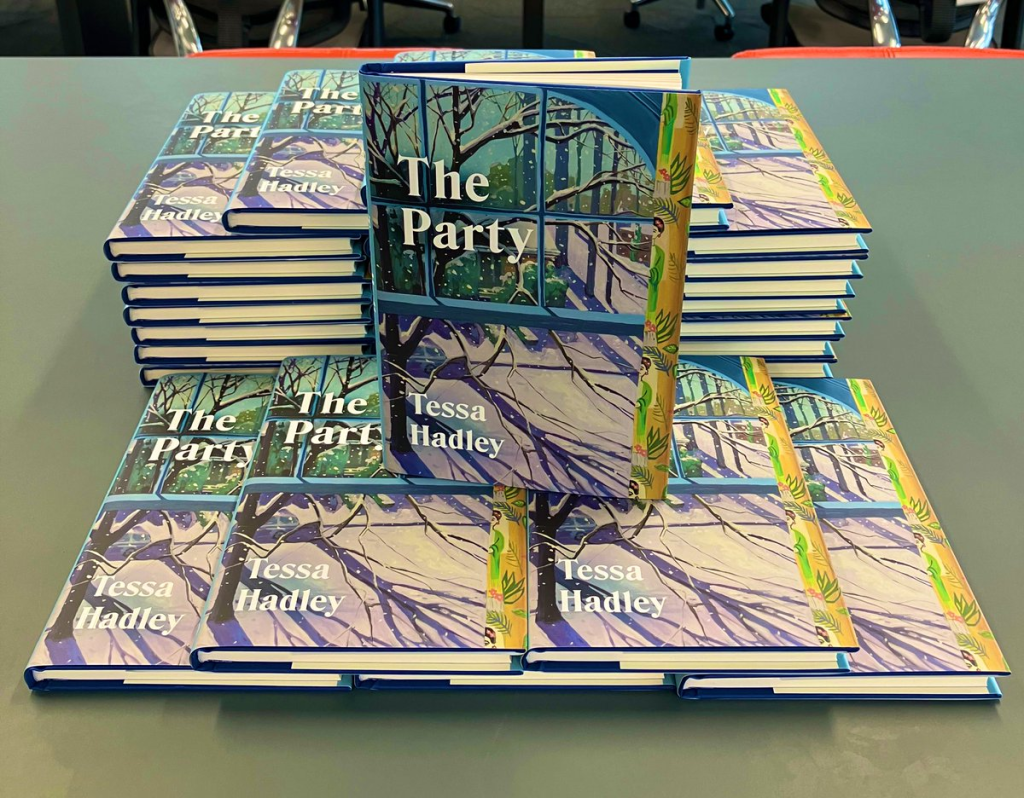
A new book from Tessa Hadley is always a treat, even a slim novella like The Party. It ought perhaps to have been called Two Parties because the story is bookended by two social events, attended by two sisters, Evelyn and Moira, both students. The first takes place in a Bristol pub shortly after the end of World War Two and the second, more of an ad hoc get-together, in a grand but faded house elsewhere in the city the following weekend.

How far can any of us really achieve the lives we want to have? What real influence do we have over the shape of our future? Can we realize the lives we want by sheer force of personality and determination, or are our futures mapped out for us by factors over which we have so little control such as class or gender constraints, real or perceived? These are the questions that interest Tessa Hadley, and she uses the sisters with their common upbringing and history as exemplars of two distinct perspectives. Not that Moira and Evelyn are simple cyphers. Not at all. Hadley is far too accomplished a writer for that, and Evelyn especially is a brilliantly realized character.

Does this all sound a little old-fashioned, like Anita Brookner or Barbara Pym for the 21st century? Perhaps, but don’t be put off. There is more inventiveness, daring, and insight in Hadley’s writing than some more experimental novelists can dream of realizing.

Creation Lake

Only a very confident and self-assured author takes a familiar genre, in this case the spy novel, and uses it as a channel for ideas. A burden comes with that decision. Spy novels are traditionally plot-driven vehicles and readers of the genre expect pace, twists and turns, and action. So manipulating and subverting the classic espionage tale is all very well, but the ideas had better be worth the effort and at least some of the familiar features of the genre had better be respected. No one ought to buy Creation Lake expecting a conventional spy novel, and anyone who does will be disappointed. If that happens, some reviewers might be responsible. The Guardian critic talked about “a killer plot and expert pacing”. That’s downright misleading in my view.

Sadie Smith, the heroine and narrator of Rachel Kushner’s latest novel, is a spy working in the private sector and has an assignment to infiltrate a shadowy group in rural France suspected of planning acts of sabotage. Sadie is unscrupulous, a quality that might be considered an asset in her line of work. It has, however, got her into trouble in the past when, working for a spy agency in the US, she was found to have entrapped an innocent man and got fired as a result. Now in France, she has seduced an impressionable activist to gain entry to the suspected terrorist cell. This lack of a moral compass might be Sadie’s least unattractive quality. Her superficial pronouncements on everything from Europe and its culture (overrated) to Italian food (horrible), her glib philosophizing (“The truth of a person, under all the layers and guises, is a substance that is pure, and stubborn, and consistent”), her unassailable belief in the superiority of English (in other words American) culture marks her out as the worst kind of entitled, privileged, and semi-educated American who has everything, values little, and has earned nothing. Sadie hacks into the emails of Bruno Lacombe, the leader and guru of the protest group, and pokes fun at his tiresome ideas, but his silly intellectualizing about what we can learn from Neanderthals makes him look like a genius compared to Sadie and her moral vacuity.

I am surprised that Creation Lake was shortlisted for The Booker Prize. It’s a novel that’s executed with lots of confidence and it’s an enjoyable enough read, but I couldn’t shake off the feeling that there’s no substance or heart in the book. Rachel Kushner’s critical reputation seems to be growing with every new novel, but on the evidence of the two I have read (The Flamethrowers and Creation Lake), I don’t understand why.

Married Love

There is a new Tessa Hadley novel coming at the end of the month (The Party). Hearing that news while I was browsing in Hatchard’s recently prompted me to pick up an older collection of short stories, Married Love, first published in 2013. The cover includes a gushing quote from The Times‘s review, describing the collection as “unexpected, exhilarating, life-changing”. Married Love is none of those things. It’s an uneven collection that includes masterful stories and some that miss the mark. The best of them are a reminder of what a supremely accomplished writer Hadley is. I have pre-ordered The Party and will devour it once it arrives.

The Western Wind

The Western Wind is a novel set in a small and isolated English village at the end of the 15th century. Its narrator is the local priest, John Reve. John’s parish, Oakham, is a farming community, mostly poor, mostly hardworking, and mostly god-fearing. As the story opens, its wealthiest and worldliest member, Tom Newman, is missing, feared drowned in the treacherous local river after unprecedented storms and floods. His torn shirt has been found, nothing more, and the villagers are distressed and fearful. The local dean, representing ecclesiastical and temporal power, has arrived to investigate, making things uncomfortable for Fr. Reve.

My summary makes the novel sound like a medieval mystery story. To some extent it is, but there’s so much more to The Western Wind. It’s a beautifully written and thoughtful tale about faith, superstition, and power, and about how and where we find meaning in life. It’s a novel that never strives to be explicitly historical, but is filled with authentic detail of life in a medieval English village. It plays with time, telling the story in reverse, and this helps make medieval Oakham shockingly modern. It’s best read slowly and carefully, with every sentence savored.

Death at La Fenice

Summer vacations are the perfect opportunity to dive into a mystery series. Nothing makes a long flight or train journey pass more quickly. Having exhausted some of my favorite novelists in the genre (Henning Mankell, Susan Hill, Nicci French, et al), and on the cusp of a trip to Europe, it seemed like the perfect time to make a start on a series that I have inexplicably overlooked until now – Donna Leon’s celebrated Brunetti novels. There are now more than 30 titles in the series, so I’m making no commitment to read them all at this point, but it seemed only right to start at the beginning, Death at La Fenice.

A celebrated conductor is found dead in his dressing room during an intermission at a performance at the famous Venice opera house. The cause of death is immediately clear, cyanide poisoning, but who killed the maestro, and why? Enter Commissario Guido Brunetti, the senior detective assigned to solve the puzzle. Flawed in many ways, Brunetti is a contrary, anti-establishment figure, a man who loves his family, Venice, and his work (probably in that order).

Death at La Fenice sets, I suspect, the tone of the entire Brunetti series. This is a long love letter to Venice and a prolonged character study of a passionate Venetian. The plot here is secondary and the denouement feels hurried. I have already bought numbers 2 and 3 in the series, so we’ll see if anything changes.