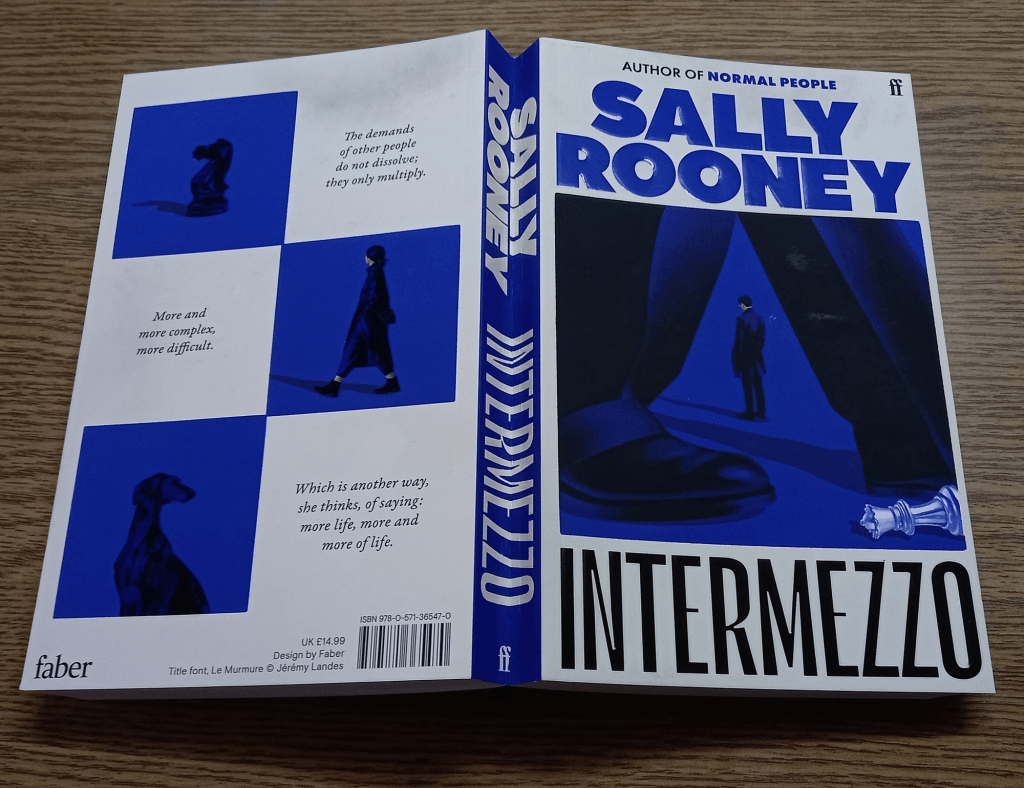
Intermezzo

I finally got around to reading a novel by Sally Rooney. There is no obvious explanation of why it took me so long. Huge sales, well received TV adaptations, and all the critical plaudits a young novelist could hope to attract turned Rooney into a literary sensation quite some time ago. I caught up with everyone else just recently and completed her most recent book, Intermezzo. It’s very good.

Intermezzo tells the tale of two very different brothers. Peter, the eldest, is a successful lawyer in Dublin. Socially fluent, accomplished, and intellectual, he’s a conventional success story, at least on the surface. Closer inspection reveals the flaws. The insecurities, the grief following his father’s recent death, and the inability to settle, are masked by drug taking, but he’s not fooling anyone. Ivan, ten years younger, is a competitive chess player, once expected to get to the very top, but now plagued by doubts. He’s socially inept, shy, and nerdy. Each is offered the prospect of salvation through the love of good women (two good women in Peter’s case).

Not much happens by way of a plot. The brilliance of this novel lies in the exposure of Peter’s and Ivan’s interior lives and their troubled relationship. I can’t remember when I was last so impressed by a novelist’s skill at dialogue, or by the uncovering of those interior monologues we all deploy to make sense of our own and others’ experience. It’s all so utterly convincing. The climax of the novel is deeply impressive – truthful and authentic. Strange to say, but I now feel slightly reluctant to read Rooney’s earlier books in case they are not as good as Intermezzo.

Munichs

Only a small proportion of Manchester United’s fans around the world gets to visit Old Trafford. For those that do, the trip to the Theatre of Dreams has the character of a pilgrimage. The statue of Best, Charlton, and Law might top the list of sights to see, or a seat in the Stretford End, but for many it’s the Munich clock, that painfully poignant memorial to the terrible day in 1958 when eight of the first team died as their plane crashed on take-off from Munich airport. David Peace’s book, Munichs, tells the story of that tragic day and its aftermath. It is, quite simply, a masterpiece.

Although the tragedy happened less than seventy years ago and is remembered vividly by older United fans, Munich has become part of the mythology of the club. And, as is so often the case with myths, the real story of what happened that snowy day in 1958 is known to many only in outline. The death of the precociously talented Duncan Edwards or the remarkable recovery of the manager, Matt Busby, for example. But Munich was about much more. The journalists who died that day, the relatives of those who perished, the guilt of those who survived, the grief of hundreds of thousands of supporters who lined the streets for the funerals, and the shock of a nation – all this and more is captured brilliantly and unforgettably by David Peace.

Munichs is not a history book. It’s a novel, but one obviously informed by a deep engagement with contemporary sources. Its brilliance in part is due to its evocation of a world that feels long past. A world in which football was a working class sport, one with deep roots in local communities and one where the passion to play and win had nothing to do with money. David Peace tells the story with the imagination, empathy, and compassion of a fine novelist, portraying the grief, courage, and resilience of those who survived and those who lost loved ones. Only ten years after the tragedy, Manchester United went on to win the 1968 European Cup. I remember that game very clearly, but had no idea as I watched the post-match celebrations on television that Bobby Charlton, Bill Foulkes, and Matt Busby had been pulled from the burning wreckage only a decade earlier. Munichs should be read by anyone who loves football, but it will have special meaning for those who follow United.

Our Evenings

Critics love Alan Hollinghurst’s work. They receive every new novel with rapturous reviews. They applaud the elegance of his prose, the emotional precision of his observations, the brilliance of his characterizations, and celebrate him as the great chronicler of gay lives and experience in recent decades. His most recent novel, Our Evenings, has been greeted in very much the same vein, with some critics saying it is his best yet.

We meet Dave Win at the beginning of the novel looking back on his early life from the vantage point of middle age. With an English mother and an absent Burmese father, Dave’s dark skin makes him a target at a rural boarding school in postwar England. Dave is a scholarship boy of very limited means (his mother is a seamstress), and the beneficiary of a rich patron’s generosity. His school friends are well aware of his precocious intelligence and his relative poverty, and his status as the outsider looking on from the sidelines is confirmed as he moves to Oxford. He excels there as a student actor and, after university, drifts into acting jobs in television and theatre.

I felt peculiarly detached from Our Evenings. It was easy to admire Hollinghurst’s style, but little here really engaged me, other than perhaps the touching portrayal of Dave’s love for his mother. I think that may be because so much of the ground felt well trodden by novelists of the past. The man, defined as an outsider by his race, skin color, social class, and sexuality, looking into, but never fully joining, the lives of his “betters” is a theme that many others have felt drawn to, and it takes some special ingredient to elevate it to somewhere that feels new and special. I could not detect or experience that ingredient and I closed the book at the end with a feeling of admiration but no real sense of immersion.

Heart, be at peace

Novelists who choose to narrate a story using multiple voices set themselves a very difficult challenge. Making a handful of characters sound distinctive and recognizable is tricky enough, but deploying a chorus of twenty-one voices to tell a story pushes the skills of the writer, and the tolerance of the reader, to the absolute limit. Donal Ryan is clearly a very accomplished writer (some earlier work won prizes), but on the evidence of Heart, be at peace, he just bit off more than he could chew.

I didn’t feel this way in the early stages of the novel. In some of the initial chapters, the voices seemed distinct and some of them struck powerful and poignant notes, but as the novel progressed it all melded confusingly into something of an amorphous blob, a soup where few of the ingredients could be identified reliably from the others.

The Ireland portrayed by Ryan here is a gritty and edgy place. There is little sense of ease. People are troubled and their emotions frayed, trying to make their way or just survive. Relationships are similarly uneasy. There is betrayal, jealousy, disappointment, and very little that’s simply loving and kind. My hunch is that Ryan has powerful stories to tell but has chosen the wrong way to tell them. This is a book where the whole is less than the sum of the parts.

The Land in Winter

I have written here in the past about my admiration for Andrew Miller’s fiction, so when I saw The Land in Winter showing up on critics’ “best books of 2024” it was bound to be one of my first priorities in 2025. The winter referred to in the title is the infamous one of 1962-1963 when Britain recorded some of the lowest temperatures ever recorded and heavy snowfalls persisted in many parts of the country until early March. Miller’s story is set in a frozen and fog-bound village not far from Bristol and has as its central characters two young couples living as neighbors. Eric, the local doctor, and his genteel wife, Irene, occupy a cottage next to a small farm where Bill is struggling in his first farming venture while his young, bohemian wife, Rita, stays at home reading science fiction novels. At the opening of the novel, both women are in the early stages of pregnancy.

It’s ostensibly a novel about marriage and love, about the accommodations and compromises that individuals make as they seek to manage the task of living with someone else. Miller is superb at exploring the nuances of relationships, but this is just the foreground and he has bigger ambitions. England in 1963 was still a country living in the shadow of a world war and a place where its horrors were still vivid for some. Miller’s theme is how we avoid madness and how we carve out lives and futures when those horrors are so close and so real. The snow, ice, and fog that have frozen and paralyzed Somerset foreshadow a world broken beyond repair by environmental catastrophe.

The Land in Winter is a novel of unusual subtlety and nuance. That won’t surprise anyone who has read Miller’s earlier work. He’s an ambitious and cunning writer, and understands better than most how the conventions of traditional fiction can be adapted and subverted to explore and explain the deepest workings of human behavior. It is not a perfect novel. Some of the story’s tension is dissipated when the plot moves beyond the confines of the snowbound village and some of the peripheral characters are sketched rather than drawn. These are quibbles. The Land in Winter should be on the reading list of anyone interested in the best of contemporary English literary fiction.

The City and its Uncertain Walls

A book’s dust jacket can tell you a lot. The one covering the UK hardcover edition of The City and its Uncertain Walls has the word Murakami printed in large letters on the spine and front cover. No first name. Not Haruki Murakami, just Murakami. The author’s name is much larger than the title. The message is clear. Murakami is special. Murakami is a big deal. Murakami is a brand.

The publication of a new novel by Murakami is an event these days. Lots of advance publicity building anticipation among his millions of admirers around the world. Lots of talk about the Nobel Prize (which still eludes him), and pages of critical reviews. Has he lost his edge? Are the novels too bloated and self-regarding, etc. etc. All of this reflects the enormous global following he has attracted and can sometimes detract from what matters: the appreciation of the work.

This most recent novel has not been well received critically. Reviewers have focused a lot on the fact that it re-works an earlier novel and an even earlier novella published many years ago. Murakami himself addresses that in an Afterword. I have not read either of the earlier works, so my appreciation of The City and its Uncertain Walls was entirely unaffected. I found it to be an engaging, thought-provoking novel, marked by that distinctive atmosphere that is unique to Murakami. It is a novel, at least in part, about how to live. How to connect with others, how to be separate from them, and what that final separation – death – might mean. Murakami’s legions of fans won’t be surprised by any of this. What it really means to be an individual in a world of other individuals has always been his great interest. Our fundamental “aloneness” and singularity and how we deal with the expectation and reality of interaction with others. The boundaries and intersections between things, between individuals, between life and whatever might (or might not) come after, between what’s real and what isn’t, between fact and fiction – this is Murakami’s territory, and it’s all on display and explored in his inimitable style in his latest work.

Reading in 2024

Looking backwards is one of the pleasures of maintaining this blog. It has become a habit of mine at the end of each year to take a look at my reading choices in the previous twelve months. What have my reading habits been? Have any new trends or influences crept in or are the old preferences still firmly in place? Do the choices I made in the past year reveal commendable experimentation or deplorable predictability?

It’s clear, especially as far as fiction is concerned, that I tend to go back to favorite authors and that I’m quick to pick up the new books they publish. Tessa Hadley, Niall Williams, and John Banville were examples of that in 2024. I’m not searching out new novelists (new to me, that is) as often as I think I should. I read for the first time this year only Jose Saramago, Paul Lynch, and Samantha Harvey. I was glad I did in every case. I’m not showing much interest in classic fiction or indeed anything written before the 21st or 20th centuries. Turgenev’s First Love was the exception in 2024, and what a delight that was! I am reading too much second-rate mystery fiction. That needs to change. Two novels stand out from the herd: Time of the Child by Niall Williams and The Western Wind by Samantha Harvey. Both were outstanding and I have recommended them far and wide.

My non-fiction reading was more varied, but my interests are visible clearly nonetheless. Literary memoirs (Werner Herzog, Iain Sinclair, and John McPhee), travel writing inspired by spiritual quests, architecture, and some politics. I think I chose well in 2024, and there were few, if any, regrets. All the non-fiction I read this year was uniformly excellent and engaging.

I am already thinking of 2025. Every time I go into a bookshop, I leave with a different resolution. Read more classics. Read some of the great American novels. Read books from different cultures. Will I follow through on any of these high-minded ambitions? I guess I’ll see soon enough.

The Drowned

The arrival of a new installment in John Banville’s highly successful Quirke/Strafford series gladdens my heart. The latest, The Drowned, which I think is the tenth, continues and extends a very popular franchise. Continuity matters to devotees of such series. Familiar characters (Quirke, the pathologist, and Strafford, the Inspector), a familiar setting (Dublin in the 1950s), and most of all a familiar atmosphere or ambiance, a world of looming menace, the immanence of illness and death, and the strategies we all deploy to make sense of it all while searching for happiness.

It is clear Banville understands very well how the success of such series depends on a balance of the familiar with the new. The Drowned sees one established character depart while the stage is set for the entrance of new ones. Established relationships shift into a different gear, all against the background of a fairly straightforward plot.

Banville is a wonderfully sensitive and skilled storyteller. The Drowned, like its predecessors in the series, is the sort of novel one wants to devour in a single sitting, perhaps sitting by the fire on a winter’s day, or on a long, comfortable train journey.

Death at the Sign of the Rook

Kate Atkinson’s latest novel is the sixth to feature Jackson Brodie, the sour and sweet private investigator. We find him back in the north of England, Yorkshire specifically, hired to investigate the disappearance of a valuable painting. The missing painting leads to another missing painting which in turn leads to a shadowy woman who may (or may not) have stolen them both. Brodie’s sleuthing takes him to a country house hotel in a snow storm. Not just any country house hotel, but one hosting a Murder Mystery Night for its guests ….

If this all sounds a little like Agatha Christie, that’s exactly what Kate Atkinson intends. In the hands of a less accomplished writer, not to mention one with a less sure comic touch, it might all seem more than a little self-conscious or twee. That is not the case here. Atkinson is having fun adapting a well-worn genre to her popular Brodie series and the fun is infectious. Having said that, the build-up to the gathering of the characters at the hotel (roughly the first two thirds of the novel) was what I enjoyed the most. The denouement was a bit too contrived for my tastes.

Death at the Sign of the Rook is a light and frothy tale and a great addition to the series. Perfect holiday reading.

Time of the Child

Niall Williams’ latest novel is one of the finest I have read in a very long time. I rarely use the word, but I think it’s a masterpiece. The novel is beautifully crafted and practically every sentence is a joy to read. It is written with a lyricism that is so rare in contemporary fiction and with a sensitivity for language and for its nuances that feels like a skill from a bygone age. Who else writes like this today? Marilynne Robinson comes to mind, but few others.

Time of the Child is set in the fictional village of Faha in the west of Ireland. The time is December 1962. Electricity, televisions, and telephones came to the village just a few years earlier, but many of Faha’s residents are stuck in earlier times. They live in houses illuminated by candles and heated by peat fires. They work mostly on the land, and the rhythms of their lives are set by the changing seasons and by religious festivals. The priests have power. The church and the pubs are where people meet. If this sounds far-fetched, it isn’t. My childhood visits to rural Connemara and West Cork started in the mid-1960s, and Williams’ depiction of the place is faithful to what I saw and experienced.

A gift arrives in this isolated and timeless place. A newborn baby is abandoned in the village churchyard and discovered by a local boy. Thinking it dead, he takes it to the local doctor. What happens next is a mystery. Whether by Dr. Troy’s skill or the power of prayer, the baby girl is revived and given the name Noelle. No more about the plot. I do not want to spoil anyone’s enjoyment of the novel.

Time of the Child is everything I want in a novel. Exquisite lyrical prose, deep insight into what it is to be human and humane, into how to live alone and in community, and what it means to be open to the possibility of transformation and redemption.