Eastbound

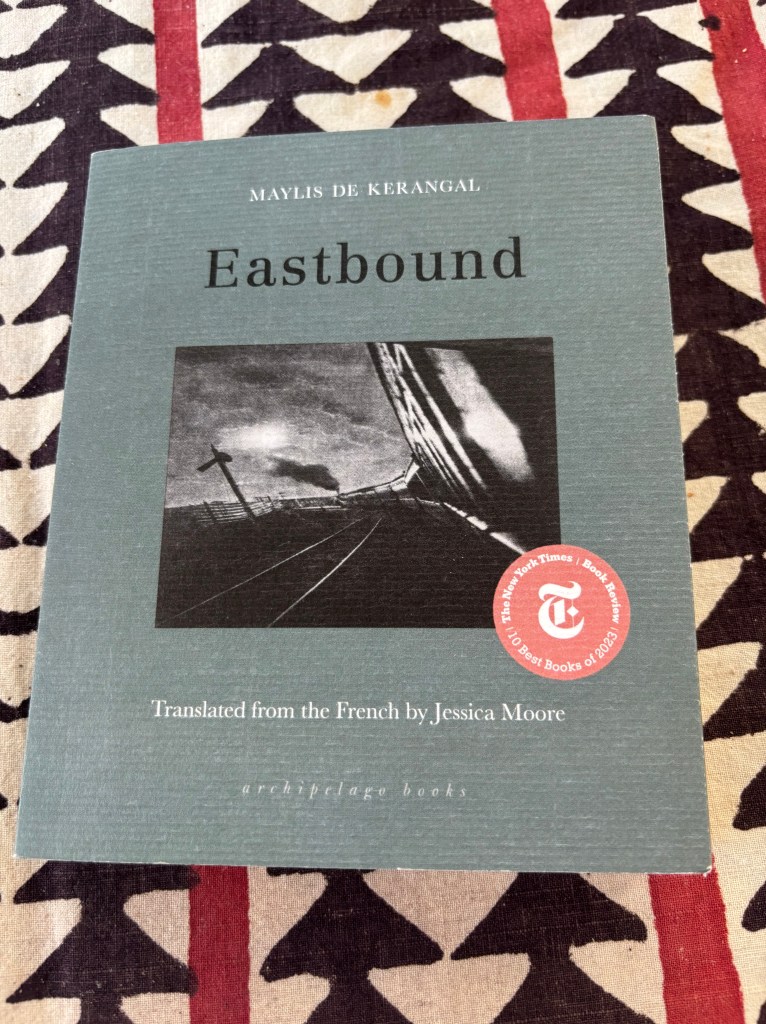
Most books are published in a relatively small number of standard sizes. While there are good reasons for that, titles published in unusual formats or with distinctive designs have a good chance of standing out among the thousands of similar looking books stocked by the average bookstore. Imaginative publishers know that. Browsing one evening recently in a fairly undistinguished chain bookshop in a Massachusetts mall, my eye was caught by a small, almost square paperback called Eastbound by Maylis de Kerangal. No doubt it was the unusual format and pared down, minimalist design that made me pick it off the shelf.

Eastbound features Aliocha, a young Russian conscript on his way to report for compulsory military service in Siberia. Traveling on the Trans-Siberian Express, Aliocha is so frightened of what lies at the end of the long journey that he is determined to abscond. On the train he meets Helene, a French tourist traveling in first class, and sees an opportunity to escape.

It may seem an implausible tale, but the author (Maylis de Kerangal) creates such an intense and dreamlike atmosphere on board the cramped and claustrophobic train moving relentlessly towards the frozen wastelands of Siberia that it hardly seems to matter. This is a novella about shared humanity, people’s destinies and fates and how they intertwine in the least likely of circumstances. Fevered and almost surreal, Eastbound may be short but it sticks in the memory.

What We Can Know

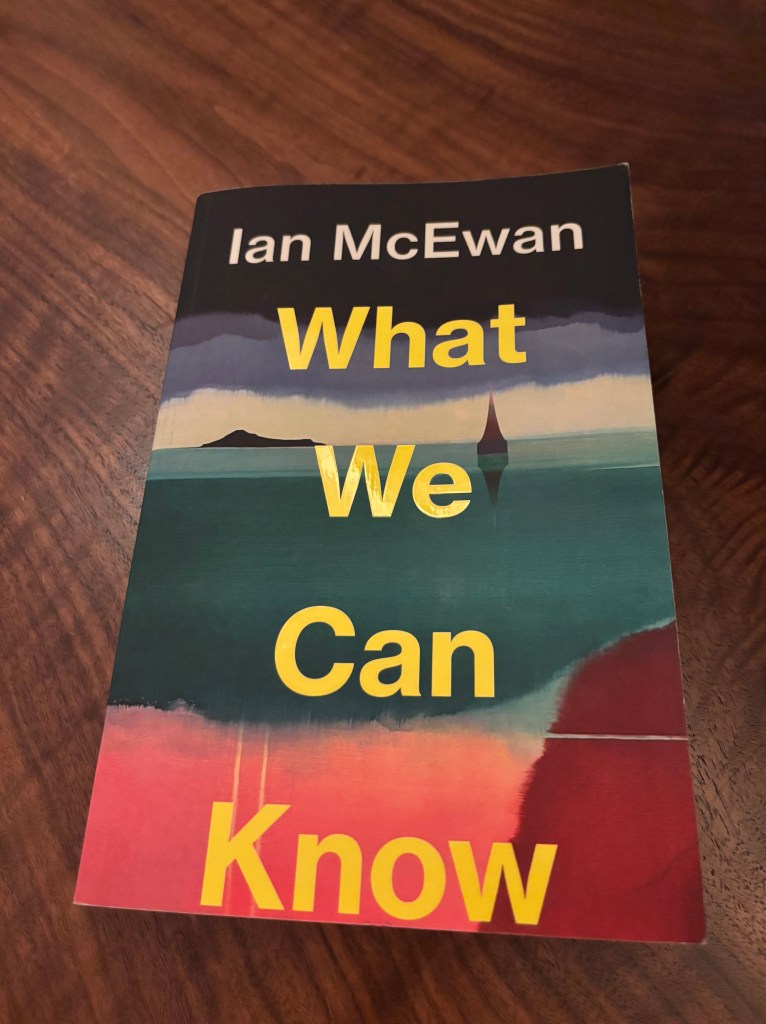
What can we really know about the past, even in a world in which almost everything – every email, every photograph, every recording – is preserved? What can we ever know about the figures of history, the writers, the artists, the politicians and so on? Do all those biographies that scrutinize every detail of a life ever capture what the living, breathing, and thinking person was truly like ? Do biographers and academics ever get close to the objects of their examination? And what does all that uncovering of the past teach us about the present? Perhaps instead of trawling through archives and reading books and manuscripts, we might learn more about today by imagining a future world and looking back at the present from that vantage point. What we can know is about what we can know. It’s about trying to understand what we can ever really understand, about the past and the present. That is vital because if we can really see clearly, if we can really understand, and if we can really know, from that understanding and knowledge perhaps we might start to value, protect, and preserve what is valuable and meaningful, and stop destroying what really matters before it is too late.

What we can know is is that unusual thing, a novel of ideas. It’s a wonderful accomplishment and to my mind one of the best things McEwan has written for a long time. The story is set in 2119 in Britain, a country which by that time is an archipelago, much of its earlier landmass having been left uninhabitable by rising sea levels. Tom Metcalfe is an academic and his research centers on a poem, written in 2014 and recited at a famous dinner party. No written copy of the poem has ever been found, making it that rarest of things, an unpreserved masterpiece known only by its reputation and by the memories of those who heard it spoken aloud on one occasion more than a century in the past. For Tom the effort to discover the whereabouts of this unread poem is his life’s mission. No spoilers here!

McEwan’s probing intelligence is one of the features I most associate with him and in his least successful novels it can be on full display unleavened by emotional insight. In What we can know the balance is almost perfect. It’s certainly a clever and thought-provoking story, but it also has tenderness, wit, and compassion.

Death and the Gardener

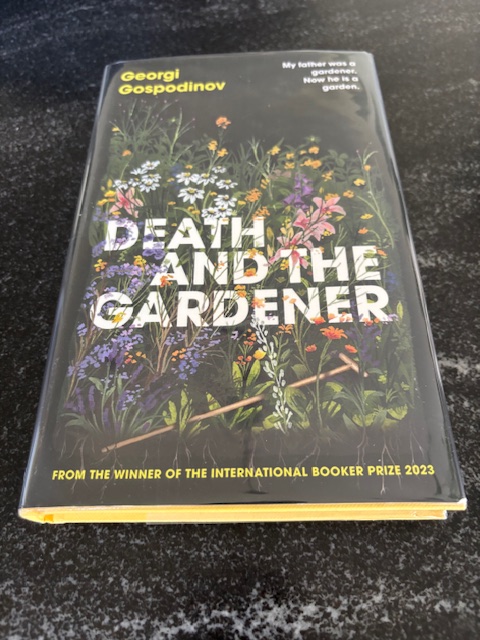
I have the impression that fewer novels are written about fathers and fatherhood than mothers and motherhood. That may simply reflect my reading choices and experience. Anyone who loved their father and lost him to illness is likely to be moved deeply by Death and the Gardener, the most recent novel from the Bulgarian writer (and winner of the International Booker prize in 2023), Georgi Gospodinov.

The book reads like a memoir. The narrator is a celebrated Bulgarian writer and his story is told with the apparently unflinching candor that one normally associates with journals or autobiographies. His account weaves memories of his father with a description of the old man’s illness, treatment, and death, all told in a style marked by simple directness with flashes of real tenderness. It’s one of those books that you find yourself wanting to read more slowly, more carefully, going back over particular sentences and paragraphs to embed them firmly in your memory and experience.

In remembering his father, and telling those remembrances, the narrator creates a eulogy and a memorial that will outlast the father and the son. And Gospodinov, in creating the story, creates a eulogy and memorial for every father that was loved and lost, so that perhaps the sons still living might realize and cherish what they had and what will never return. “We will never be as safe as we once were in our father’s arms“.

Seascraper

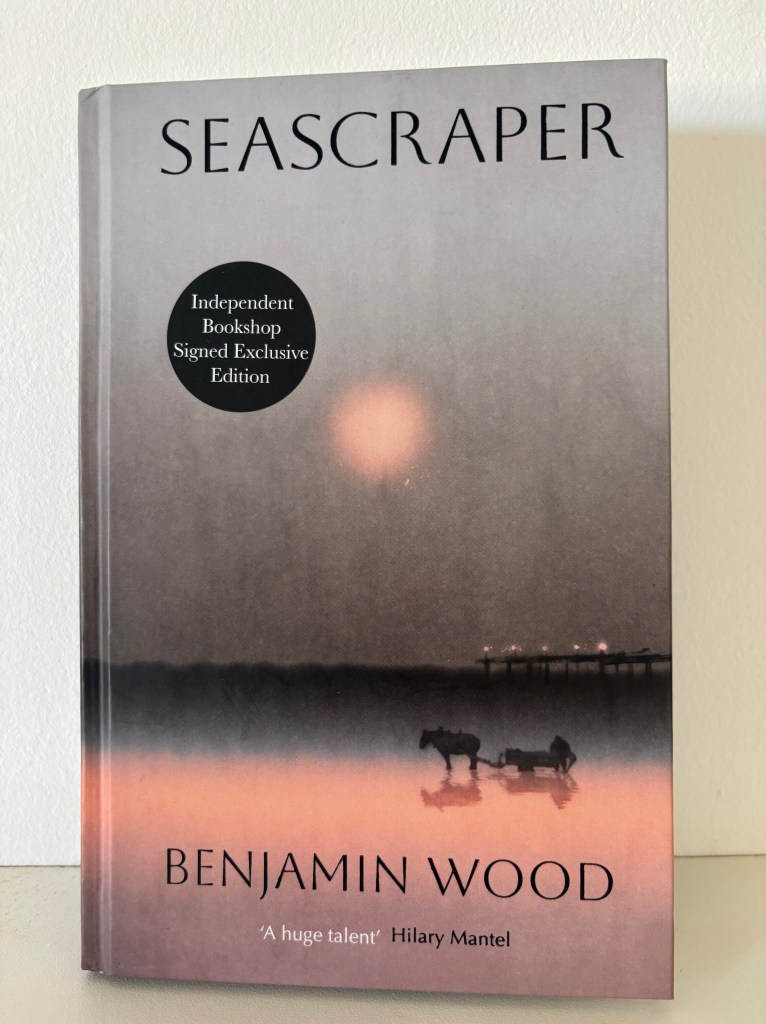
Thomas Flett is a shanker. Every morning at low tide he takes his horse and wagon to the beach, scrapes the sand and the shallow waters for shrimp, and delivers his haul for sale in the nearby town. He does it reluctantly and even resentfully, dreaming all the while of the folk music he would like to write and perform. Thomas lives with his mother in a rundown cottage. Money is scarce, so he conceals his ambitions from her, hiding his guitar and everything of his inner life. Work is hard, leaving him little or no time to follow his dreams, until one day, without warning, an American film director shows up scouting for suitable locations for his new project.

Disappointed and disillusioned young men, tied to labors they loathe, tethered by poverty, and dreaming of other lives are something of a literary staple. Think of Thomas Hardy, for example. Seascraper is firmly within that tradition. That in no way is intended to diminish Benjamin Wood’s achievement here. His tale is a memorable and poignant one, and he writes with great feeling for the frustrations of daily life and especially of thwarted ambition. In spite of that, Seascraper for me didn’t quite come off. It’s filled with atmosphere and the character of Thomas is written with subtlety and insight, but minor characters feel sketched rather than fully drawn. Nevertheless, this is a fine novel and one I’m pleased to have read.

A Whole Life

Flicking through a Saturday edition of The Financial Times recently, I came across one of those Q&As in which someone in the public eye (I’ve forgotten who) is asked about their interests, habits, recommendations, and so on. The interviewee, when asked about the best book they had read in the past year, spoke effusively about Robert Seethaler’s novella, A Whole Life. I had never heard of the writer or the book and was surprised to learn that the book had been shortlisted for the Man Booker International Prize. My only surprise after reading it is that it didn’t win.

In 150 pages of spare, elegant prose, Seethaler tells the story of Andreas Egger, a man who spends almost his entire life in the mountains of Austria. It’s a life of great simplicity marked by hard work, hardship, occasional cruelty, and a lot of solitude. “He had never felt compelled to believe in God, and he wasn’t afraid of death. He couldn’t remember where he had come from, and ultimately he didn’t know where he would go. But he could look back without regret on the time in between, his life, with a full-throated laugh and utter amazement.”

A Whole Life is, quite simply, a wonderful work of art. What it does with great stealth and skill, in spare, soft-spoken prose of real elegance and power, is capture a simple life, and to encourage those who read it, without sermonizing, to make the best of their lives however those lives turn out. Unmissable, A Whole Life is close to perfection.

The Optimists

Like most people with large book collections and limited shelving space, from time to time I fill a few bags with the unwanted and unloved and make a trip to the local thrift store. While doing so recently, I came across The Optimists by Andrew Miller. Miller is one of my favorite novelists, so it was a little bit of a shock (and a pleasant surprise) to discover an unread book by him in one of my bookcases. The novel was published twenty years ago. That makes it one of his earliest novels, but also one released after he had received some critical acclaim (for Oxygen).

In my experience anything by Miller is worth reading, but The Optimists is the least persuasive and satisfying of those I read previously. The plot is engaging enough, focusing on Clem Glass, a celebrated war photographer adjusting to life at home following an assignment in Africa in which he had witnessed and recorded unimaginable horrors. It’s also an ambitious book, exploring recovery from trauma, the role and value of artists in the face of wickedness, and the tricky relationship between images and truth. The ambition isn’t part of the failure of this novel. It’s the transparency of the ambition and the obviousness of Miller’s plan that undermines what he wanted to achieve. It’s all just a little too evident and too neatly packaged, and the lack of subtlety became distracting and grating. Also, the imaginative effort required to get into the mind and experience of a war photographer exposed to atrocities is just too much for Miller. It felt forced and ultimately unconvincing.

So, not one of Andrew Miller’s most satisfying or successful novels, but a thoughtful and thought-provoking read nevertheless.

Let me go mad in my own way

Claire teaches literature at a university in the west of Ireland. She has left her life in London and, after the deaths of her parents and the end of her relationship to Tom, has moved back to where she grew up. Whatever she’s escaping from or whatever she’s hoping to find, it’s all put in jeopardy when Tom moves into a friend’s cottage nearby ….

I bought my copy of Elaine Feeney’s latest novel on the strength of an earlier one I had read and enjoyed (How to Build a Boat) which had been longlisted for the Booker Prize. I had high hopes but turned the final page with a little disappointment.

There is some exceptional writing in the novel. The Christmas meal hosted by Claire for her friends and family, the childhood flashback when a horse is injured, and especially the harrowing visit of the Black and Tans are rendered so vividly and persuasively. The problem is with the whole, not individual parts. At no point did I care much or at all about Claire’s emotional attachment to Tom or the anguish and joy it provoked. Without that, what was supposed to be the heart of the story didn’t move or engage me at all and I was left occasionally admiring but never immersed.

Ripley’s Game

In need of some vacation reading, I dropped by a local bookstore in Sorrento with a couple of shelves of English-language novels and found Patricia Highsmith’s Ripley’s Game. That seemed like a perfect choice because the film and TV adaptions of The Talented Mr. Ripley had been shot, at least in part, along the beautiful Amalfi coast. And so it proved. Ripley’s Game is a tightly plotted and psychologically convincing novel, written by a master of the genre when she was at the height of her powers. Highsmith’s preoccupation is a simple and important one. If the circumstances are propitious, can a conventional, respectable person be convinced to commit an evil act? What does it take to tip a good man into murder?

I have read more plausible stories, but I enjoyed every page of my first Ripley novel and am now looking forward to the others.

Twelve Post-War Tales

Graham Swift has for me been the most consistently satisfying storyteller from that generation of British writers that began to publish in the early 1980s. Some of his peers have been more prolific (Ian McEwan and Salman Rushdie), and others have won greater acclaim (Kazuo Ishiguro and Julian Barnes), but Swift is the one whose books I look forward to most and have been the most dependably rewarding.

Twelve Post-War Tales is, I think, only his third collection of short stories in a writing career that began in 1980. Many of the stories feature, directly or indirectly, a moment or incident of great crisis for the world. A retired doctor volunteers his time to help out at his local hospital during the COVID pandemic. The attacks of September 11th upend the plans of a family due to return to America after a diplomatic posting to London comes to an end. Pearl Harbor, the assassination of JFK, the burning of Crystal Palace, and the Blitz; incidents of global or national importance become the lens through which a small, individual life is examined for signs of impact and trauma.

The writing here is masterful, as anyone who knows Swift would expect, and there’s something arresting and truthful in every story. Having said that, it’s an uneven collection, and one or two of the tales miss the intended marks. A small quibble. This is a wonderful book by a master of the short story art.

The Safekeep

The Safekeep is a debut novel by Yael van der Wouden. It is set in the early 1960s in a quiet provincial corner of the Netherlands. Isabel lives alone in the family home following the death of her mother, but the house isn’t Isabel’s. It’s owned by one of her two brothers, and Isabel lives every day with uncertainty. She loves the house, cares for it, but has no rights. Where will she go if Louis decides to sell it? Into this small world bursts Eva, one of Louis’s girlfriends. Eva is lively, talkative, and perhaps a little silly. Everything Isabel is not. The impact is predictable until it isn’t. No plot spoilers here. Suffice to say, Isabel’s life becomes anything but safe, quiet, and conservative.

The Safekeep is an ambitious and affecting novel, and an impressive achievement for a young author.