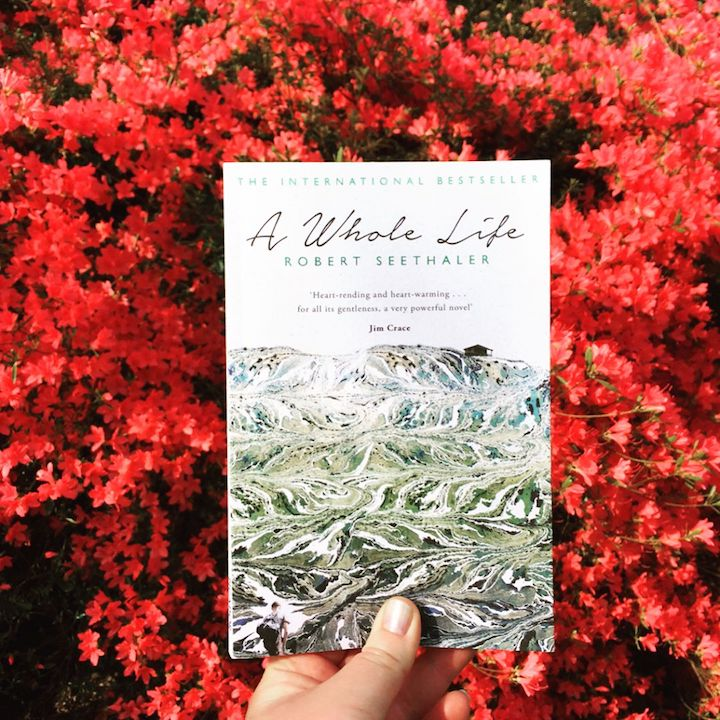
A Whole Life

Flicking through a Saturday edition of The Financial Times recently, I came across one of those Q&As in which someone in the public eye (I’ve forgotten who) is asked about their interests, habits, recommendations, and so on. The interviewee, when asked about the best book they had read in the past year, spoke effusively about Robert Seethaler’s novella, A Whole Life. I had never heard of the writer or the book and was surprised to learn that the book had been shortlisted for the Man Booker International Prize. My only surprise after reading it is that it didn’t win.

In 150 pages of spare, elegant prose, Seethaler tells the story of Andreas Egger, a man who spends almost his entire life in the mountains of Austria. It’s a life of great simplicity marked by hard work, hardship, occasional cruelty, and a lot of solitude. “He had never felt compelled to believe in God, and he wasn’t afraid of death. He couldn’t remember where he had come from, and ultimately he didn’t know where he would go. But he could look back without regret on the time in between, his life, with a full-throated laugh and utter amazement.”

A Whole Life is, quite simply, a wonderful work of art. What it does with great stealth and skill, in spare, soft-spoken prose of real elegance and power, is capture a simple life, and to encourage those who read it, without sermonizing, to make the best of their lives however those lives turn out. Unmissable, A Whole Life is close to perfection.

The Optimists

Like most people with large book collections and limited shelving space, from time to time I fill a few bags with the unwanted and unloved and make a trip to the local thrift store. While doing so recently, I came across The Optimists by Andrew Miller. Miller is one of my favorite novelists, so it was a little bit of a shock (and a pleasant surprise) to discover an unread book by him in one of my bookcases. The novel was published twenty years ago. That makes it one of his earliest novels, but also one released after he had received some critical acclaim (for Oxygen).

In my experience anything by Miller is worth reading, but The Optimists is the least persuasive and satisfying of those I read previously. The plot is engaging enough, focusing on Clem Glass, a celebrated war photographer adjusting to life at home following an assignment in Africa in which he had witnessed and recorded unimaginable horrors. It’s also an ambitious book, exploring recovery from trauma, the role and value of artists in the face of wickedness, and the tricky relationship between images and truth. The ambition isn’t part of the failure of this novel. It’s the transparency of the ambition and the obviousness of Miller’s plan that undermines what he wanted to achieve. It’s all just a little too evident and too neatly packaged, and the lack of subtlety became distracting and grating. Also, the imaginative effort required to get into the mind and experience of a war photographer exposed to atrocities is just too much for Miller. It felt forced and ultimately unconvincing.

So, not one of Andrew Miller’s most satisfying or successful novels, but a thoughtful and thought-provoking read nevertheless.

Let me go mad in my own way

Claire teaches literature at a university in the west of Ireland. She has left her life in London and, after the deaths of her parents and the end of her relationship to Tom, has moved back to where she grew up. Whatever she’s escaping from or whatever she’s hoping to find, it’s all put in jeopardy when Tom moves into a friend’s cottage nearby ….

I bought my copy of Elaine Feeney’s latest novel on the strength of an earlier one I had read and enjoyed (How to Build a Boat) which had been longlisted for the Booker Prize. I had high hopes but turned the final page with a little disappointment.

There is some exceptional writing in the novel. The Christmas meal hosted by Claire for her friends and family, the childhood flashback when a horse is injured, and especially the harrowing visit of the Black and Tans are rendered so vividly and persuasively. The problem is with the whole, not individual parts. At no point did I care much or at all about Claire’s emotional attachment to Tom or the anguish and joy it provoked. Without that, what was supposed to be the heart of the story didn’t move or engage me at all and I was left occasionally admiring but never immersed.

All the Beauty in the World

I rarely notice museum guards. When I do, I find myself pitying them. The job looks exhausting and boring in equal measure. Being surrounded by priceless treasures cannot be much compensation in the circumstances. Patrick Bringley’s delightful account of working for ten years at The Metropolitan Museum did little to change my outlook, at least as far as that particular job is concerned.

All the Beauty in the World tells his story. Leaving behind an enviable position at The New Yorker magazine, Bringley, devastated by the illness and death of his much loved older brother, sought (and found) refuge and consolation amid the beauties and wonders of The Met’s collections. In his decade as a guard, Bringley learned a lot about art and history, but much more about himself and the life he wanted to live. It’s no exaggeration to say art saved his life. It taught him how to look and to live. Whether one believes there is a “purpose” to art or not, surely no one who loves looking at pictures and sculptures denies their power to heal, console, educate and transform. The book is a deeply felt account of his journey, and along the way it gives us a fond and funny insider’s account of that extraordinary institution and some of the people who protect its treasures and educate its visitors. I recommend it highly.

Ripley’s Game

In need of some vacation reading, I dropped by a local bookstore in Sorrento with a couple of shelves of English-language novels and found Patricia Highsmith’s Ripley’s Game. That seemed like a perfect choice because the film and TV adaptions of The Talented Mr. Ripley had been shot, at least in part, along the beautiful Amalfi coast. And so it proved. Ripley’s Game is a tightly plotted and psychologically convincing novel, written by a master of the genre when she was at the height of her powers. Highsmith’s preoccupation is a simple and important one. If the circumstances are propitious, can a conventional, respectable person be convinced to commit an evil act? What does it take to tip a good man into murder?

I have read more plausible stories, but I enjoyed every page of my first Ripley novel and am now looking forward to the others.

Twelve Post-War Tales

Graham Swift has for me been the most consistently satisfying storyteller from that generation of British writers that began to publish in the early 1980s. Some of his peers have been more prolific (Ian McEwan and Salman Rushdie), and others have won greater acclaim (Kazuo Ishiguro and Julian Barnes), but Swift is the one whose books I look forward to most and have been the most dependably rewarding.

Twelve Post-War Tales is, I think, only his third collection of short stories in a writing career that began in 1980. Many of the stories feature, directly or indirectly, a moment or incident of great crisis for the world. A retired doctor volunteers his time to help out at his local hospital during the COVID pandemic. The attacks of September 11th upend the plans of a family due to return to America after a diplomatic posting to London comes to an end. Pearl Harbor, the assassination of JFK, the burning of Crystal Palace, and the Blitz; incidents of global or national importance become the lens through which a small, individual life is examined for signs of impact and trauma.

The writing here is masterful, as anyone who knows Swift would expect, and there’s something arresting and truthful in every story. Having said that, it’s an uneven collection, and one or two of the tales miss the intended marks. A small quibble. This is a wonderful book by a master of the short story art.

Intermezzo

I finally got around to reading a novel by Sally Rooney. There is no obvious explanation of why it took me so long. Huge sales, well received TV adaptations, and all the critical plaudits a young novelist could hope to attract turned Rooney into a literary sensation quite some time ago. I caught up with everyone else just recently and completed her most recent book, Intermezzo. It’s very good.

Intermezzo tells the tale of two very different brothers. Peter, the eldest, is a successful lawyer in Dublin. Socially fluent, accomplished, and intellectual, he’s a conventional success story, at least on the surface. Closer inspection reveals the flaws. The insecurities, the grief following his father’s recent death, and the inability to settle, are masked by drug taking, but he’s not fooling anyone. Ivan, ten years younger, is a competitive chess player, once expected to get to the very top, but now plagued by doubts. He’s socially inept, shy, and nerdy. Each is offered the prospect of salvation through the love of good women (two good women in Peter’s case).

Not much happens by way of a plot. The brilliance of this novel lies in the exposure of Peter’s and Ivan’s interior lives and their troubled relationship. I can’t remember when I was last so impressed by a novelist’s skill at dialogue, or by the uncovering of those interior monologues we all deploy to make sense of our own and others’ experience. It’s all so utterly convincing. The climax of the novel is deeply impressive – truthful and authentic. Strange to say, but I now feel slightly reluctant to read Rooney’s earlier books in case they are not as good as Intermezzo.

Munichs

Only a small proportion of Manchester United’s fans around the world gets to visit Old Trafford. For those that do, the trip to the Theatre of Dreams has the character of a pilgrimage. The statue of Best, Charlton, and Law might top the list of sights to see, or a seat in the Stretford End, but for many it’s the Munich clock, that painfully poignant memorial to the terrible day in 1958 when eight of the first team died as their plane crashed on take-off from Munich airport. David Peace’s book, Munichs, tells the story of that tragic day and its aftermath. It is, quite simply, a masterpiece.

Although the tragedy happened less than seventy years ago and is remembered vividly by older United fans, Munich has become part of the mythology of the club. And, as is so often the case with myths, the real story of what happened that snowy day in 1958 is known to many only in outline. The death of the precociously talented Duncan Edwards or the remarkable recovery of the manager, Matt Busby, for example. But Munich was about much more. The journalists who died that day, the relatives of those who perished, the guilt of those who survived, the grief of hundreds of thousands of supporters who lined the streets for the funerals, and the shock of a nation – all this and more is captured brilliantly and unforgettably by David Peace.

Munichs is not a history book. It’s a novel, but one obviously informed by a deep engagement with contemporary sources. Its brilliance in part is due to its evocation of a world that feels long past. A world in which football was a working class sport, one with deep roots in local communities and one where the passion to play and win had nothing to do with money. David Peace tells the story with the imagination, empathy, and compassion of a fine novelist, portraying the grief, courage, and resilience of those who survived and those who lost loved ones. Only ten years after the tragedy, Manchester United went on to win the 1968 European Cup. I remember that game very clearly, but had no idea as I watched the post-match celebrations on television that Bobby Charlton, Bill Foulkes, and Matt Busby had been pulled from the burning wreckage only a decade earlier. Munichs should be read by anyone who loves football, but it will have special meaning for those who follow United.

Our Evenings

Critics love Alan Hollinghurst’s work. They receive every new novel with rapturous reviews. They applaud the elegance of his prose, the emotional precision of his observations, the brilliance of his characterizations, and celebrate him as the great chronicler of gay lives and experience in recent decades. His most recent novel, Our Evenings, has been greeted in very much the same vein, with some critics saying it is his best yet.

We meet Dave Win at the beginning of the novel looking back on his early life from the vantage point of middle age. With an English mother and an absent Burmese father, Dave’s dark skin makes him a target at a rural boarding school in postwar England. Dave is a scholarship boy of very limited means (his mother is a seamstress), and the beneficiary of a rich patron’s generosity. His school friends are well aware of his precocious intelligence and his relative poverty, and his status as the outsider looking on from the sidelines is confirmed as he moves to Oxford. He excels there as a student actor and, after university, drifts into acting jobs in television and theatre.

I felt peculiarly detached from Our Evenings. It was easy to admire Hollinghurst’s style, but little here really engaged me, other than perhaps the touching portrayal of Dave’s love for his mother. I think that may be because so much of the ground felt well trodden by novelists of the past. The man, defined as an outsider by his race, skin color, social class, and sexuality, looking into, but never fully joining, the lives of his “betters” is a theme that many others have felt drawn to, and it takes some special ingredient to elevate it to somewhere that feels new and special. I could not detect or experience that ingredient and I closed the book at the end with a feeling of admiration but no real sense of immersion.

Heart, be at peace

Novelists who choose to narrate a story using multiple voices set themselves a very difficult challenge. Making a handful of characters sound distinctive and recognizable is tricky enough, but deploying a chorus of twenty-one voices to tell a story pushes the skills of the writer, and the tolerance of the reader, to the absolute limit. Donal Ryan is clearly a very accomplished writer (some earlier work won prizes), but on the evidence of Heart, be at peace, he just bit off more than he could chew.

I didn’t feel this way in the early stages of the novel. In some of the initial chapters, the voices seemed distinct and some of them struck powerful and poignant notes, but as the novel progressed it all melded confusingly into something of an amorphous blob, a soup where few of the ingredients could be identified reliably from the others.

The Ireland portrayed by Ryan here is a gritty and edgy place. There is little sense of ease. People are troubled and their emotions frayed, trying to make their way or just survive. Relationships are similarly uneasy. There is betrayal, jealousy, disappointment, and very little that’s simply loving and kind. My hunch is that Ryan has powerful stories to tell but has chosen the wrong way to tell them. This is a book where the whole is less than the sum of the parts.