Life in Progress

Hans Ulrich Obrist is a celebrated curator and gallery director. He is currently Artistic Director of the Serpentine Galleries in London. His professional success, at least on the basis of this autobiography, seems to owe as much to determination, drive, hard work, and imagination as it does to any formal training in art history or curation. All very commendable, not least because I imagine the world in which he operates is very competitive.

His professional life has been an interesting one so far (he is only 57), filled with encounters with many of the world’s greatest artists. He has thought deeply about exhibition making and the role of curators in the artistic process. Life in Progress is the story of those experiences and thoughts. Unfortunately, Obrist is no writer. The prose here is flat and lifeless, and the effect of that is occasionally to render a life filled with achievement and insight as something bland and trite. Surely he could, like many others, have found a ghost writer or collaborator. It would have been a far better book if he had.

Les Tres Riches Heures

Some experiences really are once-in-a-lifetime experiences. About a year ago it was announced that in mid-2025 one of the rarest and most exquisite medieval manuscripts would go on display to the public. Les Tres Riches Heures du Duc de Berry is an illuminated book of hours (a book of prayers intended to be read at specific hours of the day) first created between 1412 and 1416 for John, Duke of Berry, the brother of King Charles V of France. The manuscript, believed to be the work of the Limbourg brothers, was left unfinished because the brothers died, most likely victims of plague. Further work was done on the manuscript later in the 15th century by Barthelemy d’Eyck and Jean Colombe.

The manuscript is very rarely displayed because of its fragility and has only been seen by the public twice since the end of the 19th century. Even scholars have been denied access since the 1980s and forced to rely on facsimiles. The need to repair its binding gave an opportunity to exhibit some of the unbound pages at the Chateau de Chantilly where it is usually housed, an event so rare that it was described as one of the cultural highlights of the century. Needless to say, art lovers, historians, and bibliophiles have descended on Chantilly in huge numbers since June, but by the time I arrived in mid-September the crowds had subsided and I was able to see the exhibited pages up close.

Twelve pages were on display the day I visited, each one representing a month of the year. It is hard to describe how vivid, rich, and elaborate the illumination is on these pages, as well as the perfection of the calligraphy. It is a credit not just to the artists, but also those charged with the care and conservation of this treasure, that the illustrations look as if they could have been painted yesterday, such is the depth and brilliance of the color.

Some works of art defy categorization. This precious manuscript, a priceless example of medieval art, is one of them. I feel privileged to have seen it.

A Bigger Message

Martin Gayford wrote a book a few years ago about the experience of having his portrait painted by Lucien Freud. Man with a Blue Scarf proved to be not only an insightful, up-close-and-personal look at Freud, but also an engaging account of what it took to be one of his sitters. It’s one of my favorite books. Gayford has now focused his attention on David Hockney, transcribing a series of conversations he had with the prolific artist over more than a decade.

The portrait that emerges from the book is of an inexhaustibly inventive, restless, curious, and thoughtful artist. Now in his late eighties, Hockney has spent some seven decades not just painting and drawing, but thinking deeply about the act of looking. The book is filled with his insights on his own working methods, on other painters (Constable, Fra Angelico, Picasso, Van Gogh and many more), his fascination with new technologies, and the tireless determination to see clearly and record faithfully. It’s not in any sense a conventional biography, but Gayford’s clever and sensitive questioning tells you more about the personality, passions, and compulsions of this extraordinary painter than a traditional account might.

A Bigger Message is a book for Hockney fans for sure, but also for anyone interested in the mind and work of a great artist.

The Aberlemno Stones

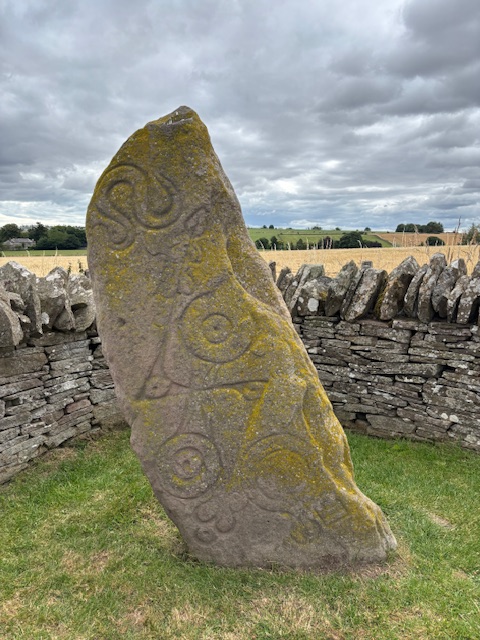
Relatively little is known about the Picts. They lived in what is now northern Scotland between 300 AD and 900 AD before gradually integrating with other tribes and kingdoms. They resisted the expansion of the Romans and earned the reputation of being fearsome warriors. They left behind a significant artistic legacy, and it was specifically their beautifully carved stones that drew me recently to the tiny village of Aberlemno in Angus. Normally one would find four stones in Aberlemno, three by the roadside and one in the churchyard, but a storm recently toppled and damaged Aberlemno 3, causing it to be removed from the site for inspection and repair.

Precise dating of the stones is, of course, difficult, but there seems to be consensus that the earliest could have been carved in the 6th century and that the most recent (Aberlemno 2, the one in the churchyard) is from around 850 AD. Aberlemno 1 is carved with mysterious Pictish symbols, including a serpent, a double disc and what appears to be a comb. It’s a powerful and confidently executed piece of work, but much simpler than Aberlemno 2. The stone in the churchyard feels like two distinct works. One side depicts Pictish symbols and figures in what looks like a battle, while the other side is a Celtic cross with beautiful and elaborate knotwork and keywork designs.

The stones, beautiful works of art though they are, are also extraordinary reminders of a long disappeared civilization. They have stood for all to see for more than 1.200 years, among a community, not hidden in a museum. I hope they are cared for and protected for generations to come because they testify to our persistent and enduring creativity.

Constellation (Diane Arbus)

The critical reputation of an artist can be shaped for a generation by a major retrospective of their work. When large numbers of works are exhibited, a reputation can be enhanced or diminished. In the case of Diane Arbus: Constellation (at the Park Avenue Armory), I fear the overall impact might be a damaging one.

Part of the problem, and this is obviously nothing to do with the artist, is that Constellation is one of the worst staged shows I have ever seen. More than 400 pictures are displayed entirely randomly and largely without captions. Some are hung so high on the wall that only exceptionally tall visitors could see them properly, while others are near the floor. It is, let’s be clear, a complete mess. Arbus deserves better than this amateurish staging.

The photographs themselves are surprisingly uneven. The best ones are brilliant. Unsettling portraits of what Arbus called “freaks” or ordinary people captured on a street or in a park. These are often arresting and disturbing, and reflect Arbus’s genius for capturing with humanity, generosity, and good humor the enormous diversity of life as it’s lived. Children playing in the park, society hostesses in their salons, and performers in the “freak shows” that were still a feature of New York in the 1960s – all are caught in a single moment with tenderness and without judgement. By way of contrast, her few portraits of well-known people (Herbert von Karajan or James Brown, for example), are less successful, though I loved her picture of Marianne Moore with W.H. Auden.

Some of Arbus’s interests are explored here too extensively. There are, for example, dozens of pictures of people wearing masks of various kinds. The effect overall is somehow to emphasize the narrowness of her artistic vision, not its breadth. A wiser curator would have selected fewer pictures. So, in summary, a great talent not well served by the show’s curator, but Constellation is worth seeing.

All the Beauty in the World

I rarely notice museum guards. When I do, I find myself pitying them. The job looks exhausting and boring in equal measure. Being surrounded by priceless treasures cannot be much compensation in the circumstances. Patrick Bringley’s delightful account of working for ten years at The Metropolitan Museum did little to change my outlook, at least as far as that particular job is concerned.

All the Beauty in the World tells his story. Leaving behind an enviable position at The New Yorker magazine, Bringley, devastated by the illness and death of his much loved older brother, sought (and found) refuge and consolation amid the beauties and wonders of The Met’s collections. In his decade as a guard, Bringley learned a lot about art and history, but much more about himself and the life he wanted to live. It’s no exaggeration to say art saved his life. It taught him how to look and to live. Whether one believes there is a “purpose” to art or not, surely no one who loves looking at pictures and sculptures denies their power to heal, console, educate and transform. The book is a deeply felt account of his journey, and along the way it gives us a fond and funny insider’s account of that extraordinary institution and some of the people who protect its treasures and educate its visitors. I recommend it highly.

Siena: the Rise of Painting 1300-1350

Critics lucky enough to get a sneak preview last year of Siena: the rise of painting 1300-1350 hailed it as the must-see exhibition of the season. They weren’t wrong, but they were guilty of understatement. The show is a once-in-a-lifetime masterpiece. It transfers from The Metropolitan Museum in New York to The National Gallery in London at the end of January. Anyone who loves painting and who missed it in Manhattan might, if circumstances permit, want to consider booking a flight and an entrance ticket now. It is sure to sell out, and rightly so.

The exhibition featured a range of objects, including sculpture, textiles, manuscripts and liturgical artifacts, but it is the paintings that steal the show. Paintings of sublime and timeless beauty, paintings of extraordinary sophistication that anticipate what was to come in the Renaissance. The focus is on Martini, the Lorenzetti brothers, and especially on the brilliant Duccio di Buoninsegna, whose Maesta altarpiece is the star exhibit. Many of the individual paintings that originally made up the Maesta were dispersed over the centuries, and what makes this a unique exhibition is seeing many of them brought together again. It is no exaggeration to say this may never happen again once the show ends in London.

The show is also a triumph of exhibition design and the Met’s staff deserve congratulations for finding such creative ways to see these precious and fragile masterpieces up close and in some cases from 360 degrees. The designers in London have a high bar to reach!

Francis Bacon: Human Presence

Is it appropriate to measure the greatness of a painter by the range of human feeling they elicit in the viewer or display on the canvas? Perhaps narrow and deep should be sufficient, picking at one feature of human existence over and over again, worrying relentlessly at a scab to burrow deeper to discover and uncover the real wound beneath the surface. The thought occurred to me walking around The National Portrait Gallery’s outstanding exhibition of Francis Bacon’s portraits, Francis Bacon: Human Presence.

Bacon understood despair and the awareness of futility. He knew something about the longing to accept and impose cruelty. Suffering, isolation, and pain are never far from the canvas. He detected such things in the artists and paintings he admired, in Velazquez, Picasso, and Van Gogh. He discovered over time his own language in paint to express such things. His greatness lies in that language. His reputation is growing all the time, eight decades after he made his first impact on the world, and his work reverberates even more powerfully now when so many experience the world as a threatening, ominous, and lonely place.

Where is the affection, tenderness, and love in Bacon’s world and work? An exhibition devoted to his portraits might reasonably be expected to be a useful starting point, perhaps in paintings of his friends (including Lucian Freud and Frank Auerbach) or lovers (Peter Lacy, George Dyer, and John Edwards). But Bacon’s grim inspection of the skull beneath the skin is abundant even here and the portraits are full of snarling, grimacing, and screaming faces, many of them distorted by injury and pain. Only in some of the later paintings, especially one of John Edwards, is some tenderness detectable. Did Bacon soften slightly in old age?

This was one of the most impressive and compelling exhibitions I have seen in recent years. An opportunity to see some really important pictures rarely on display (notably the double portrait of Freud and Auerbach which I had only see before in reproductions), and confirmation, if confirmation is needed, of what a great (and grim) artist Bacon was.

Cork City Musings

Even Cork’s greatest admirer would struggle to say the city is a pretty one. The dominant theme is one of grayness. Gray buildings under skies that are often that particular gray that signals rain. It can all seem a little grim at times in the city center, somewhat neglected and shabby. But whatever it might lack in prettiness, Cork has character, charm, and energy in abundance.

For decades the city has been little more than the beginning of my frequent trips further west, but recently I had the opportunity to spend a couple of days there, and I enjoyed it very much. The food scene is vibrant (highlights included Goldie and Nano Nagle Cafe), and there is, of course, no shortage of historic pubs. Sin E for traditional music, The Oval, Mutton Lane, and Arthur Maynes for unique atmosphere and craic in general. The Crawford Art Gallery is an unmissable spot and I was delighted to visit before it closes for major restoration work. Tempting as it might be to skip the city en route to the glories and splendors of West Cork, that would be a mistake. Linger a little and let it work its magic.