The Western Wind

The Western Wind is a novel set in a small and isolated English village at the end of the 15th century. Its narrator is the local priest, John Reve. John’s parish, Oakham, is a farming community, mostly poor, mostly hardworking, and mostly god-fearing. As the story opens, its wealthiest and worldliest member, Tom Newman, is missing, feared drowned in the treacherous local river after unprecedented storms and floods. His torn shirt has been found, nothing more, and the villagers are distressed and fearful. The local dean, representing ecclesiastical and temporal power, has arrived to investigate, making things uncomfortable for Fr. Reve.

My summary makes the novel sound like a medieval mystery story. To some extent it is, but there’s so much more to The Western Wind. It’s a beautifully written and thoughtful tale about faith, superstition, and power, and about how and where we find meaning in life. It’s a novel that never strives to be explicitly historical, but is filled with authentic detail of life in a medieval English village. It plays with time, telling the story in reverse, and this helps make medieval Oakham shockingly modern. It’s best read slowly and carefully, with every sentence savored.

Autocracy, Inc.

The emergence of autocratic regimes has been one of the defining features of the global political landscape in recent years. Russia, China, Venezuela, Zimbabwe, North Korea, Belarus. The list goes on and on. In Autocracy, Inc. Anne Applebaum gives a short but compelling account of the phenomenon, focusing less on why these anti-democratic leaders have prospered and more on how they operate. It’s a necessary and urgent read, written with passion, intelligence, and deep experience. Anyone troubled by and curious about what is happening ought to read it. For me the most eye-opening part of her account was the interconnectedness of the autocracies, the sense that they operate very effectively as an international system, a supportive network that offers an alternative world order. It’s a network that relies heavily on the willingness of the international finance community to hide and launder the autocrats’ ill gotten money and on a global diaspora of friends and fellow travelers to sustain it.

I would have liked the author to emphasize more strongly how the autocrats have studied the playbook of Western democracies when it comes to propaganda techniques and other ways of controlling their messaging. The anti-democratic regimes have built upon techniques devised and deployed over many decades by Western democracies to spread their own ideology. Autocracy flourishes for many reasons, not least because the financial systems based in liberal democracies enable it and because it has learned how to use and extend some of its tools to great effect.

Coriolanus

I have seen several remarkable performances of Coriolanus. Two stand out in my memory. Ian McKellen took on the role at The National Theatre in 1984. I remember it as a blood-soaked staging, and the picture below seems to confirm that.

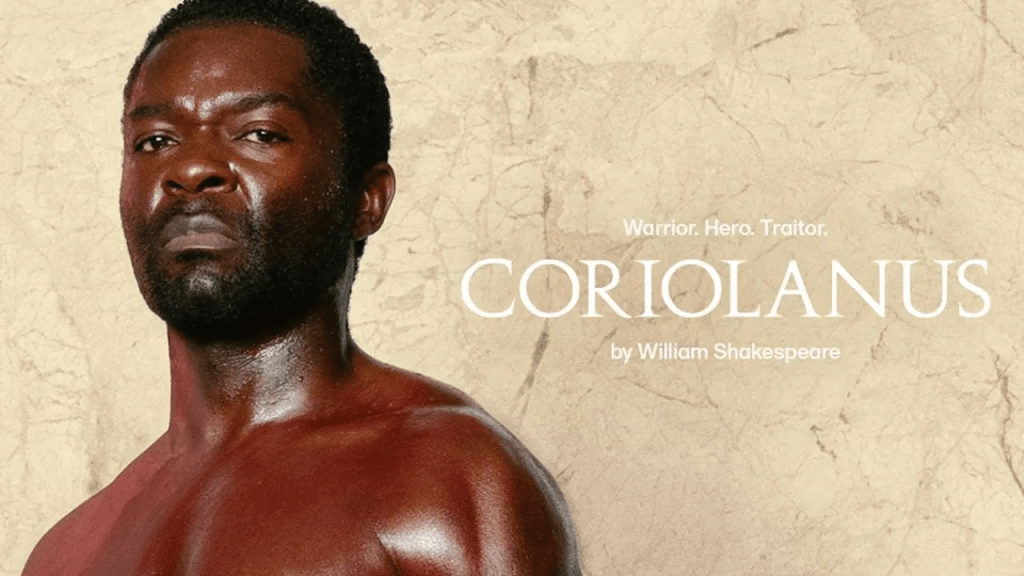
More than fifteen years later, I saw Ralph Fiennes play the part of the arrogant Roman in a darker, more psychologically intense staging at (I think) the Gainsborough Studios in London. It has always been one of my favorite Shakespeare plays, so I was excited to head back to The National Theatre recently to see how David Oyelowo would interpret the role. The production was still in preview, so the cast was still working out the kinks. (Oyelowo forgot his lines at one point, but recovered after a nerve-racking moment). Overall, it struck me as a cinematic, polished, and slightly flashy staging. It felt a little muddled in design terms. Generals brief their battlefield commanders via cell phones and video calls while soldiers fight with swords and shields. The action moves from sleek, expensive, hotel-style interiors to unadorned public spaces staged like a museum. Performances were generally very strong.

Coriolanus is very much a play for our times. Politicians inflated with hubris and boastfulness, pretending to care for the people when it suits, but otherwise deeply contemptuous of them, and fickle, easily. manipulated electors. Does any of that sound familiar or urgently relevant to our times?

Henry Moore: Shadows on the Wall

Henry Moore first attracted significant public attention during the Second World War when the drawings he made of Londoners sheltering from the Blitz in tube stations were first published. Although Moore’s reputation today rests mainly on his monumental sculptures, those intimate drawings of men, women, and children taking refuge in such claustrophobic conditions remain powerful and affecting. The Courtauld in London has displayed some of this work in a small exhibition called Shadows on the Wall.

The premise of the exhibition is Moore’s fascination with those confining walls, ceilings, and tunnels – architectural elements that he explored further in his well-known drawings of the Yorkshire coal mines and that were far more than simple backdrops for the human figures he represented. It’s an interesting idea. Looking closely at the drawings, the fusion of the human and the architectural becomes more pronounced.

The engrossing exhibition in London ends soon, but a catalog authored by Penelope Curtis and others is available.

Cork City Musings

Even Cork’s greatest admirer would struggle to say the city is a pretty one. The dominant theme is one of grayness. Gray buildings under skies that are often that particular gray that signals rain. It can all seem a little grim at times in the city center, somewhat neglected and shabby. But whatever it might lack in prettiness, Cork has character, charm, and energy in abundance.

For decades the city has been little more than the beginning of my frequent trips further west, but recently I had the opportunity to spend a couple of days there, and I enjoyed it very much. The food scene is vibrant (highlights included Goldie and Nano Nagle Cafe), and there is, of course, no shortage of historic pubs. Sin E for traditional music, The Oval, Mutton Lane, and Arthur Maynes for unique atmosphere and craic in general. The Crawford Art Gallery is an unmissable spot and I was delighted to visit before it closes for major restoration work. Tempting as it might be to skip the city en route to the glories and splendors of West Cork, that would be a mistake. Linger a little and let it work its magic.

On This Holy Island

Oliver Smith had long dreamed about completing the camino, the ancient pilgrims’ walk to Santiago de Compostela. The pandemic put the realization of that particular longing on hold. He started to think about focusing his interest in pilgrimage in a different way, reflecting instead on the pathways and destinations, ancient and modern, to be found closer to home, and planning an adventure across the sacred landscape of his native Britain. On This Holy Island is the result.

Some of the places that featured in his journey are familiar to almost every Briton. Stonehenge, Glastonbury, Avebury, Lindisfarne, and the White Horse at Uffington – these are places we learn about at school (even if we never get to visit them or understand their significance). But the history of pilgrimage in Britain encompasses a much broader topography, physical, emotional, and spiritual.

Smith writes with a self-deprecating charm and a light touch. This isn’t some dry, heavy thesis about the nature and meaning of pilgrimage. It’s a fact-filled, anecdote-filled travelogue, a book of encounters and conversations as much as wanderings and destinations.