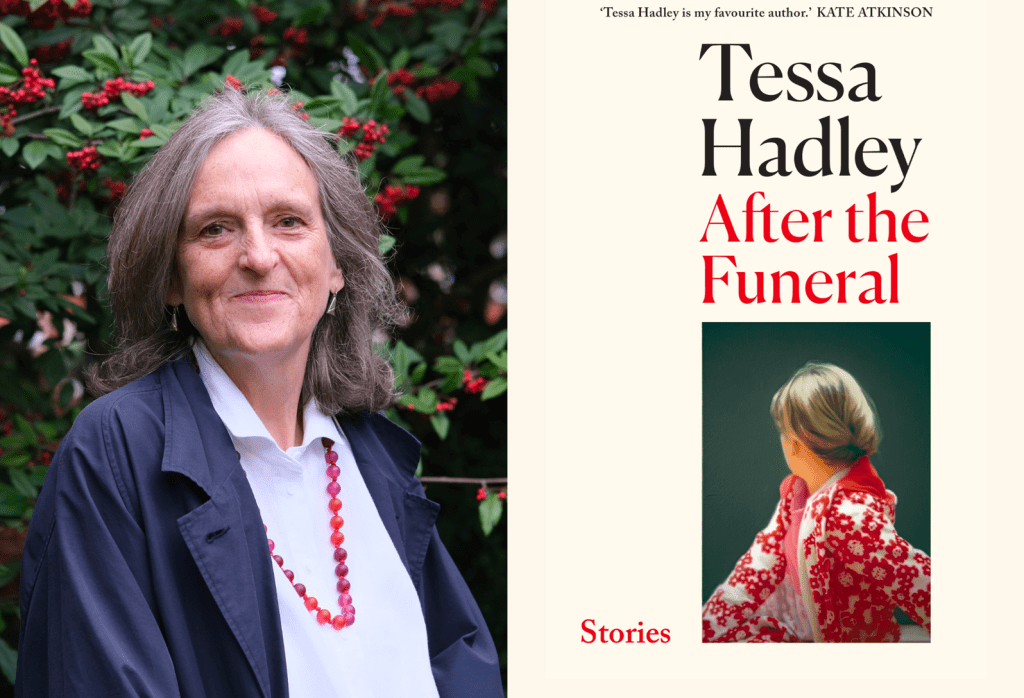
I have read many of Tessa Hadley’s novels and enjoyed all of them. She is, I think, one of the most accomplished novelists working today and is certainly one whose new work I buy as soon as it’s published. Having bought After the Funeral as a birthday gift for a friend, I was curious to see how I would respond to a collection of Hadley’s short stories, so when I spotted a signed edition when I was killing time at Daunt’s bookshop in Cheapside, it felt like the right moment to find out.
The short story is such a demanding and unforgiving genre. In the hands of the very best practitioners (William Trevor is my favorite example), a short story can capture perfectly a whole world or a whole person in the span of a few pages. Done well, there’s nothing quite like the experience of reading a great story.
Many of the stories in After the Funeral catch people, and especially women, in those moments of particularly intense emotion. Funerals and weddings, of course, but also those extended rites of passage like the death of a parent; all of these feature. It’s a superb collection of stories, but that’s hardly surprising coming from someone so in command of her craft.
I scarcely noticed a feature in The Financial Times earlier this year encouraging readers to visit the latest “hot” destination, the small island of Porquerolles. Yet only a few months later there I was after a short ferry ride from Hyeres. For most visitors, Porquerolle’s beaches are the top attraction. After disembarking, they head to the bike rental places along from the ferry terminal and on to one of the many beautiful stretches of sand.
My plan was different. I was there to see Villa Carmignac, a gallery dedicated to contemporary art and housed in a striking building just a short walk from the small downtown area. It’s the brainchild of Edouard Carmignac and was set up in 2000 to house a collection of some 300 works of art. Figures like Lichtenstein, Richter, and Warhol feature, but also a large number of less well known artists. It’s well worth a visit, not least to see the beautiful building itself with its cool, white space and aquatic ceiling.
Whether you’re interested in swimming, sunbathing, or immersing yourself in modern art, Porquerolles makes for a wonderful day trip, especially in September when the summer crowds have left.
The Gilbert & George Centre opened in April this year, a few steps from the artists’ home in Fournier Street. Its inaugural exhibition, The Paradisical Pictures, is an interesting one. The pictures, intensely colored like all their recent work, feature Gilbert and George, staring out from behind and sometimes partly concealed by rotting vegetation and flowers. Their eyes are reddened, perhaps by fatigue, grief, or demonic power. Are these sinister images of decay and death some kind of exhortation to reverse the damage we are all inflicting on the world? Like almost all their work, the surface playfulness, the cheerful vividness of the colors, and the omnipresence of the artists themselves, are counterpoints to the deep seriousness of the exhibition’s message. The Centre itself consolidates the presence of Gilbert and George in Spitalfields, giving them a permanent place to display their work in a neighborhood they have called home since 1968.
From East London I headed to Trafalgar Square, the heart of London’s traditional art establishment, and The National Portrait Gallery. The NPG reopened in June after being closed for three years. Among other things, the collection was re-hung during the closure, and I was interested to see the results. That wasn’t as easy as I had hoped because half of London had the same idea. The galleries were very crowded – a good thing, of course – so I restricted my trip to some of the rooms on the second floor and to a wonderful small exhibition dedicated to the sketchbooks of Lucian Freud. I’ll certainly be going back, but next time I’ll choose the time more wisely.
Ordovas, a leading commercial gallery, has its premises in Savile Row, a few minutes’ walk from the NPG. I try to make a visit whenever I’m in London because its exhibitions, though small, are always curated with real care and always seem to include treasures I’ve never seen. My most recent visit was no exception. Entitled Endless Variations, it features only eight works, four by Francis Bacon and four by Andy Warhol. It claims to “explore common interests and influences shared by the artists”. I am not convinced, but what matters is the opportunity to see up close three masterworks by Bacon, Portrait of Henrietta Moraes (1969), Study for Portrait of John Edwards (1984), and Three Studies for Portrait of George Dyer (1964). All are magnificent, confirming, if confirmation were needed, that Bacon was one the greatest painters of the late 20th century. Warhol may be the better known of the two, but his work looks trivial and vacuous in this setting.
At some time around 1157, a group of Cistercian monks abandoned a property they had occupied near Tourtour and moved to Le Thoronet, a site more fertile and better suited to their system of agriculture. No one can be sure when they completed work on the monastery, but it’s likely to have been at the very beginning of the 13th century. The monks remained there until the abbey was deconsecrated in 1785. Many of the buildings were acquired by the French government in 1854 and Le Thoronet was one of the first sites to be added to the list of national monuments.
Unlike many ancient abbeys, Le Thoronet was largely built in one, uninterrupted period, and it’s this fact that gives the site such architectural integrity and purity. Much of it is beautifully preserved, especially the church and cloisters. Visit outside the summer months and you’ll experience the deep tranquility and splendor of this magnificent place without the crowds. Time on this occasion didn’t allow me to get to Le Thoronet’s sister abbeys in Provence, Senanque and Silvacane, but I’m already hatching a plan for a future visit.
Jamie O’Neill is not a typical teenager. He likes the rain and the works of Edgar Allan Poe. He likes to watch videos of lectures delivered by famous mathematicians, and knows the exact number of steps between his house and his school. He’s more than a little pre-occupied by the idea of building a perpetual motion machine because, for reasons only clear to Jamie, he thinks it will allow him to go back in time and meet his mother, who died shortly after giving birth to him. Unsurprisingly, Jamie doesn’t fit in at school. Classmates bully him. The headteacher has no time for misfits and outliers like Jamie, preferring boys with more conventional ambitions and more predictable behaviors.
Fortunately for Jamie, he has a loving father and grandmother, and he attracts the attention of two caring teachers, both of whom have complex lives and pasts of their own. One of them is Tadhg Foley, a woodwork teacher, who encourages Jamie to help him build a currach, a traditional Irish boat.
Elaine Feeney’s second novel could easily have ended up as sentimental and cloying. It doesn’t, largely because she portrays so compassionately how difficult it is to be Jamie. Nevertheless, she isn’t able to avoid entirely the traps she builds for herself. Much of the story’s setup is predictable, and not all the characters come alive from the page. Not everyone fits neatly into the slots the world makes for them, and many need care and affection to find their way. Parenting, and especially the consequences of its absence, is Feeney’s theme and it’s one she studies with a compassionate eye.
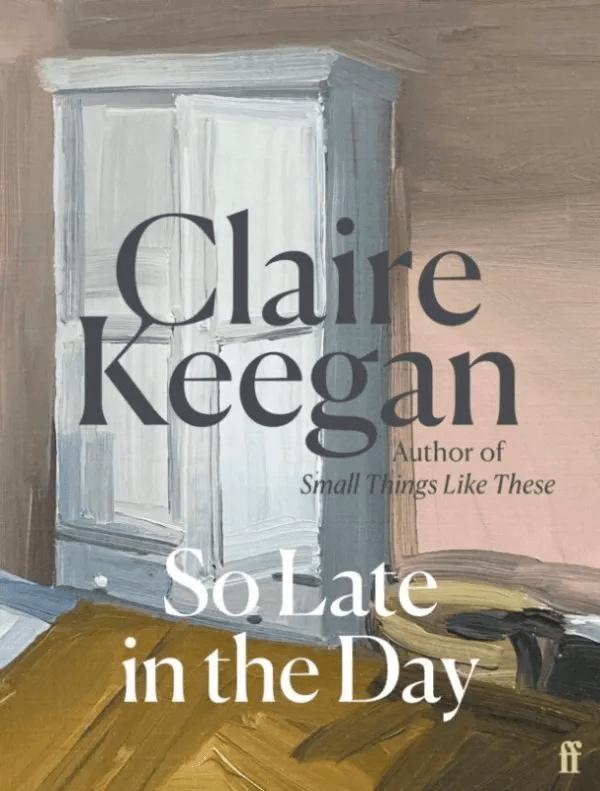
It tells us, I suppose, how hot a property Claire Keegan is these days that her UK publisher, Faber & Faber, is able to package and publish one of her short stories as a hardback book for £8.99. Commercial opportunism for sure, but it’s hard to complain when the story is as exquisite as So Late in the Day.
Not a single word is wasted in this poignant tale. Cathal faces an evening alone and time to reflect on what he might have had with Sabine if only he had been more generous. So much pain, bitterness, and loss is compressed into a few pages, reminding readers yet again what mastery Claire Keegan has over the short story. Her work recalls that of William Trevor, and for me there’s no higher praise than that.



 Miscellaneous Musings