
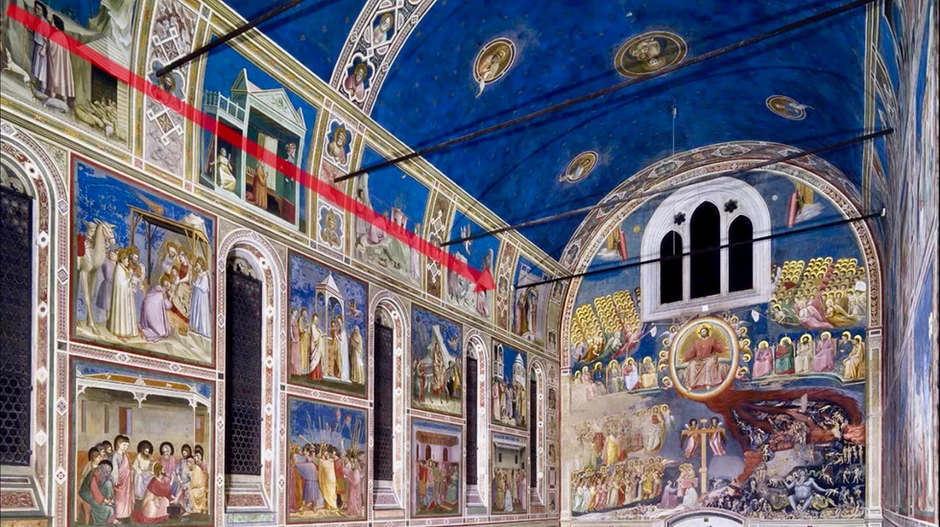
I wonder what Enrico Scrovegni was expecting when he commissioned Giotto to paint frescoes in his chapel at the very beginning of the 14th century. Perhaps some high-minded decoration to impress his friends and competitors. After all, Padua at that time was an intensely political place and Scrovegni was something of an operator in local society. Maybe his motives were more pure and he was looking for something quite traditional to help him focus on the divine mysteries as he prayed with his family. Whatever his expectations and motivations were, surely he cannot have predicted the wonders that Giotto would produce, one of the greatest masterpieces in Western art and work that revolutionized the language of painting.
My short visit to Padua (Padova) was not long in the planning. In fact, it was little more than an impromptu stop-off on my way from Lake Garda to Venice. Pulling off the highway, I looked for a parking spot with no plan other than to spend the afternoon strolling around what I had heard was a lovely, small city. Perhaps a quick visit to the Basilica, the Church of the Eremitani, and the ancient university? I had read previously that unplanned, same day visits to The Scrovegni Chapel were impossible. What I didn’t know was that visitors in the off-season were far fewer than in the summer, and that all I needed to do was go to the ticket office to secure my timed admission later that day.
The frescoes are fragile and are vulnerable to environmental pollution, so access to the Chapel is managed very strictly. Entry is achieved through a temperature controlled anteroom and only small groups are permitted. Once visitors are inside, the Chapel doors are closed to minimize pollutants and stabilize the immediate environment. The visit is timed and quite short, so there is no opportunity to study Giotto’s masterpiece in any real depth. None of that should deter visitors. The constraints and controls are necessary, and it is a privilege to spend any time, however short, surrounded by these treasures.
It is not easy to find the words to describe how wonderful these frescoes are, or their impact, but since returning I find myself thinking about them every day. Craning my neck that day to look at the sequence of images, it was difficult to focus, such is the richness and scale of the work as a whole. The vividness of the color is remarkable in a work more than 700 years old, not to mention the sense of animation in some of the figures depicted. What Giotto achieved here in the confines of a small family chapel is nothing less than one of the greatest artworks of Western civilization.
If you visit, I recommend getting Giuliano Pisani’s guide to the chapel. It deepened my appreciation of it. And don’t miss the Eremitani church next door.

 Miscellaneous Musings