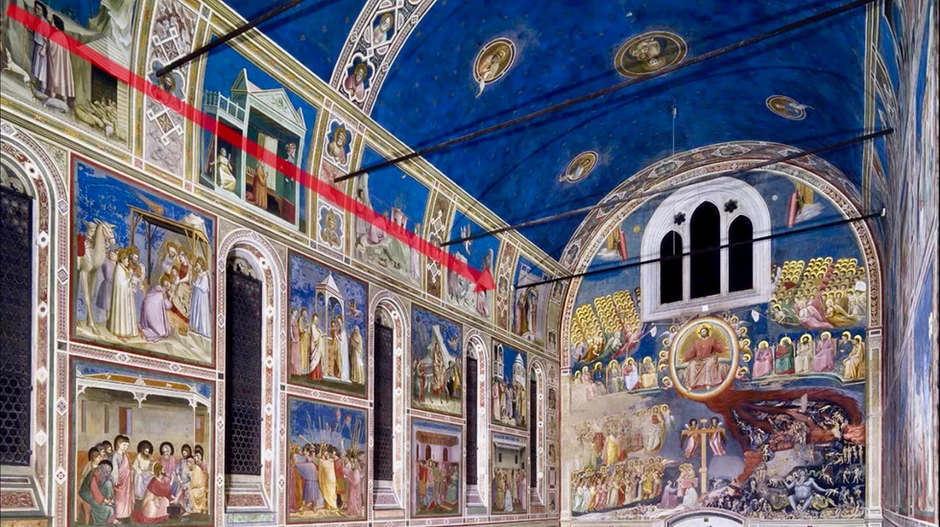
The Scrovegni Chapel

I wonder what Enrico Scrovegni was expecting when he commissioned Giotto to paint frescoes in his chapel at the very beginning of the 14th century. Perhaps some high-minded decoration to impress his friends and competitors. After all, Padua at that time was an intensely political place and Scrovegni was something of an operator in local society. Maybe his motives were more pure and he was looking for something quite traditional to help him focus on the divine mysteries as he prayed with his family. Whatever his expectations and motivations were, surely he cannot have predicted the wonders that Giotto would produce, one of the greatest masterpieces in Western art and work that revolutionized the language of painting.

My short visit to Padua (Padova) was not long in the planning. In fact, it was little more than an impromptu stop-off on my way from Lake Garda to Venice. Pulling off the highway, I looked for a parking spot with no plan other than to spend the afternoon strolling around what I had heard was a lovely, small city. Perhaps a quick visit to the Basilica, the Church of the Eremitani, and the ancient university? I had read previously that unplanned, same day visits to The Scrovegni Chapel were impossible. What I didn’t know was that visitors in the off-season were far fewer than in the summer, and that all I needed to do was go to the ticket office to secure my timed admission later that day.

The frescoes are fragile and are vulnerable to environmental pollution, so access to the Chapel is managed very strictly. Entry is achieved through a temperature controlled anteroom and only small groups are permitted. Once visitors are inside, the Chapel doors are closed to minimize pollutants and stabilize the immediate environment. The visit is timed and quite short, so there is no opportunity to study Giotto’s masterpiece in any real depth. None of that should deter visitors. The constraints and controls are necessary, and it is a privilege to spend any time, however short, surrounded by these treasures.

It is not easy to find the words to describe how wonderful these frescoes are, or their impact, but since returning I find myself thinking about them every day. Craning my neck that day to look at the sequence of images, it was difficult to focus, such is the richness and scale of the work as a whole. The vividness of the color is remarkable in a work more than 700 years old, not to mention the sense of animation in some of the figures depicted. What Giotto achieved here in the confines of a small family chapel is nothing less than one of the greatest artworks of Western civilization.

If you visit, I recommend getting Giuliano Pisani’s guide to the chapel. It deepened my appreciation of it. And don’t miss the Eremitani church next door.

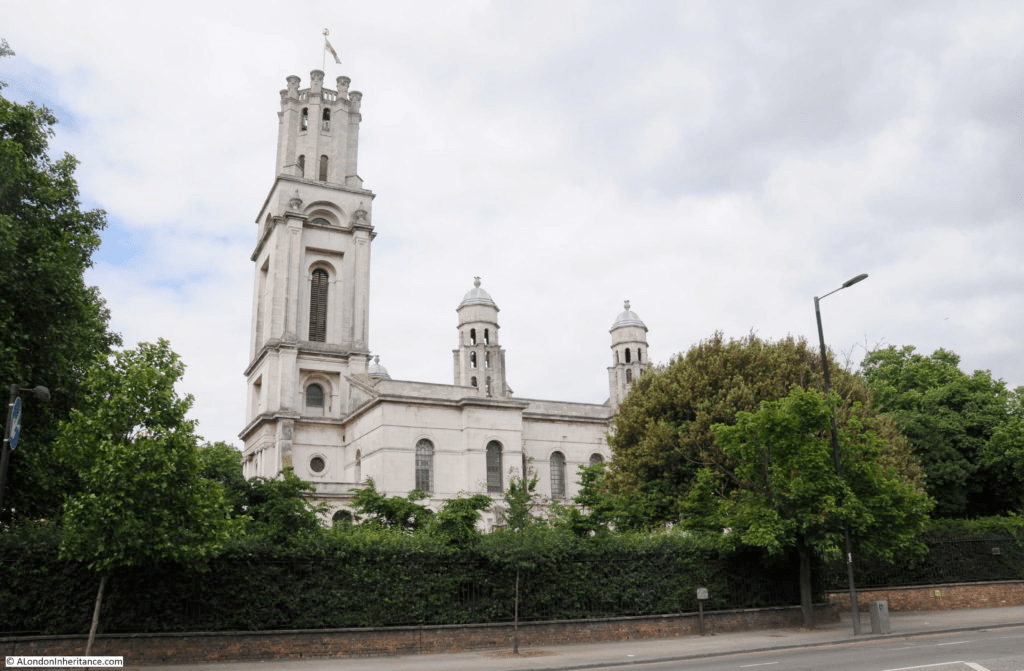
St. George-in-the-East

Continuing my pilgrimage to see all six of Hawksmoor’s churches in London, I walked a little more than a mile from St. Anne’s, Limehouse to St. George-in-the-East. The direct route, which I chose to take, is not the prettiest of walks, and it took me along noisy, traffic congested roads leading into and away from the old City of London. But arriving at the magnificent church, I found it set in a small oasis of calm created by the large, quiet churchyard surrounding it. It was a blustery and overcast day but the gardens east of the church were dotted with daffodils and crocuses signalling the arrival of spring.

The church was built between 1714 and 1729 with its construction funded by the same Act of Parliament in 1711 that gave us St. Anne’s and other Hawksmoor masterpieces. Sadly, the original interior was destroyed by a bomb during the Blitz of May 1941, but the strange and extravagant exterior survived somehow. With its distinctive “pepper pot” towers, St. George-in-the-East continues to stand as one of Hawksmoor’s most imposing and peculiar London churches. Don’t be deterred by the location. It’s a spectacular, unmissable building for anyone who loves the work of Hawksmoor.

Lake Garda

In the middle of March the towns on the shores of Lake Garda start to emerge from their winter hibernation. This is the time when the restaurants, bars, and gelaterias get a fresh coat of paint and when the store owners re-stock their shelves for the influx of visitors who will arrive with the better weather. It is a good moment to be here. The days are bright and there is enough warmth in the sun to walk around the lake in comfort, but visitors are few and the lovely towns can be enjoyed in relative solitude.

I traveled perhaps two thirds of the lake’s coastline recently, from Riva del Garda on the northwestern tip to Bardolino and Garda on the east coast. The towns I visited all shared an understated elegance and, without their seasonal crowds, an air of melancholy. At this particular time of the year, this is a place for long walks, for visits to ancient churches, and for a coffee or aperol spritz overlooking the gorgeous lake. My base was Desenzano del Garda, one of the largest and loveliest towns on the lake, but if forced to pick my favorites I would have to choose Limone sul Garda, Sirmione, or Lazise. Not that a choice is required. Pretty much everywhere is easily accessible by car. My advice? See it all, pick your moment carefully, and go in the autumn or the spring.

The Slowworm’s Song

Stephen Rose is a former soldier. Serving in the British Army during the Troubles in Northern Ireland, he shot and killed an innocent teenager. Many years later, now a recovering alcoholic, divorced, and trying to build a relationship with the daughter he barely knows, Stephen receives an invitation to testify before a commission investigating the conflict. The invitation provokes him to write a letter to his daughter setting out the steps that led to that fateful day in 1982 and all the consequences that flowed from it.

The experience of reading a novel as good as The Slowworm’s Song is in part an appreciation of the particular genius required to convey an authentic human life in a work of fiction. Stephen Rose is an unforgettable creation – wholly believable in all his complexity, his longing for love and acceptance, his evasions, and his honesty. This is a human life rendered in words of fiction, yet entirely convincing and real. It is more than four years since I first discovered Andrew Miller’s 2018 novel Now We Shall Be Entirely Free and, on the evidence of the two novels by him I have read, I think he is one of the most talented and creative novelists working in English today.