St. Anne’s, Limehouse

At the beginning of the 18th century, London’s non-conformist chapels were enjoying a surge of popularity. Baptists, Quakers, and Presbyterians were in the ascendant, having enjoyed political power in the period after the English Civil War. Thousands of immigrants had flooded into the City of London from Europe, setting up their own chapels. In contrast, London’s Anglican churches, many of which had been destroyed in The Great Fire of 1666, were in the doldrums. Things started to change in 1710. The Tories, supporters of the Church of England, returned to power. Queen Anne, an Anglican, had been on the throne since 1702.

In 1711 an Act of Parliament was passed with the aim of building 50 new Anglican churches, and a new Commission was established to oversee the work. Construction was to be funded by a tax on coal arriving in London that had first been introduced following the Great Fire. The Commission ultimately failed to meet its target, but several of London’s most famous churches had their origins in the scheme. Perhaps its biggest individual beneficiary was Nicholas Hawksmoor (c.1661-1736), London’s leading architect of the time and a pupil of Christopher Wren, who was commissioned to build several of the churches. St. Anne’s in Limehouse, my local church in London, is one of them. Completed in 1727 and consecrated in 1730, St. Anne’s stands at the heart of the Limehouse community, its huge spire sharing the sky-scape with the modern towers of nearby Canary Wharf.

The best opportunity to see the interior is the Sunday morning service because the church is rarely open on other occasions. Anyone hoping to see an early 18th century interior will, however, be disappointed, because a fire in 1850 destroyed much of the original fittings. Today the enameled and colorful east window made by Charles Clutterbuck following the 1850 fire dominates an otherwise plain and unadorned interior. The window is in poor condition and a fundraising effort is underway to restore it.

To see St. Anne’s at its best, go on a winter’s evening when the sky is clear and the church is floodlit. With the moon hovering over the spire, it’s something of an eerie sight, one that has been familiar to Limehouse residents for nearly 300 years.

Henry ‘Chips’ Channon: The Diaries: 1943-1957

I made it. Three volumes and some 3,500 pages later, I have completed the final installment of Chips Channon’s unexpurgated diaries. Was it worth it? I’ll come back to that ….

Volume 3 opens in 1944 with Britain still at war with Germany and Channon still sitting as a Member of Parliament. His interest in politics seems to have waned in the years covered in these diaries and his position remains unchanged as a minor and marginal figure in British public life. Channon seems to have made few friends in Parliament (and many enemies) and any hope of advancement or influence appears to have been extinguished by 1944. Despite this, there are some interesting and colorful depictions here of Parliamentary life at important moments and of some legendary figures in action like Churchill, Rab Butler, and Lloyd George. Nevertheless, there is little in this final volume to interest history lovers, other than some colorful accounts of a few key moments such as VE Day and Churchill’s shock defeat in the 1945 election.

With little to interest or divert him on the political front, Channon’s focus shifts to the personal. Although his relationship with Peter Coats continues, he falls hard for the playwright, Terence Rattigan, a romance that introduces Channon to a younger, more bohemian circle that includes John Gielgud and Frederick Ashton. The center of his social circle remains, however, the now familiar assortment of British aristocrats and European royals, with whom Channon lunches and dines as energetically as he did in the preceding volumes. His relationship with his only child, Paul (later to become a Cabinet minister under Margaret Thatcher), is a close and touching one in these years.

By the time I had turned the final page of the final volume, I was certain that Channon was, in many respects, a repulsive character. Snobbish, racist, anti-Semitic, spoiled, foolish, and conceited, he accomplished little despite all the benefits and good fortune that came his way and that he did so little to earn. But here is the paradox. This dilettante left us not only a compelling portrait over forty years of an age of huge historical significance and of a political scene he witnessed first hand and at close quarters. He gave us one of the most exposing, most sustained, and most honest self-examinations in history. Wrong about almost everything that mattered, and often self-deluded, Cannon’s gift was this decades-long diary, a remarkable study in introspection.

Getting Lost

Our own passions absorb, fascinate, and sometimes consume us. In contrast, the passions of others can seem bewildering and often tedious. That paradox seems to me to sit at the heart of Annie Ernaux’s account of the love affair that overwhelmed her life in 1989. That year Ernaux, then in her late forties, started an intense relationship with a married man, a Soviet diplomat attached to the embassy in Paris. Her diary, published as Getting Lost, tells that story. With the benefit of distance and separation, the reader gets to see two things that Ernaux, in the cauldron of that affair, was unable to see. First, the object of her infatuation, identified here only as S, is using her for sex, to feed his ego, and nothing more. Second, none of the intensity, passion, and obsession felt by Ernaux was reciprocated by S. That lends a poignancy and pathos to this diary when read more than thirty years after the experiences it recounts. It may sound harsh, but none of this is intrinsically interesting. She committed herself to someone unworthy of her love, that commitment wasn’t reciprocated, and she suffered greatly. Keeping a journal as a record of that experience is easily understood, but publishing it seems to me to require some explanation. Does Ernaux’s undeniable brilliance as a writer necessarily elevate this record of painful, deeply felt experience into literature? No, I don’t think so. Although honest, frank, and courageous, Ernaux’s diary of a year of deception and self-deception, agony and bitterness ultimately left me feeling that it should have been kept in a locked drawer, for her eyes only.

When it was announced that Annie Ernaux had won the 2022 Nobel Prize in Literature, I was very intrigued to read her work. Getting Lost may not have been the best place to start, but I am eager now to read her fiction.

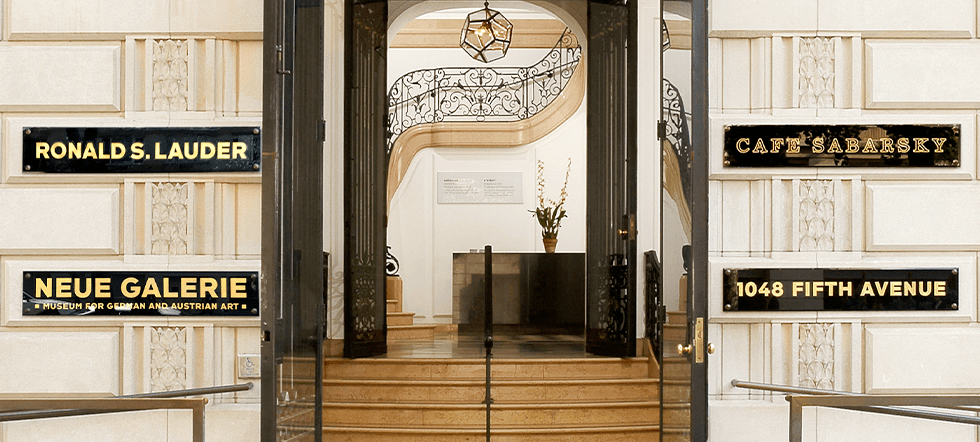
Neue Galerie

I do not make New Year resolutions. Nevertheless, going into 2023 I was determined to fill some of the gaps in my NY cultural experience. Top of the list was a visit to the Neue Galerie, the museum on the Upper East Side dedicated to the art and design of Germany and Austria from the early 20th century. I can’t quite believe that it has taken me nearly seventeen years to get there, but a chilly Saturday afternoon in mid-January seemed like a good moment to explore the elegant townhouse where 86th Street meets Fifth Avenue. What really drove me, however, wasn’t the wintry conditions, but the opportunity to get a glimpse of the collection of Ronald S. Lauder, one of the Galerie’s patrons, in an exhibition that closes next month.

Lauder’s collection and the museum as a whole is especially rich in paintings and drawings by the great Austrian and German masters: Klimt, Kokoschka, Grosz, Dix, and Schiele. Their work is well represented here, but Lauder’s interests as a collector go much further. Renaissance altarpieces, armor, even a slightly incongruous trove of items connected to the movie, Casablanca, serve to remind you that this is a rich man showing off his various enthusiasms.

The Neue Galerie is a gem, a beautiful setting in which to see some wonderful treasures. Klimt’s Portrait of Adele Bloch-Bauer may be the centerpiece, but there’s so much more. I’ll be back.

Last year’s reading

2022 was a very mixed year on the reading front. That was especially the case with fiction and that’s somewhat surprising because I read newly-published books by some of my favorite authors, including Ian McEwan and Julian Barnes. Only Tess Hadley’s Free Love stood out from that crop as being especially strong. Several others were mediocre or downright dull. Among the new voices (new to me), Damon Galgut’s The Promise was exciting and groundbreaking. As for the rest, very little was memorable.

In non-fiction books I chose more wisely. The trilogy of memoirs by Tove Ditlevsen was outstanding, as were Celia Paul’s Letters to Gwen John and the second volume of Robert Crawford’s biography of T.S. Eliot. I am starting to wonder whether this marks a significant and permanent shift in my reading habits as I get older or whether I am selecting new fiction with insufficient care. Time will tell.

Unlike previous years I start 2023 without a tall pile of books I urgently want to read. The final volume of Chips Channon’s diaries is a treat I know I will enjoy, but as for the rest I’ll just wait to see where my interests (and serendipity) take me.

An Honest Man

Ben Fergusson’s engaging novel is billed by his publisher as a literary thriller. While partly true, such a categorization might deter some readers and disappoint others, and that would be a shame because An Honest Man is more than that. Set in Berlin in 1989 in the months leading up to the fall of the Wall, the novel features as its central character a young man, Ralf, caught in a series of transitions. Ralf has a German father and an English mother. His school days in West Berlin have ended and university studies in England have yet to begin. He spends the summer days hanging out with German friends, swimming, cycling, and going on field trips with a local wildlife group. His carefree days come to an abrupt end when he meets Oz, an encounter that transforms his life and upends all the foundations he took for granted. In the wider world signals can be heard that the city, divided since 1945, is about to be transformed.

An Honest Man is a story about growing up, about learning the meaning and importance of loyalty, and about what happens when people are not what they seem. It is absorbing and often very moving, especially about Ralf’s relationship with his mother and his friends. I hope readers looking for a thriller, literary or otherwise, persevere with what is really an affecting a coming-of-age story.