
News reports remind us almost daily of the tragedy of forced migration. They tell us of tens of thousands of women, men, and children risking their lives every day to flee from unbearable conditions in their homelands. Behind the stories, of course, stand individual tragedies. Every migrant’s story is uniquely painful and poignant. We must try as far as we can to differentiate and individualize and avoid the trap of seeing nothing more than an impersonal mass of victims. Crowds dull our sensitivity and compassion.
We’re going to have to confront the reality of mass migration far more urgently than we have so far. Climate change looks likely to displace millions from their homelands, creating a crisis of a scale we have never seen before. We cannot look away. If we fail to act now, the horrors we have seen in recent years – the bodies of refugees washed up on distant shores, the appalling conditions endured in “temporary” camps – will be trivial in comparison to what’s coming.
Forced migration is only one form of exile. There are others. Think of the agonies of those who choose to separate themselves from their homelands rather than to endure the conditions that prevail there: perhaps intolerance, repression, restrictions on freedom of speech, the inability to be, in the place you were born, the person you want to be. Such persecution and repression have throughout history found their expression in the destruction of libraries, the burning and banning of books. Books are dangerous for autocrats. Condensed expressions of individuality and imagination easily distributed to ignite the minds and stir the feelings of others. So much easier to destroy the buildings, the shelves, the catalogs, and the books themselves, and to kill the librarians, the publishers, and the writers, than to allow ideas and emotions to circulate freely….
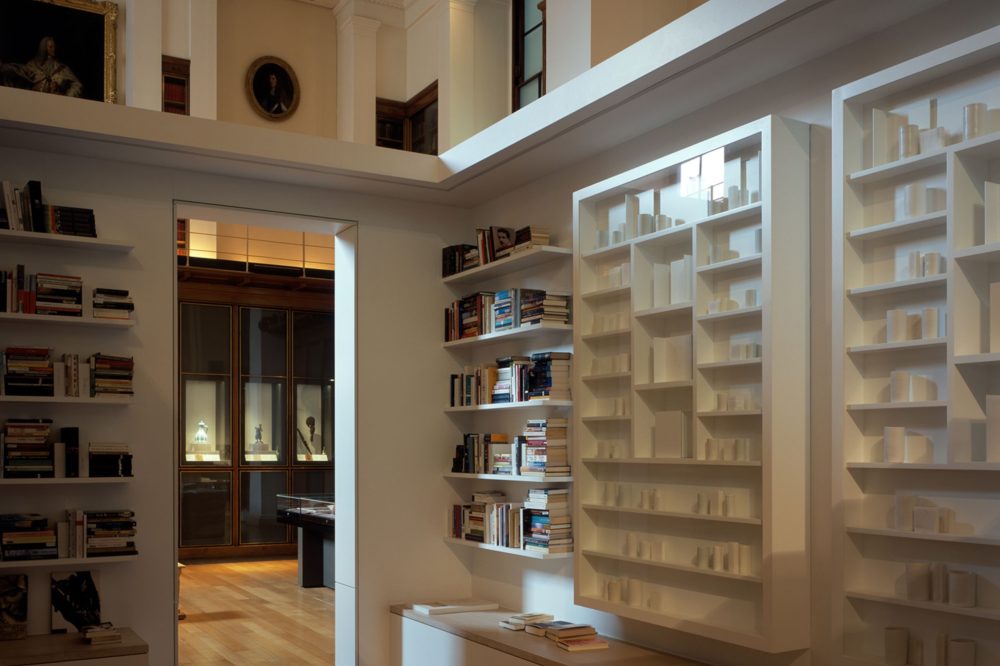
Such themes were at the heart of an exhibition or installation, library of exile, created and curated by the renowned ceramicist and author, Edmund de Waal. He made a collection of two thousand books by writers forced to live in exile. Some of the books came from his personal library and those of family members. Inside each book was placed a bookplate, and visitors to the exhibition were encouraged to take a favorite book from the shelves and write their names in the bookplate. Alongside the books, de Waal placed porcelain vases he had made especially for the installation. The exhibition traveled to places that in the past have witnessed the destruction of books – Dresden, Venice, London – and ended its journey at the University of Mosul where, in 2015, the forces of Daesh/IS destroyed the library and burned more than a million books and manuscripts.
I would have loved to see the library of exile and I like to think that one day I’ll see it in Iraq, a place I visited as a librarian more than thirty years ago. Until then, I’ll have to make do with the lovely book about it published by The British Museum.
 Miscellaneous Musings