Lisa Dwan in Happy Days at The Riverside Studios, London
I wonder what Samuel Beckett would have thought of the pandemic. Surely he would have smiled at the sight of an all-masked audience watching one of his plays – especially one called Happy Days – from socially distanced chairs. Beckett completed the English version of Happy Days in May 1961, so Trevor Nunn’s staging of the play at The Riverside Studios in Hammersmith marks its 60th anniversary.
What an extraordinary play it is. Winnie, encased in the earth up to her waist in Act 1, and up to her neck in Act 2, speaks into the void, compelled to communicate and longing to be heard. Her monologue, punctuated occasionally by comments and groans from Willie (mostly hidden by the mound in which Winnie is held), is a stream of memories, prayers, and snatches of song and poetry. As with all Beckett’s work, you’re left wondering. Is Winnie’s plight a statement about despair and helplessness, or is it a tribute to the resilience of the human spirit in the face of nothingness and meaninglessness? Probably both.
It felt so good to be back in a theatre and to see such a remarkable staging of what is a classic of the modern canon. Even in conditions as strange as these, perhaps especially in conditions as strange as these, no one is better than Beckett on the essentials of human existence.
News reports remind us almost daily of the tragedy of forced migration. They tell us of tens of thousands of women, men, and children risking their lives every day to flee from unbearable conditions in their homelands. Behind the stories, of course, stand individual tragedies. Every migrant’s story is uniquely painful and poignant. We must try as far as we can to differentiate and individualize and avoid the trap of seeing nothing more than an impersonal mass of victims. Crowds dull our sensitivity and compassion.
We’re going to have to confront the reality of mass migration far more urgently than we have so far. Climate change looks likely to displace millions from their homelands, creating a crisis of a scale we have never seen before. We cannot look away. If we fail to act now, the horrors we have seen in recent years – the bodies of refugees washed up on distant shores, the appalling conditions endured in “temporary” camps – will be trivial in comparison to what’s coming.
Forced migration is only one form of exile. There are others. Think of the agonies of those who choose to separate themselves from their homelands rather than to endure the conditions that prevail there: perhaps intolerance, repression, restrictions on freedom of speech, the inability to be, in the place you were born, the person you want to be. Such persecution and repression have throughout history found their expression in the destruction of libraries, the burning and banning of books. Books are dangerous for autocrats. Condensed expressions of individuality and imagination easily distributed to ignite the minds and stir the feelings of others. So much easier to destroy the buildings, the shelves, the catalogs, and the books themselves, and to kill the librarians, the publishers, and the writers, than to allow ideas and emotions to circulate freely….
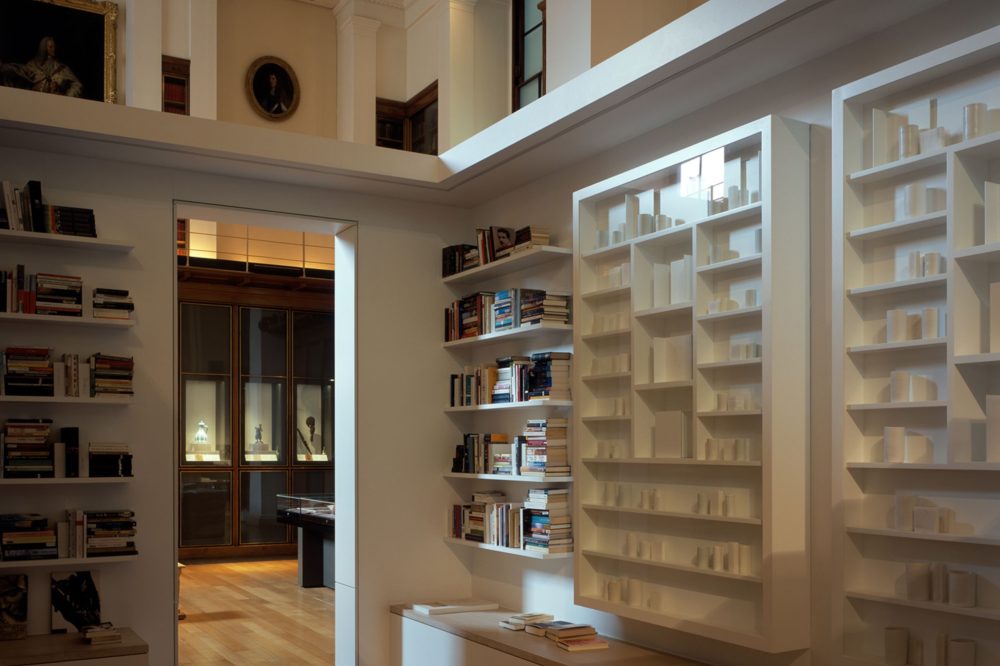
Such themes were at the heart of an exhibition or installation, library of exile, created and curated by the renowned ceramicist and author, Edmund de Waal. He made a collection of two thousand books by writers forced to live in exile. Some of the books came from his personal library and those of family members. Inside each book was placed a bookplate, and visitors to the exhibition were encouraged to take a favorite book from the shelves and write their names in the bookplate. Alongside the books, de Waal placed porcelain vases he had made especially for the installation. The exhibition traveled to places that in the past have witnessed the destruction of books – Dresden, Venice, London – and ended its journey at the University of Mosul where, in 2015, the forces of Daesh/IS destroyed the library and burned more than a million books and manuscripts.
I would have loved to see the library of exile and I like to think that one day I’ll see it in Iraq, a place I visited as a librarian more than thirty years ago. Until then, I’ll have to make do with the lovely book about it published by The British Museum.
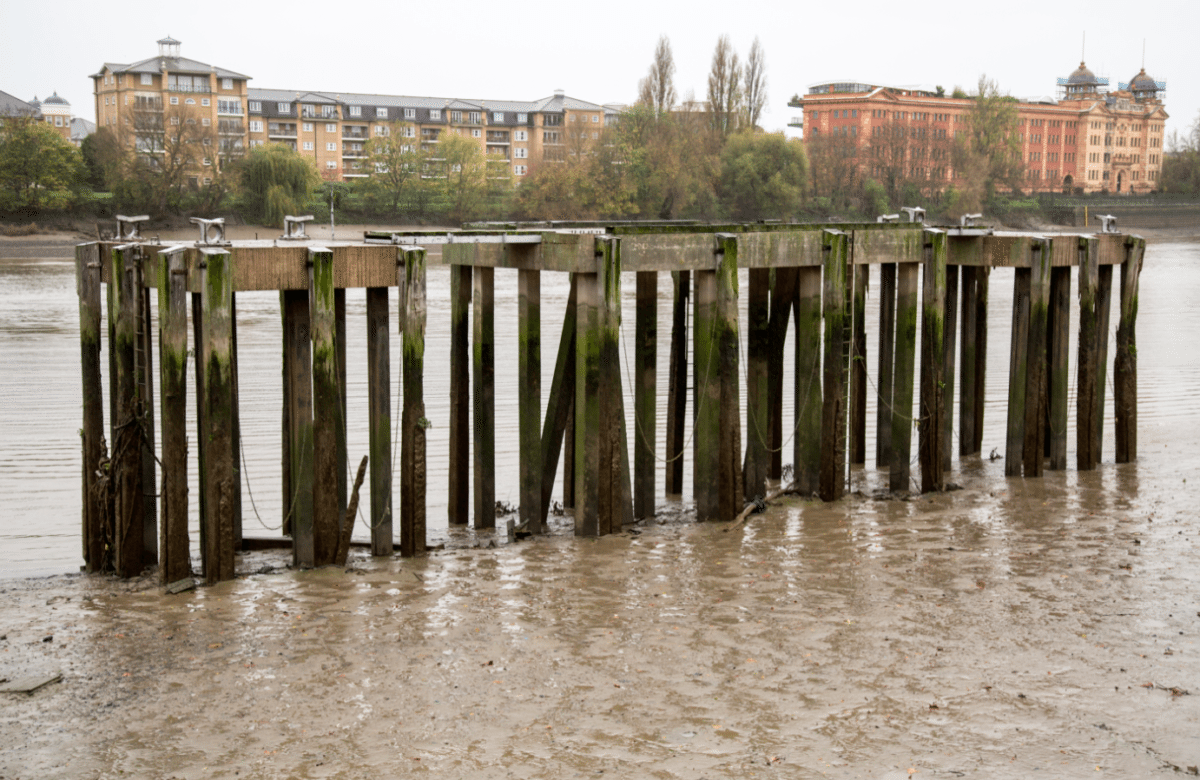
The stretch of the Thames between Putney and Hammersmith bridges is typically quiet on a Sunday morning. Little disturbs the surface of the sludgy brown water, other than the occasional crew from one of the many rowing clubs based on this part of the river. It’s a pretty and peaceful place to walk. Plane, ash, and willow trees overhang the path near Bishop’s Park and residents have planted gardens of wildflowers. Swans, ducks, and geese are plentiful. Maybe that’s one reason why artists and writers have based themselves here for so long. William Morris lived at 26 Upper Mall for nearly twenty years and established his Kelmscott Press nearby at 16 Upper Mall in 1891. Eric Ravilious lived just around the corner. Today it’s a haven for those walking their dogs or those looking for a pint in one of the many 18th century pubs close to Hammersmith Bridge (The Dove and The Blue Anchor are especially good). For the lucky few, there’s a table at the famed River Cafe.
The Thames is one of London glories. After centuries of neglect and pollution, a huge effort has been made to clean it up and make it more accessible to Londoners. That far-sighted investment has paid off. There’s nothing better than a walk along it to remind oneself that few, if any, cities can match London for beauty and tradition. I don’t even pretend to be impartial …
London has more historic palaces than many people realize. Some are amongst the most recognizable buildings in the world, while others are overlooked, tucked away in neighborhoods that attract few tourists. Fulham Palace, home to the Bishops of London since the 8th century, is certainly one of the latter. It sits, largely hidden from view and bordered by a busy road and the riverbank, in an affluent residential area. I’ve often wondered how many drivers, stuck in traffic on their way to and from Hammersmith and Putney, are aware of the little gem just behind the trees.
The palace itself has been much modified over the centuries. The various bishops who called the place home seemed to like re-modelling and tinkering, so what’s left today is something of a patchwork of styles. The oldest surviving part of the palace is the pretty redbrick Tudor courtyard that dates back to 1495. The grounds and gardens (13 acres in all) are lovely and attract local residents on sunny days, many of whom may never have set foot in the palace itself. Bishop Compton (17th century) and Bishop Terrick (18th century) were celebrated botanists and filled the grounds with rare and exotic plants and trees, many of which survive to this day.
Although the pandemic has closed the palace’s interior to visitors for the time being (it’s expected to re-open at some point in July 2021), the gardens are open. If the sun is shining, as it was when I was there recently, take a picnic and enjoy one of London’s hidden oases of tranquility.
Perhaps it’s the tourists, or its slightly sordid edge, or just the sense of transience that clings to it, but I’ve never really liked Soho. I’m happy enough to grab a quick drink or a bite to eat there, but it’s not a place I like to linger. Soho has it fans and its detractors – and has for centuries. It’s one of those neighborhoods that invariably attracts slightly nostalgic disparagement. “It’s not what it used to be in the 1950s” (or 60s, 70s, 80s, pick your decade). London’s sex trade no longer has its center there, but it clings on in a few places, hold-outs against the tide of gentrification that brought PR and media companies, members’ clubs, and coffee shop chains. It’s here that Fiona Mozley has chosen to set her second novel, Hot Stew (a “stew” being a word used in medieval times for a brothel).
The heart of the plot is a series of battles. A battle between those who call a place home and those for whom it’s just another investment opportunity. A battle between those who want to preserve a little of the past, however sordid, and those pushing forward to a future of bland uniformity offering little more than expensive apartments and offices. Which side are you on – the squalid and colorful or the bland and safe? And where do your sympathies lie – with the exploiters or the exploited?
Hot Stew is vivid and colorful (much like Soho itself), and occasionally funny and poignant. I enjoyed the experience of reading it, but I doubt it will leave the sort of lasting mark that Mozley’s debut novel (Elmet) left. The imaginative effort is impressive, but I don’t think the effort should be so visible.




 Miscellaneous Musings