
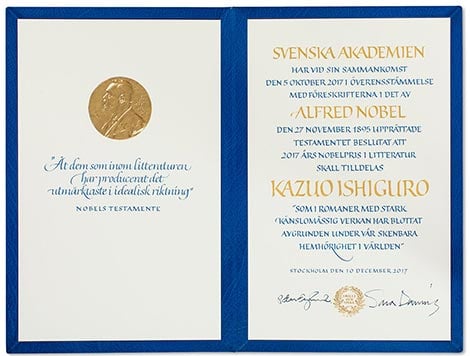
Anyone interested in listening to the acceptance speech that Kazuo Ishiguro gave after being awarded the Nobel Prize in Literature in 2017 can find it here. Having listened to it some time ago, I hadn’t planned to read it until, browsing in one of my favorite bookshops, Tsutaya in Daikanyama, I spotted it on one of the few shelves that the shop sets aside for English translations. Why would anyone read a lecture when it’s just as easy to watch it? Or to pay for it when it’s available for free? Because in this instance the Laureate is a writer and a writer’s written words are different from his spoken words, even when they are identical.
Ishiguro’s lecture is about remembering and forgetting and about how those two things are done differently by individuals and by societies. Memories are fragile and elusive things. Writing them down preserves them but in the process of remembering we all deceive, deny, and distort. How should nations remember? Should everything be remembered or is wilful amnesia sometimes the only way to move forward? Should the ruins of Auschwitz be preserved under a Perspex dome or allowed to crumble slowly until they disappear from view?
Ishiguro closes his lecture with a sombre reminder of the political events of 2016 and being forced by them “to acknowledge that the unstoppable advance of liberal-humanist values taken for granted since childhood may have been an illusion“. His hope is that good writing and good reading will help to break down barriers and find “a great humane vision” around which we can all rally.
 Miscellaneous Musings