Livery Musings

Image result for stationers hall

“Think of them as medieval trade associations”. That’s what I tend to say to American friends when I’m trying to explain what livery companies are. If that piques their interest, I tell them about the charitable focus of the 110 companies still thriving in the UK and the role they play in the governance of the City of London (aka the city’s financial center and powerhouse). Many of the companies represent professions and trades still thriving and still familiar in modern times. Goldsmiths, clock makers, distillers, butchers, and so on. Some take a little more explanation. Loriners (makers and suppliers of equestrian equipment), broderers (embroiderers), and cordwainers (fine leather workers) – those and others aren’t immediately obvious. The oldest company is The Worshipful Company of Mercers, established in 1394 and thriving still today.

The livery company for publishers, booksellers, and those in the wider content and communications industries is The Worshipful Company of Stationers and Newspaper Makers. It was set up in 1403 and its home is the magnificent Stationers Hall close to St. Paul’s Cathedral. I was recently admitted as a Freeman of the Company at a picturesque and touching ceremony at the Hall in the presence of the wardens, a beadle, and much antique paraphernalia.  Great fun, but with a serious purpose: to help educate a future generation of professionals in the content industries.

A Paris Pilgrimage

At some point in the second half of the 1980s, John Minihan’s famous portrait of Samuel Beckett first appeared in one of London’s Sunday newspapers. I tracked John down – no easy feat in those pre-Google days – and met him over drinks one evening. He very kindly gave me some pictures, told me about his friendship with Beckett, and about the circumstances in which that extraordinary image of the writer was taken. It was 1985 and Beckett and Minihan were meeting across the street from Beckett’s apartment on the Boulevard St. Jacques in Paris, in Le Petit Café of the PLM Hotel.

Samuel Beckett in his local cafe in Montparnasse, Paris

Last week I checked into the Marriott Rive Gauche and discovered quite by chance that the PLM Hotel had morphed into a Marriott at some point in the intervening years and that my room looked out onto Beckett’s modest apartment on the 6th floor of 38 Boulevard St. Jacques. On heading to the lobby it was easy to find the spot Beckett and Minihan had sat that day more than 30 years ago. I strolled over to the apartment block, marveling that it bore no sign or plaque recording the years spent there by a great writer, and then went around the corner to Le Tiers Temps, the nursing home where Beckett died in December 1989.  Time pressures prevented me from completing this mini pilgrimage with a short stroll to the great writer’s resting place in the nearby Montparnasse Cemetery and, as many do, leaving a small pebble on his gravestone as a small mark of honor. Next time, for sure.

Image result for samuel beckett grave site


Here We Are

If we give any thought at all to who we are, I suspect most of us think of our identity as something fixed and permanent. We’re born who we are and we stay that way until we die, with our fundamental essence, much like our eye color, unchanged. Graham Swift, I think, sees things differently and knows that identity is much more slippery and a lot less permanent than most of us realize. Living is a process of subtly shifting and evolving identities. The unique core of every individual changes shape over a lifetime, often unconsciously but sometimes willfully and abruptly. We’re mostly careful to hide the process from others, preferring the illusion of constancy.

Illusion is the key word here because Swift’s latest novel is set in the late 1950s among the popular entertainers – magicians, novelty acts, and comedians – that were the fodder for UK theatergoers in those days. A type of entertainment that today seems archaic was even then beginning to feel old fashioned as it gave way to television and cinema. Ronnie Deane (aka The Great Pablo), along with his assistant, Eve, is the triumph of the summer season in Brighton, delighting crowds with his illusions and magic tricks. When the season ends with the final show, Ronnie has one final trick up his sleeve …

Here We Are is about secrets, memories, and the common and not-so-common illusions of ordinary lives. In the brilliance of its storytelling Graham Swift reminds us again what a magical artist he is.

Image result for graham swift here we are

The Nobel Lecture

Image result for ishiguro nobel lecture

Anyone interested in listening to the acceptance speech that Kazuo Ishiguro gave after being awarded the Nobel Prize in Literature in 2017 can find it here. Having listened to it some time ago, I hadn’t planned to read it until, browsing in one of my favorite bookshops, Tsutaya in Daikanyama, I spotted it on one of the few shelves that the shop sets aside for English translations. Why would anyone read a lecture when it’s just as easy to watch it? Or to pay for it when it’s available for free? Because in this instance the Laureate is a writer and a writer’s written words are different from his spoken words, even when they are identical.

Ishiguro’s lecture is about remembering and forgetting and about how those two things are done differently by individuals and by societies. Memories are fragile and elusive things. Writing them down preserves them but in the process of remembering we all deceive, deny, and distort. How should nations remember? Should everything be remembered or is wilful amnesia sometimes the only way to move forward? Should the ruins of Auschwitz be preserved under a Perspex dome or allowed to crumble slowly until they disappear from view?

Ishiguro closes his lecture with a sombre reminder of the political events of 2016 and being forced by them “to acknowledge that the unstoppable advance of liberal-humanist values taken for granted since childhood may have been an illusion“. His hope is that good writing and good reading will help to break down barriers and find “a great humane vision” around which we can all rally.


Howards End is on the Landing

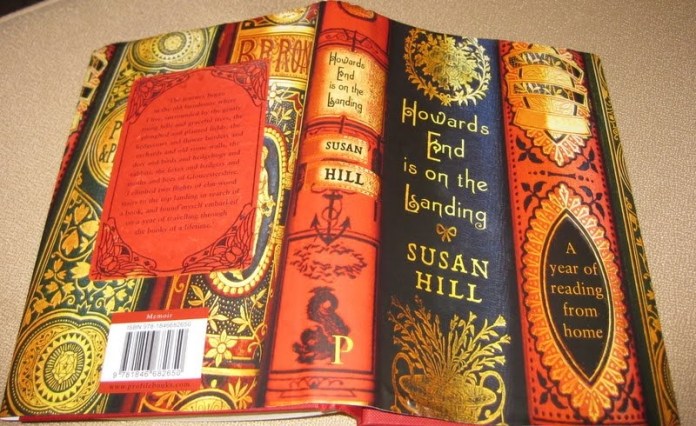
Books about books are some of my favorite books and reading about reading is something I love to do, so when browsing in Hatchards in Piccadilly recently I was delighted to come across a book by Susan Hill first published in 2009. Its premise is simple. We all have books in our collections that we haven’t read or would love to read again, so why not dedicate a year to reading nothing other than what we own already? Hill’s idea, not likely to appeal to booksellers and publishers, of course, is in truth just a jumping-off point for her to write about her favorite authors, her love of books, reading, publishing, bindings, typography and pretty much anything else that catches the eye of a sensitive, intelligent bibliophile. And, because it’s written by Susan Hill, such an accomplished novelist herself, it’s all done with passion, fun, and insight.

Needless to say, I loved it. I learned a lot, too. It encouraged me to try writers I’ve overlooked so far (John Wain, for example) and to give another try to novelists I’ve found difficult or intimidating (such as Virginia Woolf). It made me think about books and reading in a new way. What more can I ask from a book than that?

Image result for howards end is on the landing