Everything In Its Place

I’ve read none of the books on which Oliver Sacks’s critical reputation rests (Awakenings, The Man Who Mistook His Wife for A Hat, and so on).  In fact, until now I had read only the posthumously published collection of essays he wrote about illness and dying called Gratitude (2015).

Image result for everything in its place oliver sacks

What I remember about Gratitude are the qualities that Sacks’s readers tend to remark upon: his sensitivity, tenderness, and limitless curiosity about what it means to be human.  All are found again in Everything In Its Place.  It’s otherwise something of a hotch-potch of a collection, combining a few very personal essays about things that influenced him in his early life (libraries, museums, and so on) with some clinically-centered pieces of the kind that made him famous.  All are written beautifully.  The explicitly autobiographical pieces are especially good, but it’s an essay in the middle of the collection called The Aging Brain that captured best for me what made Sacks such a deeply engaging writer and, I assume, such a wonderful doctor. The essay is a distillation of what he learned from a lifetime of treating patients with various types of dementia.  It’s not so much the clinical conclusions that matter here.  What sticks is his unshakeable belief in the dignity to be found in every human life, including those ravaged by cruel mental illnesses.
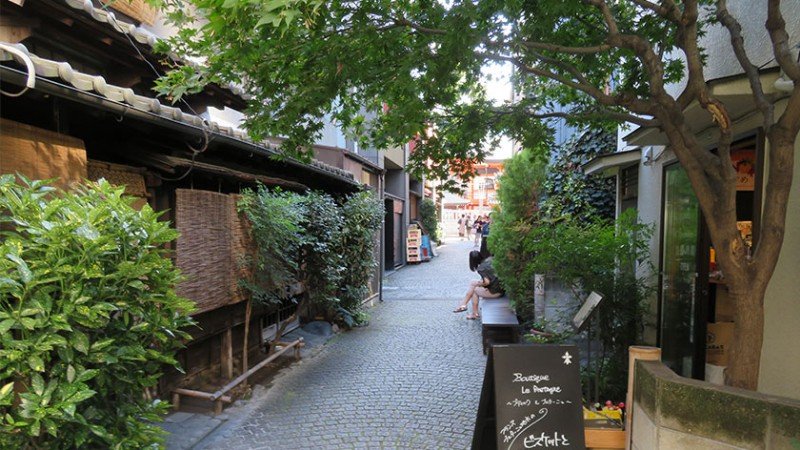
Kagurazaka

After twenty-plus visits to Tokyo, I think I have quite a good grasp of the city’s main neighborhoods, but just like any other visitor my personal topography of Tokyo is shaped by what I do and enjoy.  For me, working in Tokyo means time in places like Nogizaka, Nihonbashi, and Aoyama. Fun means Ebisu, Hiroo, Daikanyama, and Nakameguro. The opportunity, and maybe the inclination, to explore new areas is limited, so it’s a treat when someone or something introduces me to somewhere new.

Kagurazaka is a small neighborhood within Shinjuku ward that was famous in the early 20th century for its numerous geisha houses.  It has a cultured feel today, perhaps because of the proximity of a number of university campuses and publishing houses, or maybe because it’s favored by French expatriates as a place to live.  At its heart you find a warren of narrow alleyways, inaccessible to cars, where several ryotei (traditional high-end Japanese restaurants) can be found.  It was one of these, Restaurant Kamikura, that took me to the neighborhood.  It’s an enchanting area, quieter than many in the city; a place for strolling, a coffee, and most likely an outstanding dinner.  I’m already looking forward to going back.

Image result for kagurazaka

Modernists & Mavericks

Image result for modernists and mavericks

Martin Gayford is something of an insider in the London art world and has been talking about painting for more than two decades to the likes of Francis Bacon, Lucien Freud, Frank Auerbach, and David Hockney.  (His account of sitting for his portrait by Freud – Man with a Blue Scarf – is a brilliant book). It’s difficult to think of someone better qualified to write a history of what happened in English painting in the time between the end of the Second War World and the mid-1970s. With Modernists & Mavericks, he has written a really engaging and intelligent account of that period, steering clear of both gossipy reminiscence and dry theory to produce a vivid story of what we can now see was an extraordinary flourishing of talent in London.

Gayford’s own critical preferences are clear enough.  He sees Bacon as the towering figure of the period and as one of the greatest artists of the 20th century, with Freud not far behind.  He presents a strong case for this opinion and overall I think he manages to avoid the risk of making the London scene in the period feel at some points as having been all about a reaction to these two extraordinary painters. He’s sensitive to what would have been both a critical and historical distortion, presenting important painters as walk-on parts in a drama dominated by Bacon and Freud.  Nevertheless, it’s impossible to give appropriate space to everyone who flourished in London at that time, so we’ll all have to look elsewhere for a full critical appreciation of the likes of Bridget Riley or Howard Hodgkin. And only time will tell if the reputations of others will rise to challenge Gayford’s assessment.  My own hunch is that Frank Auerbach will, as time goes on, be seen as at least the equal of Bacon and Freud.  Time will tell, but in the meantime Gayford has given us a readable, even-handed, and intelligent review of a fascinating period in modern art history.