Come Rain Or Come Shine

Faber Stories is a series of short works published to celebrate the 90th anniversary of Faber & Faber.  Ishiguro’s story Come Rain Or Come Shine was first published in 2009 and now appears for a wider audience as a volume within Faber Stories.  It’s a slight and intriguing tale of seventy or so pages.  Ray, an unambitious and mostly unsuccessful language teacher in his forties, comes to stay with his two university friends, Charlie and Emily.  Charlie heads to the airport for a business trip almost as soon as Ray arrives, but not before confiding that his marriage to Emily is in trouble.  Ray is enlisted to help repair the relationship by acting so much his useless self that he makes Charlie look good by comparison.  Left alone with Emily for a day or two, will Ray succeed?

The story starts in a realistic style, but as it develops a slightly dream-like, surreal, and comic atmosphere takes hold.  Even with all his confidence and skill, Ishiguro can’t quite pull this off.  It’s entertaining enough but I was left with the feeling that he didn’t quite know what to do with a promising idea.

Image result for come rain or come shine ishiguro

Favorite Bookshops: Littered With Books (Singapore)

Great bookshops are about much more than books.  The best ones display something of what’s best about the human spirit.  Perhaps a sense of curiosity, imagination, or adventure, the longing to learn and communicate.  I often find when I leave a newly discovered bookshop that what stays with me is something it reveals about its proprietors.

Enthusiasm and fun are what strike you when you browse around Littered With Books, a small store on two levels on Duxton Road.  The neighborhood is sleepy on Sunday afternoons.  There were few customers in the bookshop but the young staff bustled around, laughing and having fun.  Colorful, handwritten post-it notes litter the edges of the shelves, recommending things to read and dispensing advice and bons mots.  A skylight in the middle of the shop floods the room with light, adding somehow to the feeling that this is a place telling you it’s OK to have fun here. The least I could do faced with all this generosity and warmth was to buy something.  I walked out with Kazuo Ishiguro’s Come Rain or Come Shine.  The salesperson gave me a free bookmark, of course.  It was pretty and fun, of course.

Image result for littered with books

Singapore’s Little India

Image result for singapore little india

With temperatures in the mid-nineties and humidity close to 100%, my walk from Tanjong Pagar to Little India wasn’t as much fun as it should have been. A cold mango lassi in one of the many restaurants on Sarangoon Road revived me and I carried on my trek around the neighborhood.

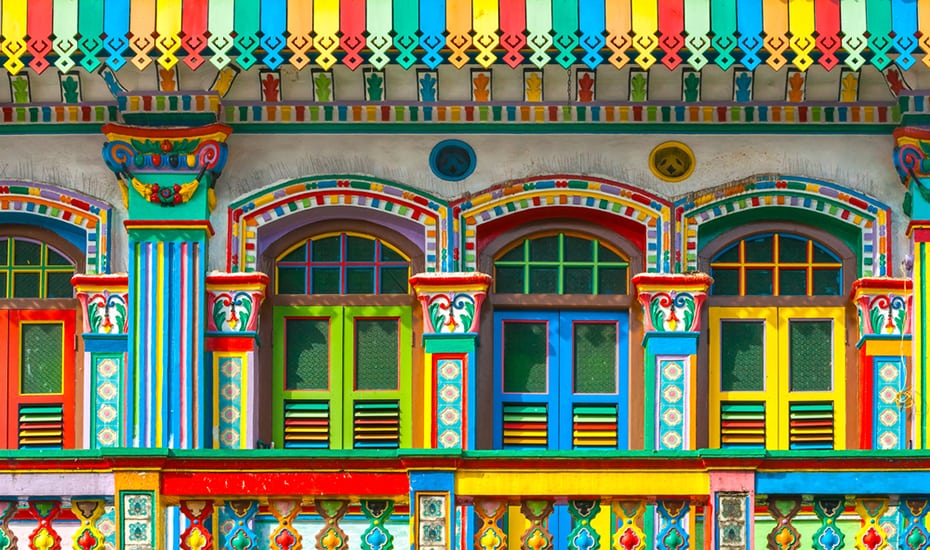
It’s not an area bursting with must-see monuments or buildings, though Sri Veeramakaliamman temple, with its facade crowded with colorful statues, is well worth a look. Dedicated to the goddess Kali, the temple has been the heart of Singapore’s Hindu community since the 19th century.  What makes Little India such a fun excursion is its vividness, color, and energy.  Shops selling saris and the bright yellow gold jewellery loved by Indians all over the world line Sarangoon Road, and on the Saturday I visited the pavements were crowded with young families heading out to lunch in the scores of South Indian vegetarian restaurants in the neighborhood.  Visitors to Singapore – myself included – often complain that its urban development has stripped away the traditional ethnic character of the city and leveled its older buildings to make way for bland office and apartment buildings.  Thankfully, that isn’t true of Little India.

Image result for singapore little india

Reunion

Hatchards’ bookstore at St. Pancras station in London is small, but its staff have a talent for displaying lesser-known titles in a way that catches the eye of browsers like me.  They seem especially interested in promoting neglected classics and on more than one occasion I’ve discovered a book I’ve ended up loving and recommending to friends.  Reunion, a slim novella by Fred Uhlman first published in 1971, is one such gem.

Image result for fred uhlman

The story is set in Germany in 1932. Two teenage schoolboys, innocent and unworldly, become firm friends. One, Hans, is Jewish, the son of a doctor. The other, Konradin, is a Protestant from a distinguished, aristocratic family.  All is innocence and purity. It’s Eden before the fall, the calm before the hurricane that would transform the world. But even in their sheltered, civilized town, disturbing rumors reach them from Berlin that Germany is changing and that it’s no longer safe to be Jewish.

The power of Reunion, a short and simply told story, is very difficult to describe.  All I can say is that in fewer than a hundred pages it speaks of innocence, awakening, horror, and some kind of redemption from a time in our recent history that all of the world’s literature will never explain adequately.  The rest I will leave to Rachel Seiffert’s elegant Afterword to the novel. “It is rare to use the word perfect to describe a book.  I don’t hesitate here”.  Neither do I.


Louvre Abu Dhabi

Image result for abu dhabi louvre

The Louvre Abu Dhabi opened in November 2017 and is situated on Saadiyat Island, a neighborhood in Abu Dhabi that will eventually  house a complex of major cultural institutions, including a new Guggenheim museum.  The building, designed by the French architect Jean Nouvel, is simply wonderful.  A structure of white cubes dazzles the eyes, reflecting (as it inevitably does) the bright Gulf sunshine, and is crowned by an intricate webbed roof that makes you think of palm fronds and Arabic calligraphy.  Inside it’s all cool, white space; a serene setting for a relatively small collection of art treasures from around the world.

The arrangement of the exhibits is loosely chronological, beginning with galleries dedicated to classical antiquity and ending with abstraction and modernism.  It’s easy enough to be snobbish about the “ready made” collection of masterpieces brought together in this extraordinary showcase.  A Leonardo here, a Delacroix there. An exquisite Torah scroll set next to a 14th century bible, and so on.  It feels like the collection of a fabulously wealthy benefactor determined to show off their buying power and the breadth (if not the depth) of their interests.  Museums can’t be hatched, fully formed.  They take decades, sometimes even centuries, to mature and to grow into their surroundings and the riches they display.  But they have to start somewhere.  It will be interesting to see how Louvre Abu Dhabi evolves and finds its natural shape. For now, we have been given a glittering jewel case filled with nothing but exquisite wonders.

David Jones

Image result for dilworth david jones

David Jones is something of a puzzle.  How is it that a painter, poet, and engraver so deeply admired by the likes of Auden, Eliot, and Heaney remains so little known?  Why didn’t critical acclaim from his peers and contemporaries ever turn into wider recognition and popularity?  Thomas Dilworth’s meticulously researched and perfectly judged account of Jones’s life and work tries to answer those questions and it’s no fault of the biographer’s that he doesn’t quite succeed in doing so.

Born in south London in 1895, Jones concentrated initially on engravings, watercolors, and paintings in the first phase of his career which started when he returned from the trenches in 1918. (No other Great War poet or artist saw as much of the fighting as Jones).  He was associated with Eric Gill in the 1920s, emerging eventually from Gill’s shadow and the narrow and suffocating Catholicism of Gill’s guild of craftsmen. He turned more seriously to writing in the late 1920s, completing In Parenthesis in 1937 in spite of his devastating mental collapse (most likely a delayed reaction to what he saw and suffered in the Great War) in 1932.  A career spanning more than three decades followed, made possible in part by a period of psychotherapy, during which he attracted prestige and honors and built a tight network of close, loving friends. Poverty and the shadow of mental illness were never far away, however.

Dilworth’s slightly tentative conclusion at the end of this long and heavily illustrated biography that Jones “may be the foremost native British modernist” offers a clue to the neglect he has suffered. The fact is – and it’s strange this never seems to occur to his biographer – that Jones’s work is difficult. His most important written works, The Anathemata and In Parenthesis (“the best work on war in English”), are dense and rich in religious, historical, and classical allusions and symbols most likely to be beyond ordinary secular readers.  His paintings and watercolors, though beautiful, can also seem difficult to penetrate beneath their crowded, filigree-like surfaces.  His early engravings and lettering are the most accessible work he did.  David Jones won’t break into the mainstream.  He’ll most likely stay where he has always been: a major figure with a small audience.

Image result for david jones engraving

Say Nothing

Image result for say nothing

No one who grew up in the UK in the 60s, 70s and 80s, as I did, could have been unaware of “the Troubles”, the terrible conflict between Irish Republicans and Loyalists that blighted Northern Ireland and occasionally spilled over to mainland England, claiming more than 3,500 lives.  Bombings, shootings, kidnappings, assassinations – this was the stuff of the nightly TV news in those years, punctuating a civil war that never seemed to end.  Say Nothing, written by an American journalist, approaches the history of the Troubles from an unusual angle by focusing mainly on one of its best known and most shocking incidents, the abduction by the IRA in 1972 of Jean McConville, a widow and mother of ten children. The cold-blooded kidnapping is used as the jumping-off point for a vividly told history of the conflict in which key figures in the Republican movement such as Gerry Adams, Dolours Price, and Brendan Hughes feature prominently.  Readers who know little or nothing about what happened in Ireland in this period couldn’t ask for a better introduction to the politics, important events, and some of the leading personalities, though it concentrates pretty much exclusively on the Republican side of the story.  The gradual move from armed conflict to negotiation and conventional politics – from the bomb to the ballot box – and the tensions that went with the journey from idealism to pragmatism are told very well here.

The carnage of those decades is long behind us. The social inequality that sparked the violence is mostly a thing of the past and Northern Ireland has been enjoying a long period of prosperity and stability.  But talk of introducing a “hard border” between the Irish Republic and Northern Ireland in the wake of Brexit has awoken old fears, not least of the possibility of a slow sliding back to tribalism and conflict.