
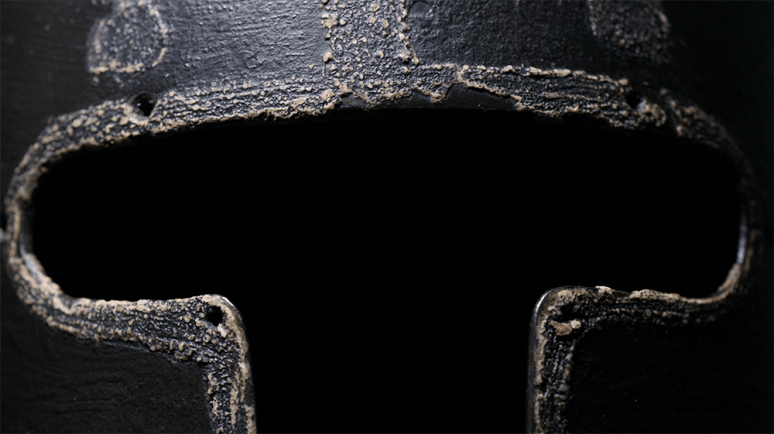
Henry Moore was a regular visitor to The Wallace Collection as a young art student in the 1920s and continued to find inspiration in its exquisite holdings of armour throughout his career. It’s clear in particular that the London museum’s beautiful Italian and German helmets from the 14th, 15th, and 16th centuries moved him deeply and were the stimulus to produce the series of Helmet Heads he made between the early 1950s and mid 1970s. For the first and probably the only time, Moore’s work and the armour that inspired it have been exhibited side by side in the museum that clearly captivated him as a young sculptor.
Moore served in the First World War and knew all about the protective qualities of military helmets. As he developed as an artist he became increasingly interested in the idea of the human head as a protective case for the psyche, strong but vulnerable, an image he appropriated later in his career in the work he did to support political causes such as the Campaign for Nuclear Disarmament.
This exhibition at The Wallace Collection juxtaposed Moore’s drawings, paintings, maquettes, and models alongside all the finished Helmet Heads and the ancient armour that inspired them. In doing so, it not only illustrated one of Moore’s lifelong interests and themes, but also the extraordinary beauty of the work that made him perhaps the greatest sculptor of the 20th century.
 Miscellaneous Musings