Incredible India

Image result for great india trucks

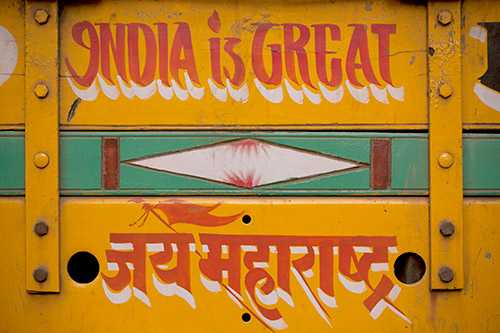
There’s a lot of pride in India these days.  Sit in a highway traffic jam for a little while and you’ll see trucks all around you, elaborately decorated and brightly colored, with the words Great India stenciled in large letters on their paintwork.  Signs from the tourist authority hanging down from bridges and lamp posts remind locals and visitors alike that they are in Incredible India.  Confidence is everywhere.

It was all very different back in 1979 when I visited for the first time.  India, vibrant and colorful though it seemed to me then, felt like a country overwhelmed by its own problems.  Forty years on, much has changed, especially in the cities, and India has become a global super power. But whenever I travel there with colleagues and friends seeing India for the first time, they’re shocked by the crumbling infrastructure, the chaotic traffic, the cows and stray dogs wandering in the city streets, the mounds of rubbish, and I realize that India’s progress, though extraordinary, isn’t always visible in the ways foreigners expect it to be.  In spite of its phenomenal development in recent decades, it remains a country with profound challenges to overcome: poverty, inequality, and illiteracy, all the more shocking because of the extraordinary advances visible in other areas of Indian society.  India does everything – even advancement – in its own unique way.

I’ve been lucky enough to return to India many, many times since that first visit four decades ago.  It’s a country I’ve grown to love and it’s one that fascinates and moves me perhaps more than any other.  It has a unique energy and culture and a deep, unaffected spirituality.  I have found in its people gracefulness, kindness, and hospitality in extraordinary measure. It’s a place that every day makes you challenge your expectations and question your assumptions and, above all, reminds you that there’s no single pattern for living.  India is incredible, indeed.


Ghost Wall

Sarah Moss has been acclaimed for several years but it’s fair to say that her work hasn’t yet broken through to the large audience it deserves.  Ghost Wall might just change all that. This is an unusually powerful novel, all the more so because the aggression and violence it exposes are uncovered by a quiet, understated, and exquisite prose.

Image result for ghost wall sarah moss

Seventeen year-old Silvie joins her parents, a group of students, and their professor at a summer camp in northern England that seeks to recreate the living conditions of Iron Age Britons.  Silvie’s father is no academic, but a bus driver, amateur historian, and enthusiastic admirer of the simpler lives of the ancients.  It becomes clear gradually that one of the features he admires particularly about Iron Age culture was its control of women, a control maintained by the physical and emotional cruelty imposed by men. Silvie’s story is book-ended by two extraordinary scenes – the opening imagining of ancient ritual sacrifice and the devastating conclusion – that capture perfectly and painfully the persistent cruelty women have suffered at the hands of men throughout history. I don’t want to make the novel sound like a tract or manifesto.  It isn’t.  It’s a sensitive evocation of an innocent young woman’s life lived under the shadow of blame and violence. Ghost Wall is an extraordinary achievement.

Jaipur Literature Festival

Anyone even slightly interested in the business of books knows that when publishers or booksellers get together there’s nothing they like to talk about more than “the reasons why no one reads books anymore”.  This is something that never changes.  Catastrophe is always just around the corner and some fiendish and irresistible foe is lurking, ready to make books a thing of the past and to transform reading into a quaint, old-fashioned pastime like Morris dancing.  The cause of the unavoidable disaster changes from time to time.  Radio, television, the Internet, video games: all at various times have been the harbingers of disaster.  Today’s trope is that we all have too little time and too many competing distractions to read anything longer than a tweet or a news headline.  Our diminishing attention span is the new thing that’s going to kill writing, reading, publishing, bookselling, libraries and just about everything else.  To quote Private Frazer in Dad’s Army (look it up if you’re not British), “We’re all doomed”.

Image result for jaipur literature festival

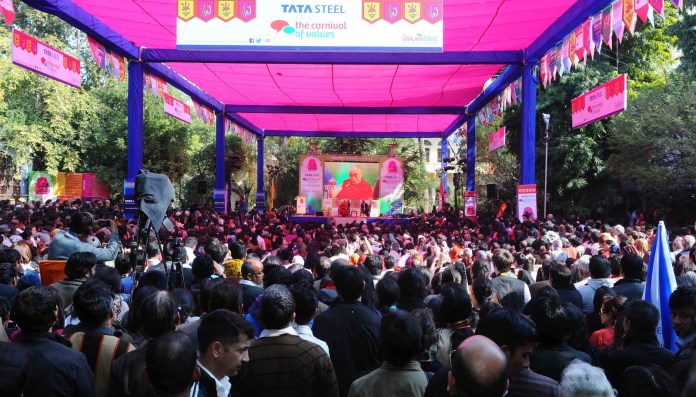
Having just been to the Jaipur Literature Festival, I’m here to tell you something: you can sleep easy because the love affair between readers and their books is as intense and as passionate as at any time in human history.  More than 500,000 people are expected to attend this year’s Festival and the numbers have grown year-on-year since it was first held back in 2008.  That’s half a million people coming together to listen to authors and talk about books. The Festival usually draws some of the world’s most famous writers and this year was no exception.  Germaine Greer, Ben Okri, Colson Whitehead, and many others talked about writing and books in front of huge audiences on the lawns of Diggi Palace in bright winter sunshine and an occasional hailstorm.  It was the most extraordinary and joyous celebration of storytelling and a reminder, if reminders were needed, of the timeless appeal and power of books.

The Trespasser

Image result for tana french books

The pleasure of reading The Trespasser has little to do with working out whodunnit.  The basic plot after all is straightforward enough: murdered woman, corrupt detectives trying to frame the obvious suspect, and justice finally served in a nice, tidy resolution.  No, the real fun – if you can call it fun – is seeing Detective Antoinette Conway prevail against the cozy male clique in the squad room determined to see a woman fail.  Tana French is brilliant at office politics and the crushing sexism of the police service.  Who could fail to root for Conway as she tries to outwit her scumbag colleagues, expose corruption, and solve the case all at the same time?  Sure, she’s a little too one dimensional to be completely believable, but who can resist the isolated underdog?

Winter Jazz in Harlem

If you walk east from Frederick Douglass Boulevard on West 132nd Street, you’ll pass a handsome brownstone that’s home to American Legion Post 398.  Take a few steps down from the street and through an inconspicuous door and you’ll find yourself in the bar and social club, a small, slightly shabby basement room. For nearly twenty years this modest setting has been the place where, every Sunday evening, one of Harlem’s last truly authentic jazz clubs has thrived.

There’s no charge to get in.  Just sign the book.  Grab a table if you’re early enough.  If not, take a spot near the bar.  Ten dollars gets you dinner: fried chicken, collard greens and potato salad served on Styrofoam plates. Beer – or liquor served in those tiny bottles you get on airplanes – is dangerously cheap by New York standards.  Then sit back , relax, and wait for the show to begin.  And what a show it was on the cold, January night I was there.  Live music rarely comes with this immediacy or intimacy.  This is how jazz should be made and heard,  in a tiny room with no stage to speak of and the small audience, mostly locals, veterans, or blow-ins like us, in touching distance of the musicians.

Image result for jazz american legion harlem


Bad Blood

Image result for bad blood theranos

The reputations of some of the biggest tech entrepreneurs have taken a well-deserved beating in recent years.  One shocking revelation has followed another and it’s little wonder that governments around the world are looking closely at regulation to curb some of the worst excesses of the larger companies.  The charge sheet is long and growing: selling confidential data, flouting privacy and confidentiality laws, evading tax, enabling election tampering, discriminating against women and ethnic minorities in the workplace, and so on.  Many of those who proclaimed their determination to change the world have ended up looking a lot like the sordid robber barons of the early 20th century: greedy, power hungry, dishonest, and arrogant. Watching the parade of tech CEOs squirming under Congressional questioning, it’s tough to imagine that their public standing could fall any lower or that they could ever recover society’s trust.

It has been a torrid time for many of these leaders and all the pain has been self-inflicted. None of them has yet plummeted as far or as fast as Elizabeth Holmes, the founder of Theranos, who claimed to have invented a pioneering and radically improved method for testing blood samples.  Once feted on Wall Street and in Silicon Valley, a pin-up for female entrepreneurs, and a billionaire in her early 20s, Holmes was exposed last year in a series of articles in The Wall Street Journal.  Her reputation is in tatters and she’s facing criminal fraud charges. What’s most extraordinary about this riveting and quite depressing story about deception and hubris is how long it took for her to be unmasked and how large the coalition of the greedy, stupid, and careless was to allow the fraud to continue for so many years.  Investors, VCs, and business partners, blinded by greed and the lure of vast profits, did very little to verify the claims of a Stanford drop-out with almost no scientific, technological, or commercial credentials.

Bad Blood reads like a thriller and is brilliantly written.  It shows us how vital it is that investigative journalism of the kind conducted by The Wall Street Journal should flourish.  We’re living in a very corrupt age.  Carreyrou’s superb reporting is a reminder that we ought to update our image of villains.  They aren’t always the old guys lurking in the corridors of government.  Keep an eye on the young and ruthless ideologues and evangelists who claim to have nothing but the purest motives while selling us snake oil.

On The Future

I have no patience for futurists and their predictions, so why was Martin Rees’s On The Future on my Christmas wish list?  First, Rees has impeccable scientific credentials.  He’s one of the world’s leading astronomers and a former President of The Royal Society.  Second, he writes about complex scientific issues with crystalline clarity.  Third, this compact and quite personal account of what lies ahead for our species and our planet featured on so many Best Books of 2018 lists that I felt I couldn’t ignore it.

Image result for martin rees on the future

I enjoyed it very much.  It’s not Rees’s style to harangue.  His approach is measured, reasonable, and careful.  There’s no hysteria or exaggeration, but he brings a passionate engagement, a sharp intelligence and intense curiosity to bear not only on the challenges he thinks have to be addressed urgently but also those in our far future. Throughout the book he manages to balance an appropriate level of respect for what scientists and technologists can achieve going forward with a healthy skepticism about their tendency towards hubris.  He coins some memorable aphorisms along the way: that we should be less alarmed by artificial intelligence than real stupidity, that the global village exposes us to global village idiots, and so on.  Ethics are always in the forefront of his thinking.

I suppose it’s too much hope that this deeply humane book might be read by our world’s political leaders.

Killing Commendatore

Image result for haruki murakami

My first book of 2019 proved to be a good one.  No big surprise. I’m a great admirer of Murakami and I found this long and sprawling novel to be one of his most engrossing. As is always the case, what captivates is the unique world he creates and that singular voice. No one sounds like Murakami.

When his wife announces that she wishes to end their marriage, the novel’s narrator, a largely unknown portrait painter in his mid-thirties, leaves Tokyo and ends up living in a remote mountainside house previously occupied by a much more celebrated artist, Tomohiko Amada. Settled into the new house and studio, the narrator agrees to paint the portrait of a neighbor, a mysterious, white-haired man who lives nearby in a grand mansion for no other reason, it seems, than to be close to a teenage girl who may or may not be his daughter.  This being a Murakami novel, the natural and supernatural worlds co-exist quite comfortably.  The narrator is woken in the middle of the night by the tolling of a bell traced to a deep, uninhabited pit in the woods nearby. A painting by Amada is found in the loft and one of the figures in the painting, the Commendatore, takes human shape, appearing from time to time to dispense gnomic wisdom to the narrator.  Amada himself appears in the dead of night, revisiting his old studio and staring at the painting.

Those puzzled by Murakami’s popularity often voice their frustration about the rambling, unfocused quality of his most recent long-form fiction.  There’s some truth in the criticism.  His newest novels are getting longer and longer and they certainly lack the beautiful precision and polish of his short stories and early novels.  Having said that, at no point did I find myself wanting the 700 pages of Killing Commendatore to end.  For sure it’s bulky.  Murakami can’t resist telling you in detail what every character is wearing and what they’re eating.  Some obviously find that irksome.  I don’t.  That layering of detail seems to me an intrinsic part of his later work.

It’s worth saying also that Killing Commendatore is a handsomely produced book.  The UK edition published by Harvill Secker, the one I read, is more beautifully designed than its US counterpart and properly reflects Murakami’s position and popularity as a novelist.

Image result for killing commendatore harvill