
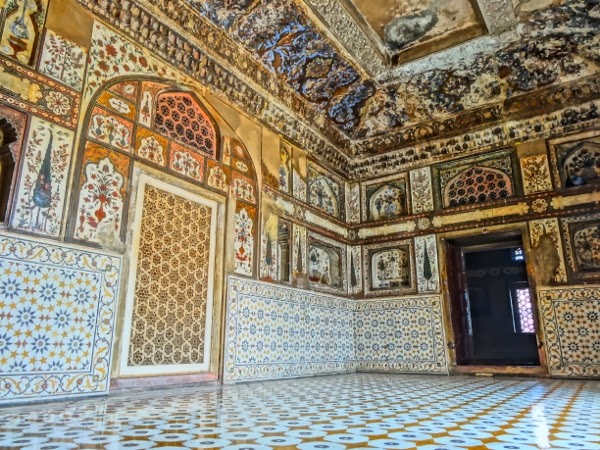
Very few of the millions who visit Agra every year to see the Taj Mahal make the short journey across the Yamuna river to visit I’timad-ud-Daulah. It was an article by Simon Schama in the Financial Times that alerted me to the tomb commissioned by Nur Jahan and built in the 1620s to house the remains of her father, Mirza Ghiyas Beg. I had missed it on four previous visits to Agra, but it was top of my “must see” list when I returned there recently. It’s a little bit of a stretch to call it “forgotten”, as Schama does, but I had to myself on the morning I visited.
The locals refer to it as Baby Taj. It’s easy enough to see why but the comparison is slightly insulting because it diminishes a monument that in some respects surpasses its much more famous neighbor. While the building’s exterior is gorgeous, decorated with onyx, jasper and topaz, it’s when you step inside that you’re likely to be thunderstruck. The richly painted ceilings and walls, covered in plants and flowers, are a riot of color, and make the interior of the Taj itself seem restrained and monochrome. Next time you’re in Agra, ask your tuk-tuk driver to head to I’timad-ud-Daulah, and take an hour to pay homage to the artists and craftsmen of seventeenth century India who created what is truly one of the wonders of the cultural world.

 Miscellaneous Musings