Two Helsinki chapels

Even the most ardent of city lovers sometimes needs a little peace and quiet, a place to reflect, or just a sanctuary from other people.  Parks can be good, but nothing beats churches and chapels.  It always surprises me that they’re so empty.  Perhaps people feel they’ll be obliged to pray when they enter, or could be accosted by some crazed evangelical minister determined to convert the innocent passer-by in need of a moment’s silence.  No matter.  The emptier the better in my view.

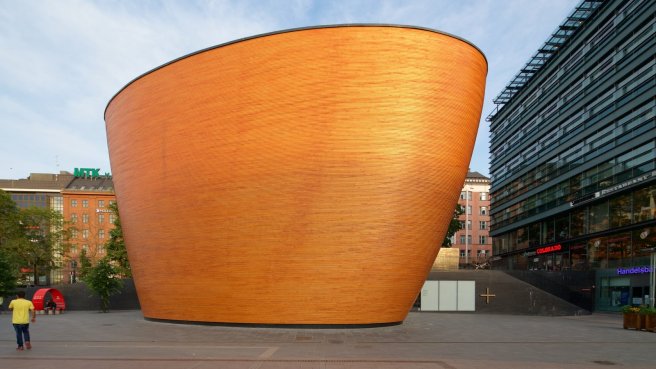
In Helsinki, residents and visitors looking to sit in silence have two very lovely havens, both of which I visited recently.  The first is Kamppi Chapel (pictured below) which opened in 2012.  I love the fact that the chapel is administered jointly by the city’s parishes and Helsinki’s Social Services Department.  It’s an extraordinary building.  Simple and beautiful, it resembles a huge wooden boat that washed up in one of the city’s busiest shopping areas.  It seems hardly possible that it has been open only five years.  It communicates that thing you find in ancient churches, the feeling that it has trapped within its walls the silence and sense of calm which its visitors are longing to absorb.
175503-Kamppi-Chapel

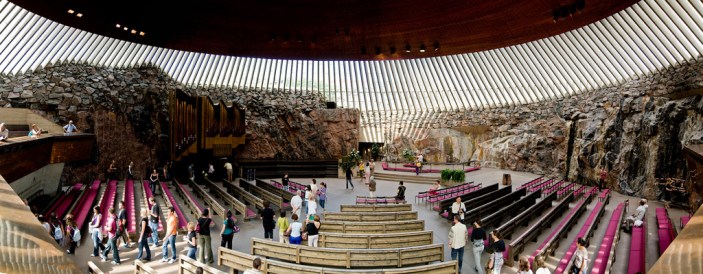
The second chapel I visited was Temppeliaukio Church, known to everyone (probably because Finnish is so hard to pronounce) as the Rock Church.  Excavated into solid rock and topped with a bronze dome, it was opened in 1969.  It has more of the trappings of a conventional church that Kamppi Chapel – altar, pews, organ, and so on – and is more explicitly Christian.  Bathed in light and the warm colors of the granite and wood, it’s a perfect place to sit for a few minutes.
4241456315_533bb740f5_b

Favorite bookshops: Little Tree (Athens)

cafe

A bookshop can become a favorite in an instant.  That’s all it takes – a fleeting moment and the perfect combination of circumstances.  Perhaps it’s lovely weather, a pretty setting, helpful staff, a chance discovery of a great book, even a memorable cup of tea.  When all the ingredients blend perfectly, you have it: that unforgettable place that immediately joins the list of your favorites.

All those ingredients came together recently on a sunny, warm afternoon in a quiet street in Athens, not far from the Acropolis.  I was doing what I like to do – wandering around, but not quite aimlessly.  I knew I wanted a place where I could sit, sip some tea, and watch the world go by.  A friend had recommended Little Tree some days previously, so it was a pleasure to stumble across it during my walk.  It had exactly what I wanted: a quiet patio, shaded by trees, where I could sit with a bunch of young Athenians enjoying coffee and tea.  I couldn’t resist the tea called Soul Euphoria (a combination of apple, chamomile, pineapple, hibiscus, and other ingredients I’ve now forgotten) and a slice of the best homemade lemon tart I’ve ever eaten.

Did I mention this was a bookshop?  Little Tree is, quite rightly, for the locals, and stocks  mostly Greek-language titles.  I found a couple of shelves of English books, mostly translations of classic Greek writers such as Giorgos Seferis.  It didn’t matter.  Great bookshops are about more than books.

London: Exmouth Market

exmouth2

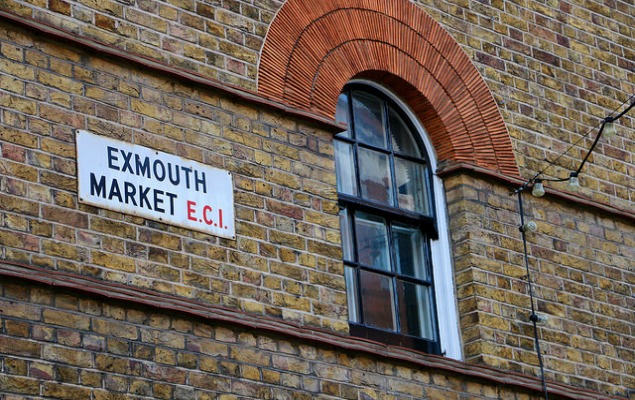
It’s hard to understand sometimes why particular neighborhoods become fashionable quite suddenly.  I might have predicted the renaissance of Bermondsey.  After all, it’s very central, close to the Thames, and has good transport links.  Its regeneration was overdue and, once the White Cube gallery opened on Bermondsey Street, unstoppable.  Exmouth Market’s emergence as a “go-to destination” is a little tougher to explain.  Although the area has a rich history and some good 19th century buildings (notably the Holy Redeemer Church), it wasn’t on anyone’s must-visit list until a few years ago.  It was, let’s be honest, scruffy and uninteresting.

Not any more.  For the past few years Exmouth Market has been a magnet for young Londoners, especially those looking for great food, bars, and cafés.  Moro, the internationally renowned Spanish restaurant, was a big part of that first push twenty years ago, and it continue to draw huge crowds.  Just as good, in my opinion, is its sister restaurant, Morito, which serves amazing, authentic tapas and which I visited recently for the first time.  Following Moro’s lead, scores of other restaurants and cafés have moved in, offering a huge variety of food and drink.  On a warm, sunny evening, the area has a wonderful atmosphere.  If you don’t know Clerkenwell and Exmouth Market, don’t miss them on your next trip to London.

Men Without Women

Have you ever watched a great illusionist very closely and tried to spot the single moment, that split second, that explains how the magic trick happened? That’s how I feel when I read Haruki Murakami.  I can’t count the number of occasions that I’ve read and re-read one of his paragraphs, sometimes a single sentence, trying to identify how he does it.  How he creates such memorable, affecting stories from such simple words.  How he conjures up the strange, yet instantly recognizable world of “Murakami Man”.

The latest collection by Haruki Murakami has seven short stories, all focusing on a single theme: men remembering women from their past.  In one story, Drive My Car, a successful actor describes to his chauffeuse his meetings with his dead wife’s lover.  In another and, in my view, the best story in the collection (An Independent Organ), a philandering plastic surgeon recalls for an acquaintance the experience of falling in love.  In Kino, a bar owner describes a single encounter with a woman customer that changed his life.   The stories stand alone but the thread connecting them all is the narrator/protagonist: the slightly cold, detached, ironic, troubled men who seem capable of deep feeling only when looking back at events long past and remembering the women no longer in their lives.

9780451494627

Those who pounce on his books the moment they’re published – I’m one of them – will be delighted by this new collection, even though (perhaps because?) there is much that’s so familiar.  The tales and their settings may change slightly from story to story, from novel to novel, but the strange, distinctive, unforgettable voice of Murakami persists and it’s a voice like no other in contemporary fiction.

Remembering Borough

Should horror seem more horrifying just because it happens in a place you know well?

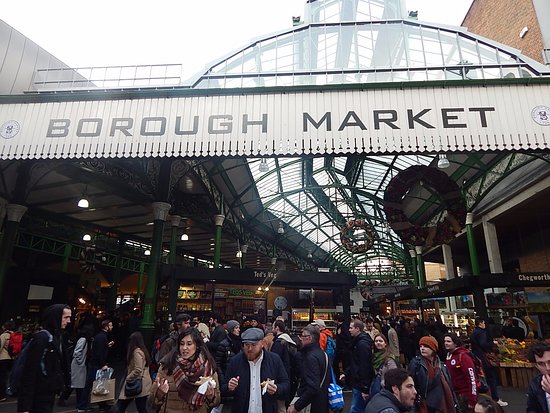
I woke this morning in London to reports of yet more violence in the city, of attacks targeted once again at innocent people.  The victims this time were on London Bridge and in Borough Market, places I know very well.  At least some of the dead and injured were in a pub in which I sat with my family last summer as we enjoyed a day on the South Bank and in nearby Bermondsey.  I remember so vividly the thousands of people thronging the food market that day, tourists and locals alike enjoying one of the most colorful and vibrant areas in the city, a place that’s so much a part of the amazing renaissance of London in recent years, a re-birth that’s embraced neighborhoods previously neglected, like Bermondsey and Borough.

borough-market

It’s impossible to shift from my imagination this morning images of what happened last night in a place I know so well.  Familiarity provokes immediacy and that feels especially true with events as horrific as those last night in London.

London: Regent’s Park

I grew up a short walk from Regent’s Park.  For much of my childhood it was simply the place I went with friends to play football, and I don’t suppose I gave much thought to how lucky I was to have nearly 500 acres of green space on my doorstep.  I knew nothing of its long history and paid no attention to its many features.  It had grass, lots of grass, and that’s all I wanted.

I strolled through the park recently on a warm, sunny morning, simply using it as a short cut from Camden Town to Marylebone.  I hadn’t been there for many years and had forgotten how lovely it is.  It’s a place stuffed full of treasures: rose gardens, historical monuments, an open air theater, and, of course, London Zoo.  It has one of my favorite fountains, endowed by “a wealthy Parsee gentleman of Bombay as a token of gratitude to the people of England for the protection enjoyed by him and his Parsee fellow countrymen under the British rule in India”.  Best of all, Regent’s Park, in spite of its size, feels like a community park, a place to be enjoyed by Londoners, with none of the “keep off the grass” nonsense you see elsewhere.  And it still has hundreds of kids playing football.

Mc280u7Qu6iawvidkFgw_RegentsPark1