
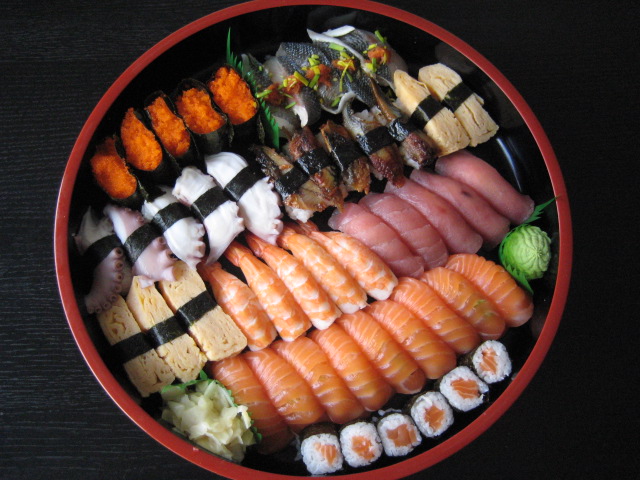
The pattern by now is well established and friends in Tokyo know what to expect. A few weeks before a visit, they’re ready for the inevitable email asking for recommendations for the best places to get sushi and sashimi, help with reservations, directions, and so on. If they’re exasperated, they never show it and never let me down. There’s a lot to be said for the exemplary politeness of the Japanese.
They know my preference for small, off-the-beaten-track places in unfamiliar neighborhoods. Mostly that’s what they give me, but occasionally they steer me to fancier Tokyo restaurants where the sushi is exceptional. On my most recent visit, I got a chance to go upscale and downscale and it was fun to compare the experiences.
We started downscale, at one of those small, unpretentious, local places that you seem to find all over Tokyo. Hiroichi seats no more than twenty people, has no English menu, two staff (neither English-speaking), and offers two basic plates, one of mixed sashimi and one of mixed sushi (mostly nigiri with a little maki). Situated in one of my favorite Tokyo neighborhoods (Ebisu), Hiroichi caters for locals: residents and office workers. The sashimi plate comprised tried and trusted favorites: tuna, yellow-tail, scallop, and flounder, but what set it apart from similar food eaten outside Japan was the extraordinary freshness and delicacy of the basic ingredients. Because I tend to base myself in Ebisu when I stay in Tokyo, Hiroichi is likely to become one of my regular haunts when I need an easy sushi fix close to my hotel.
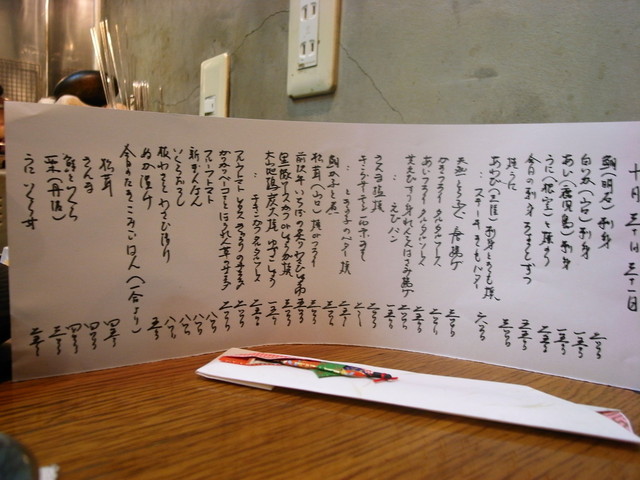
My next choice took me even further downscale, at least if you choose to measure places by their appearance. Asoko is a tiny restaurant in a neighborhood called Azabu Juban. It’s the type of restaurant a visitor would pass by without a second glance. A Japanese friend goes there all the time and was keen for me to experience it. There’s no point in sugar-coating this: it’s a shabby, slightly grim place that might fail a rigorous hygiene inspection. There are ten seats at the bar and no tables. There are no waiters, just the solitary chef who cooks and serves. If you want wine, take your own. The owner will open it for you and help himself to a glass without asking your permission. The handwritten, Japanese-only menu changes daily. On the evening I went, the main event wasn’t the sashimi (though it was excellent). That status had to go to the abalone, the large sea snail that was wriggling on the counter top one moment and within a few moments had been cooked and neatly carved on my plate. Needless to say, I enjoyed every moment at Asoko, and can’t wait to go back.
For my final sushi/sashimi experience, I went high-end, to Sushi Kenzan, a restaurant inside the ANA Intercontinental hotel. Generally I don’t like to eat in hotel restaurants. They’re often over-priced and sterile, but it’s hard to deny that in many cities some of the best cooking is happening in these places. (Just take a look at a city like New Delhi where many of the finest meals are to be had in hotel restaurants). At Kenzan you get a little of the theater of sushi: the waiters in white uniforms and hats, the neatly displayed fish, and the sleek pale woodwork that’s the standard aesthetic for most Japanese sushi restaurants. Set menus are available, but we chose individual pieces of nigiri and maki. Every one was delicious and, inevitably, much more expensive than you would pay in the other places I tried on this visit. That’s the not-too-surprising fact about sushi in Tokyo: standards are amazingly high throughout the city, pretty much regardless of what you pay. I had great fun trying the new places and will never forget the sight (not to mention the taste) of that wriggling sea snail.

 Miscellaneous Musings