Therese Raquin

therese-raquin1

When Zola’s Thérèse Raquin was first published in 1868, it was an immediate succès de scandale.  It’s not difficult to see why.  Its account of lust, betrayal, murder, and madness had all the ingredients for popular success, but it was its explicit portrayal of female sexuality that drove the censorious French critics and readers to outrage and condemnation.

It’s a straightforward enough, though somewhat lurid, read.  There’s nothing subtle about it.  In fact, its relentlessly grim and sombre tone left me feeling somewhat smothered by darkness and longing for even a glimmer of light.  I read the novel in English, in a translation by Leonard Tancock first published in the early 1960s that in part reminded me of the sensational and excessively dramatic language used in penny dreadfuls.  I’d be interested to see if this is muted in a more recent translation or whether it reflects faithfully Zola’s original.

This year’s travels

34ce8e86ecb69ca417379ab9c90ad64d

It proved to be a busy year.  Fourteen countries visited in twelve months, some of them on multiple occasions: UK (five times), Japan (twice), United Arab Emirates (twice), Jordan (twice), India (three visits), Germany, France, Netherlands, Spain, St. Lucia, Belgium, Australia, New Zealand, and South Korea.  Somehow I managed to touch down in four countries in a single day: New Zealand, Australia, Singapore, and Japan, a milestone for me that I never want to repeat or recommend to anyone else.

What will I always remember from 2016?  Walking completely alone in the chilly, early morning hours through the ruins at Petra.  Exploring the temples of Kyoto and an unforgettable kaiseki dinner.  The road from Queenstown to Glenorchy.  The quiet streets of Segovia.  I’ll never forget my first-time visits to Jordan and New Zealand, two beautiful countries where I couldn’t have been welcomed more warmly, countries I already want to re-visit, countries I want to share with others. Not all the delights were international.  My first sight of Fallingwater – just a few hours drive from my home – was unforgettable.

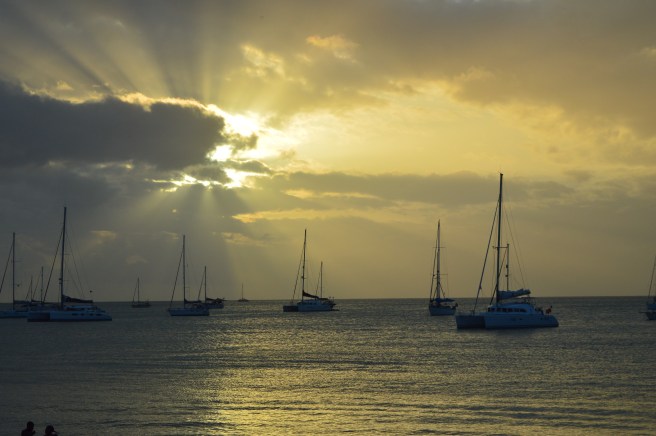
Don’t believe the clichés or the cynics.  It’s not a small world. It’s not a homogeneous world.  It’s a huge, diverse, gorgeous, thrilling, and humbling world, and here are a few pictures I took in 2016 to prove it!

DSC_0063DSC_1410IMG_1498

A Handful Of Dust

Other than the unforgettable TV adaptation of Brideshead Revisited, I knew almost nothing about Evelyn Waugh’s novels before picking up a copy of A Handful of Dust in the Amsterdam branch of Waterstone’s recently.  I had thought for some time that I should do something about this gap in my reading, but two things deterred me.  First, by all accounts Waugh was a horrible man; a cruel, snobbish misogynist.  I’m not sure why this should matter, but it certainly influenced me. Second, I’d absorbed the impression (from where I’ve no clue) that his novels were little more than period pieces; brittle, superficial accounts of a society long past.

5071
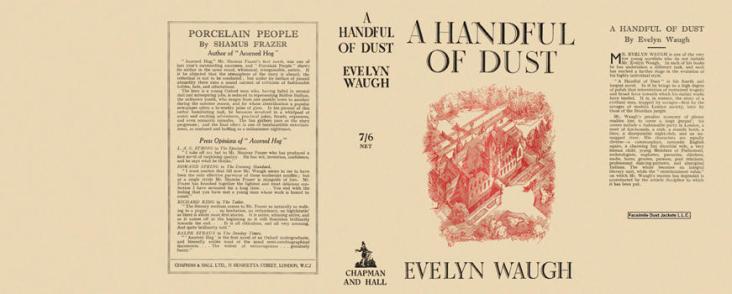
The dust jacket of the first edition of A Handful Of Dust, published by Chapman & Hall, 1934

It’s easy enough to read A Handful Of Dust as a light comedy or social satire, a biting critique of the feckless, bored, and immoral upper classes of the interwar years, but it’s much more than that. However bitter and caustic its tone, there is at the heart of the book a real sense of sadness.  Tony and Brenda, trapped by their addiction to wealth, social status, conventional good manners and routine, occasionally touching sentimentality but always incapable of reaching and expressing genuine, deep feelings, are terrifying reminders of what can happen to the aimless and lightly rooted, however privileged their circumstances.  Published in 1934, it’s very much a novel for today.