Food and community

food-and-drink-pr

I listened this evening to a conversation between people who know a lot about restaurants and bars.  Ruth Rogers, who has run for nearly thirty years the outstanding restaurant (The River Café) she co-founded with the late Rose Gray; Nemanja Borjanovic who, with his girlfriend, gave up a career in finance after a spontaneous stopover in San Sebastian and started his own place in London (Donostia) to pursue his love of Basque food; and Alice Lascelles, who writes about bars and drinks for the Financial Times.  The occasion was the London launch of The Monocle Guide to Drinking & Dining.

They talked so passionately and humorously about how it’s communities that build great restaurants and bars and that it’s restaurants and bars that build great communities.  They talked about how we use food and drink to celebrate love: our love for our partners, friends, families, and businesses.  They were scathing about formulaic, cookie-cutter restaurants and food fads, and excoriated the “turn a quick buck” mentality that almost always ends in commercial failure.  They all celebrated the essential ingredient for success: not the celebrity guests, not the critics, not the bloggers, not the tourists, but the “regulars”: the people who live within a mile of the restaurant and visit once a week.

There were many American restaurateurs and chefs in the audience, all of them from Los Angeles or New York City.  Several of them asked questions and all of them complained about the conditions – high rents, short leases, clients less interested in food than fads – that made long-term success so difficult in their native or adopted cities.  Many were resigned to a future (at best) of short-term, serial successes, something none of them wanted and all of them would have gladly traded for feeding and nourishing real established communities.  They feared for the future of great, simple, and honest food and of authentic restaurants, but most of all they feared the disappearance of the diverse and permanent urban communities necessary to sustain them.

After a really thought-provoking evening, there was only one thing to do: eat and drink.  I chose Daylesford, a London outpost of an organic farm in Gloucestershire.  I like to think the panelists would have approved.

The Theatre of Dreams

old-trafford-v2

I was seven or eight years old when my father started taking me to football matches.  We lived a short bus ride from both Highbury and White Hart Lane, so it should have been Arsenal or Spurs that won my loyalty and affection, but George Best had other ideas.  Almost single-handedly that absurdly talented and glamorous player was responsible for tying me for life to Manchester United.  One afternoon with my father at Highbury watching Best, Charlton, Law, and the others and I was swept into the community of Reds, part of the vast diaspora of fans living far from Old Trafford.  I went to the stadium a few times in 1977 when I lived near Manchester, but for most of my life I’ve followed my team through television and through the occasional away game.

An apple doesn’t fall far from the tree, so I guess it’s no big surprise that my two sons are loyal to United and join me on the sofa most Sundays between August and May to watch their team play.  They’ve seen some of the new generation of United stars play in a pre-season U.S. tour, but they haven’t experienced something an American stadium can never replicate, the unforgettable and uniquely tribal sound of 70,000 or more diehard United fans willing their heroes to victory at The Theatre of Dreams.  I’ve been planning for a long time to do something about that.  As the journalists used to say, watch this space …

Football in the late 1960s wasn’t the big business it is today.  No replica shirts, just woolen scarves and silly bobble hats.  No VIP seats, no seats at all, just terraces of chanting men and boys.  I don’t much like the bogus nostalgia for those times that you often hear.  The experience of watching football today is a lot more comfortable than it was fifty years ago and with the decline of fan violence it’s certainly a lot safer for kids.  My sons will never know what it was like to stand on terraces in the freezing cold for two hours, wearing a rosette and carrying a rattle, but maybe they’ll get something I have and all football-crazy boys should have: the precious memory of being with their Dad and in the company of their idols.

Nutshell

fetus-expel-waste_26f7bbe78fc7d6c2

It’s a small, élite group: the authors whose books I always buy as soon as they are published.  It’s a group that changes from time to time.  I used to wait impatiently for new novels by the likes of Salman Rushdie and Martin Amis, but no more.  At some point they went to places I didn’t want to go.  I’m sure I feel the loss more than they do.  Inevitably and occasionally the group gets diminished by inconveniences (major for the author, less so for me) such as death.  No more novels from John McGahern, Brian Moore, P.D. James, and Iris Murdoch.  That’s a sad thought.  No matter; sometimes someone new joins the group, someone like Julian Barnes, and that’s enough to banish the blues.  I found Barnes’ earliest work dry and self-regarding, but more recent books have been wonderful.  He’s changed and so have I. *

Ian McEwan is in the group, no question, and has been for more than thirty years.  That’s not to say he doesn’t test my patience and loyalty from time to time.  He’s written one or two real duds in his long career.  Sweet Tooth, for example, or On Chesil Beach (which a friend whose taste I respect thinks is among McEwan’s best ever work).  I always forgive him.  Why wouldn’t I?  He gave me The Comfort of Strangers, Atonement, Saturday, and many more that I’ll be re-reading for years to come.

I’d heard before buying Nutshell that the story’s narrator was a fetus.  Call me unadventurous if you must but that made me nervous. Cute idea, I thought, but maybe too cute?  But hey, this is McEwan.  He’s in the group, he’s got some credit in the bank, let’s suspend criticism and see where he takes me.  Our fetal narrator, just a few short weeks from birth, hears his mother plotting to kill his father.  And guess who’s the co-conspirator?  The father’s brother, keen to get his hands on some valuable real estate.  If you’re getting echos of Hamlet, don’t be surprised.  The parallels are explicit and quite deliberate.

There’s some lovely writing here and, perhaps surprisingly given the somewhat grand guignol plot, some very funny passages. I don’t usually think of McEwan as a comic writer, although there’s some very dark humor in some of the early novels, but there’s a light, deft touch in Nutshell that I liked a lot.  That said, it’s not one of his greatest works.  It reminded me of one of those pieces a great pianist might give as an encore, designed to show off the performer’s mastery of technique.  A delightful and charming crowd-pleaser, but not the magnum opus you wanted to hear.  Nutshell may not add much to his corpus but McEwan’s place in the group is safe, at least for now.

*Perhaps you’re wondering who else is in the group.  Haruki Murakami, Graham Swift, and Colm Toibin for sure, perhaps one or two others.

Ten Years In New York

nyc-walking-tour-broadway-history-and-culture-in-new-york-city-105440

Exactly ten years ago today I moved from London to New York.  My memories of the first few days in Manhattan are unusually vivid and surprisingly sensual.  I remember opening my eyes very early on my first morning, a Sunday.  The sirens from the fire trucks on West 57th Street might have woken me, but I don’t think so.  It was excitement, the delicious illusion that anything was possible and everything was achievable, a feeling that every immigrant has known.  I recall getting up and walking around the immediate neighborhood, surprised that the city that never sleeps likes to stay in bed on Sunday mornings.  I walked endlessly and everywhere for the sheer pleasure of it, picking a couple of new neighborhoods every weekend.  Subways, cabs, buses, trains and ferries would come later. Ten years on, I realize that my mental map of the city took shape in the long walks of those first few weeks. Like generations of new immigrants, I fell in love with New York.

Ten years on, the love affair has cooled.  Now I see the city’s flaws more than I see its charms and find myself comparing it unfavorably with other, older loves, especially London, the city in which I was born and raised.  Hoping to find New York’s substance, I try to look beneath the shiny lacquer that the city wakes up and re-applies every morning, but often uncover only things it wants to hide, things the world needs less of: greed, aggression, directionless energy, and vanity.  More and more Manhattan feels to me like a place for the young and the immature –  monochrome, uniform, and sometimes just plain bland.  The city imitated by so many (Shanghai and Hong Kong among others) has been surpassed by its progeny and feels old and tired in comparison.

No matter.  I’ve had ten very happy years in what is, for better or for worse, my adopted home, and I plan to have many more.  The early morning sunshine slanting through the east window in Grand Central still stops me in my tracks.  Who cares someone was stupid enough to allow an Apple store to open directly beneath it?  Well, I care, but what can you do?  New York loves money more than beauty, always has, and always will.

Primo Levi

I was given The Complete Works of Primo Levi as a birthday present.  It wasn’t a surprise gift: in fact I was shameless about dropping hints.  I’m so glad I did.  It’s a beautiful set, three volumes and nearly three thousand pages, a tribute to the art and craft of publishing and a fitting monument to a wonderful writer.

150928_r27011-866

Primo Levi’s fame, his reputation, and his status as one of the leading figures of 20th century literature derive to a great degree from his searing account of the year he spent in Auschwitz, If This Is A Man.  This collection reveals how much more there was to Levi.  Levi the poet, the essayist, the endlessly curious traveler to the heart of the human condition.

Primo Levi died in 1987, most likely by his own hand.  Although his simple gravestone bears only his name, the years of his life, and the sequence of numbers tattooed on his arm by the Nazis, 174517, these books are the most fitting memorial the world could have given to a great writer and an even greater man, a definitive collection of the gifts he gave to us.


I Am An American

JapaneseAmericanGrocer1942.jpg

A print of this photograph by Dorothea Lange hangs on my office wall.  It means a lot to me, but not because it’s some kind of memento of, or statement about, my becoming a U.S. citizen last year – something visitors to my office sometimes assume.

The picture was taken in Oakland, CA in March 1942, but the banner you see on the storefront was  placed there on December 8th, 1941 – the day after the strike on Pearl Harbor.  Look carefully at the business owner’s name painted on the window.  Mr. Wanto, a graduate of the University of California, was forcibly evacuated and his business shuttered, and he was interred with thousands of Americans for the duration of the war for no other reason than that he was of Japanese descent.  His banner – unbearably poignant – is at once a protest, a defense, an explanation, and a plea to the conscience of his neighbors.  The words don’t contain even a trace of the pride we usually associate with them.

In 2016, a year when one of our Presidential candidates demonized Mexican immigrants as rapists and drug dealers and routinely abused Muslim citizens, can we expect to see banners like these appearing in other parts of the country, as Americans born outside the country or to parents born outside the country are forced to defend their status and allegiance to their neighbors?  Public discourse in this election season has been unusually poisonous, but none of us should tolerate our politicians deciding if some citizens are “more American” than others.  “I am an American” is a phrase that ought to speak to the values that unite us.  Used any other way, it betrays everything the country represents.

Addlands

50-copies-of-Addlands

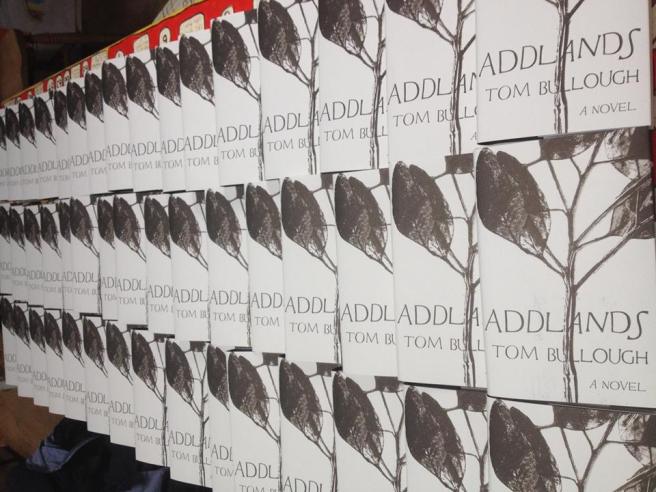
I had no idea novels such as Addlands were still being written.  Novels rooted in the countryside, novels about people’s intimate connections to the land and to nature – the kind of novels that used to be commonplace and that the likes of Zola, Hardy, and Lawrence once wrote.  I’m delighted I found this unforgettable book (through a review in the Financial Times, of all places), and not only because it introduced me to a wonderful new talent.  It woke me up to an entirely new genre: modern pastoral fiction.

Addlands is set in the Welsh borders and tells the story of a poor farming family, the Hamers,  over a period of seventy years (1941 to 2011).  Nothing much happens that doesn’t happen in any human life – birth, death, love, work, enmity – but Addlands has the force of an epic.  Reading it felt like listening to a long hymn to the land, to its rhythms and cycles, to humans and animals, and to the forces of the last century that are changing it all.

I considered having a dictionary close at hand when I started to read Addlands.  Whilcar, fescue, wittan, dankering – these and many other words previously unfamiliar to me appear in the first few pages of the novel.  I decided to forego the dictionary, thinking that the interruptions would obstruct my immersion into the extraordinarily vivid world created by Tom Bullough and into his sinuous, lyrical prose.  I think I was right.  This is a book to wash over you, to buffet you, to stun you.  Understanding some of the words can wait for the second or even third reading that a novel of this power and skill demands and merits.

“In crystalline, perfect, and stunning prose, Addlands does what literature should unstintingly aspire to do; make individual lives the essential stuff of epic.  The presence of this book – in shops, in homes, and in the minds of its readers – will improve the broken, atomized world.  It’s an astonishing work of words.”  Niall Griffiths.