A Little Life

maxresdefault

I knew nothing about this novel when I bought it.  All the kudos, all the hype that followed its appearance last year had somehow passed me by.  It wasn’t until I kept seeing – on the subway, on airplanes, on trains – so many people immersed in A Little Life, that it piqued my curiosity enough to pick it up at my local bookstore.   My first impressions weren’t positive and I came close to giving up on it on several occasions within the first hundred or so pages. It was partly the setting.  800+ pages about a quartet of entitled, privileged New Yorkers – a lawyer, actor, architect, and artist?  Not again, please. I’m very glad I stayed the course. If I had given up, I would have missed something special: a story that eventually grabbed me hard and wouldn’t let go even after I closed the book for the last time.

A Little Life is the story of Jude St. Francis, a brilliant, successful New York lawyer, and the friends who loved and admired him.  That sounds like the summary of a comforting, uplifting tale, doesn’t it?  But Jude has secrets that he can share with no one, secrets so terrible that success, love, friendship, and all the other gifts that usually sustain a life aren’t enough to rescue him, to pull him free from the pit of self-hatred in which years of childhood abuse and betrayal had buried him.

My summary makes A Little Life sound like a melodrama. In some respects it is.  It’s a novel with conspicuous faults.  It’s over-long and often over-written, cheaply sentimental in places.  A better, more confident editor would have pruned it hard.  But these shortcomings, though important, don’t diminish the novel and its power.  I can’t recall reading a story that traveled so convincingly to the heart of someone’s suffering, a suffering so ravaging that it hollowed out its victim, leaving nothing but the longing to die. Parts of it were very painful to read.  I so much wanted the redemptive power of love and friendship to be enough to heal Jude.  I wanted a happy ending, a tidy resolution, a comforting lie.  A Little Life didn’t oblige and that’s why it’s so good.

Dosai

dosa-1

Growing up in London it was never difficult to find a curry house, but only when I was older did I realize that most of the “Indian” restaurants weren’t Indian at all, but owned and operated by Bangladeshis and Pakistanis.  I was told once that the food served in London’s curry houses, unlike that in Bradford or the West Midlands, had more in common with the cuisine of Sylhet (a city in northern Bangladesh) than that of any part of India.  That was certainly my experience when I first went to India in 1979 and failed to find any of the dishes I had grown used to in London.  It took me a while to realize that, if I dug more deeply in London, I could find authentic regional Indian food without too much difficulty.  In fact, less than a mile from where I grew up, I could find several restaurants (in Drummond Street in Euston) that specialized in the vegetarian dishes of South India and one of its staples: dosai.

A dosa is a thin pancake made from a fermented batter consisting mainly of rice and urad beans.  The pancakes are usually stuffed with spicy vegetables and served with sambhar (a lentil broth) and some type of fiery chutney.  They’re a staple of South Indian cuisine but can now be found in many regions.  Whenever I return to India, one of the first things I do is to find somewhere that serves dosai for breakfast.  Watching a chef ladle the batter on to the griddle, spreading it thinly to make the pancake as crispy as possible, folding in the spicy vegetables – this has become a little ritual for me.  The texture and flavors of a dish that most Indians think of as little more than inexpensive, fast food somehow conjure up for me great memories of India … and London.


My Travel Wish List

World-Polit-Med-TMSWORLD

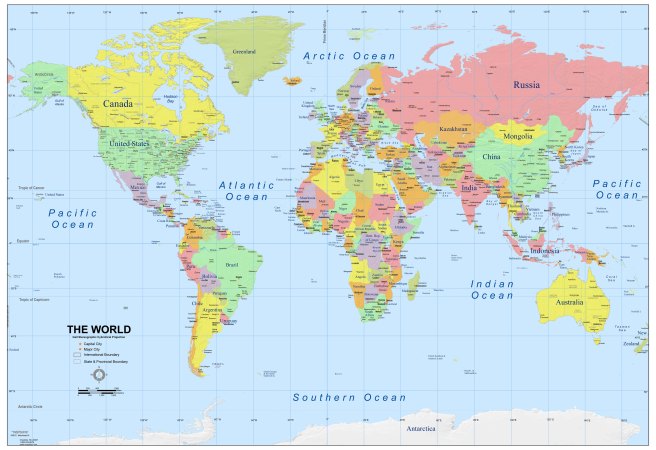
Counting the countries of the world.  That ought to be simple, right?  Well, yes and no.  Politics complicate things slightly.  Depending on whether you think Taiwan is a separate country or not, there are either 196 or 197 countries in the world.  I have visited only 63.

A favorite dinner table conversation with my kids is to name the top 10 countries that each of us would like to visit.  Here are mine.

  1. Ethiopia
  2. New Zealand
  3. Bhutan
  4. Tibet
  5. Tanzania (including Zanzibar)
  6. Peru
  7. Vietnam
  8. Laos
  9. Morocco
  10. Russia

I notice two things about my list.  First, it changes quite frequently, so I plan to check it again in a year’s time.  Second, as my kids point out to me, there are only nine countries on the list unless you think Tibet is a sovereign state (which I do).