
The meaning of kaiseki is elusive. Some of my Japanese acquaintances use the term quite generically and in much the same way as others might use haute cuisine, to refer to elaborate and expensive Japanese food, regardless of region, type, or ingredients. For those who use it more specifically, kaiseki describes a multi-course dinner in which the flavor, texture, color, and appearance of the ingredients are carefully combined and artfully presented on beautiful tableware. The most pedantic of foodies go even further, distinguishing the more generic kaiseki-ryori from cha-kaiseki, the simple meal served before a ceremonial tea. It can all get very confusing very quickly, like so many other things in Japan.
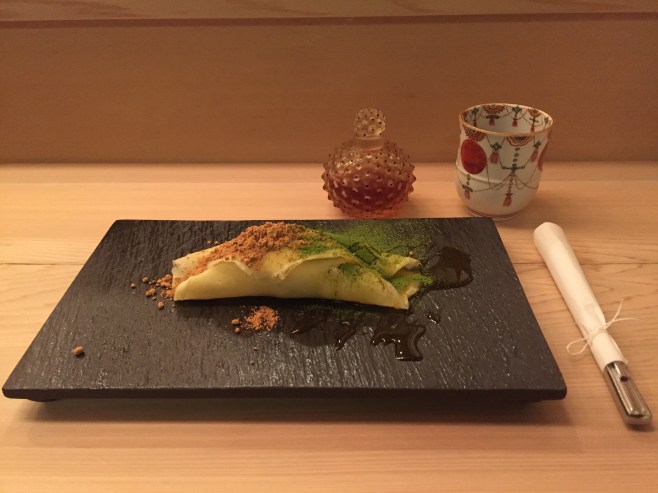
I’ve been fortunate enough to experience kaiseki at its best on a few occasions, most recently at Kichisan in Kyoto. The picture above – a crepe stuffed with banana and yuzu sorbet drizzled with cognac – shows one of fourteen or so courses served that evening at a dinner that took nearly three hours. It’s not the type of cuisine to suit the abstinent or the impatient. What’s the point of preparing and eating food so elaborate, intricate and – let’s be honest – so extravagant? It certainly has little or nothing to do with satisfying hunger, so the usual frame of reference seems unhelpful. Of course, for the restaurateur it’s a money making proposition, but it’s probably less lucrative than many other types of commercial food ventures. So what’s going on with kaiseki?
Unless you’re inclined to conclude that it’s just one of those victim-less crimes – the rapacious ripping off the gullible, the gluttonous, and the greedy – and need look no further, I think the answer can be found by looking at other experiences that are elaborate and transient. Why do some people pay large sums to watch performance art or new orchestral music – events that require meticulous preparation, are expensive to stage, and that are often unrepeatable in the precise form in which they are experienced? Can’t the appeal of kaiseki be explained in a similar way?
 Miscellaneous Musings