T-site

Courtyard at Tsutaya T-Site Bookstore.  Daikanyama, Tokyo, Japan.
Courtyard at Tsutaya T-Site Bookstore. Daikanyama, Tokyo, Japan.

It’s perhaps a little strange that one of my favorite bookshops anywhere in the world should be one in which most of the books are inaccessible to me.  I can’t read Japanese, but somehow it doesn’t seem to matter when I visit T-site, something I always do when I’m in Tokyo.  The shop is in an upscale neighborhood called Daikanyama, an area that on Sunday afternoons teems with affluent young couples pushing strollers and with hipsters checking out the local high-end boutiques.

So what makes T-site so special?  It’s certainly a beautiful store, comprising three striking buildings connected by a central aisle on the ground floor.  It’s also, as you might expect in a country renowned for its efficiency and aesthetic sensibility, smartly designed.  My favorite part of the store is the Anjin Library and Lounge on the second floor, a beautiful haven where you can order a coffee or have a bite to eat surrounded by rare books and vintage magazines.

But the best thing about T-site is the hordes of book lovers that crowd the store.  I’m not exaggerating.  Whenever I visit, its aisles are packed with young people browsing, buying, reading, and chatting.  It can be tough to move around freely – that’s how popular this store has become. If bookshops are dying, the young people of Tokyo don’t seem to have got the message, thank goodness.

York, PA

York was supposed to be nothing more than a convenient stop-over, a place to break the long drive home after my visit to Fallingwater.  First impressions weren’t favorable.  It looked like one of those many once-prosperous towns hit hard by the economic downturn: slow-moving, a little shabby and neglected.  It’s sometimes hard to give a place a second look when you’re traveling.  Time is often tight and it’s tempting to move on without exploring beneath the surface of things.  I’m glad I resisted the temptation and lingered a little while in York.

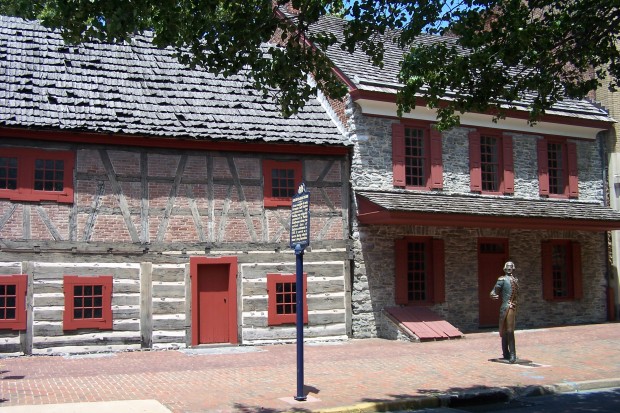
The first surprise was the abundance of historic buildings downtown, mostly brick-built but also some half-timbered, such as The Golden Plough tavern built in 1741.  One of these buildings, the Central Market Hall, built in 1888, felt like the beating heart of York, filled with small stalls selling produce of all kinds and a few eating places such as The Copper Crust Company where I had breakfast.

r41kafavcruduackwtxt

The more I wandered around the town, the more I noticed the beginnings of York’s tentative revival.  As in many places, it’s a revival that seems to be led by artists.  I stumbled across a number of small studios and galleries, including Marketview Arts Studio which offered affordable work and exhibition spaces to young artists.  And don’t overlook the culinary arts if you find yourself in York.  For a great dinner I’d recommend especially The Left Bank.

Fallingwater

“Study nature, love nature, stay close to nature.  It will never fail you”.  Frank Lloyd Wright.

It snowed the night before I visited Fallingwater for the first time.  The rhododendrons that surround the house had a fine coating of snow when I arrived on a sunny and cold morning for the first guided tour of the day. Approaching the house down the long driveway, I saw the paradox that lies at the heart of this beautiful house and Frank Lloyd Wright’s genius as an architect: that something made of steel, concrete, and glass should celebrate the natural world and remind you of its central significance in our lives.

The family that commissioned the house in the late 1930s, prosperous store owners from Pittsburgh, was surprised when it first saw the designs because they offered no view of the waterfall at the center of the site.  Wright patiently explained that his intention was that his houses should allow people to live in the natural world,  not to offer pretty views of it.

new_first

So much of the construction we see around us every day seeks to obliterate, marginalize, or smother the natural world.  Fallingwater represents the opposite viewpoint: a building that celebrates the integration of people into the environment.  Nearly 80 years after the Kaufmanns moved into their “modest cabin by the falls”, Wright’s gift to the world is much more than a house.  It’s a message about how to live.

Kinki Fish

1403768_685017868176350_1910796901_o

Whenever I go to Japan I look forward to trying cuisine that is often strikingly different from that I find at home. New ingredients, new tastes, textures and flavors – they’re all part of the magic of travel. With a Japanese friend as a guide, I recently went restaurant-hopping in Ebisu.  In the narrow streets around the train station I met the kinki fish for the first time.  Also commonly known in some places as idiot fish and more properly referred to as thornyhead rockfish, kinki is typically found in the northern Pacific.  Its habitat is the deep ocean, where low oxygen levels make it difficult for most species to survive.  Served whole and on the bone and with its crispy skin in place, kinki is a delicious and, it has to be said, very ugly fish.

Having enjoyed the food and being of a curious disposition, I decided to find out more about my kinki dinner guest, only to discover that it’s on a list of protected and at-risk species.   To say that spoiled my evening is an understatement and provoked this question. How can you be an adventurous and spontaneous traveler and at the same time be responsible to and aware of your environment?   I’m still thinking about that one and my encounter with the kinki fish.

The Dust That Falls From Dreams

Lord Flashheart, the randy fighter ace played by Rik Mayall in Blackadder Goes Forth, once jokingly complained of the First World War, “This damn war. The blood, the noise, the endless poetry”.  He could just as easily have said “the endless novels”, given how much inspiration that war has provided to novelists in recent years.

Louis de Bernières’ latest story is a sprawling 500 page family saga set mostly during and after “the war to end all wars”, as H.G. Wells described it.  It centers on the McCosh family, an affluent and somewhat eccentric clan living in Eltham, and more especially on the fates of its four daughters.

the-dust-that-falls-from-dreams

This is a soothing, comforting novel, a type of fiction that’s gone out of fashion, perhaps deservedly.  In the hands of a less gifted writer it might have turned out sentimental and silly, but de Bernières knows how to tell a story.  Reading it, I was reminded of watching Downton Abbey and that feeling of being drawn into an enchanting, seductive, and not entirely believable world.  There’s some vivid and occasionally very funny writing, and overall it’s never a strain to read, but the effort to portray the significance of the war often seems labored.  This is ground covered more subtly and effectively by the likes of Pat Barker and Sarah Waters.

Incidentally, the dust jacket of the U.S. hardback edition is one of the most attractive I’ve seen recently.

Sushi Musings

There’s a sushi restaurant in the Gotanda neighborhood of Tokyo.  It’s one of those places hidden in plain sight, easy to find only if you know it’s there, tucked among other undistinguished buildings on a featureless, busy street.  It’s small, with six seats at the counter and a private room at the back that no one ever seems to use.  It’s slightly rundown and looks like it hasn’t been modernized since it was first opened a few decades ago. I suspect it might fail any rigorous hygiene inspection.  No menu is offered and only cash is accepted.

The place is owned and run by the sushi chef and his clearly devoted wife.  He prepares and serves the sushi (usually nigiri) while she takes care of drinks, the bill, and everything else.  They’re a boisterous and hospitable pair, yelling welcomes when you arrive, farewells when you leave, and smiling all the time in between.  It feels like you’re eating in someone’s home.  Someone you can’t understand, who grins at you throughout your meal, tells you what to eat, and takes your money before you wander off happily into the night.

IMG_1622

Sushi is apparently the simplest of foods.  What other popular cuisine consists of only two ingredients: rice and fish?  But if you listen to the aficionados, they’ll tell you it’s very difficult food to pull off.  They’ll also argue endlessly and tiresomely about which of the two ingredients matters most, but will eventually agree that it’s the pairing of both that makes the difference.  In experienced and skilled hands, like those above, that simple combination can taste sublime.

If you ask me nicely and promise never to go there, I might tell you the name of the place in Gotanda.

Musing About Kaiseki

The meaning of kaiseki is elusive.  Some of my Japanese acquaintances use the term quite generically and in much the same way as others might use haute cuisine, to refer to elaborate and expensive Japanese food, regardless of region, type, or ingredients.  For those who use it more specifically, kaiseki describes a multi-course dinner in which the flavor, texture, color, and appearance of the ingredients are carefully combined and artfully presented on beautiful tableware.  The most pedantic of foodies go even further, distinguishing the more generic kaiseki-ryori from cha-kaiseki, the simple meal served before a ceremonial tea.  It can all get very confusing very quickly, like so many other things in Japan.

IMG_1617

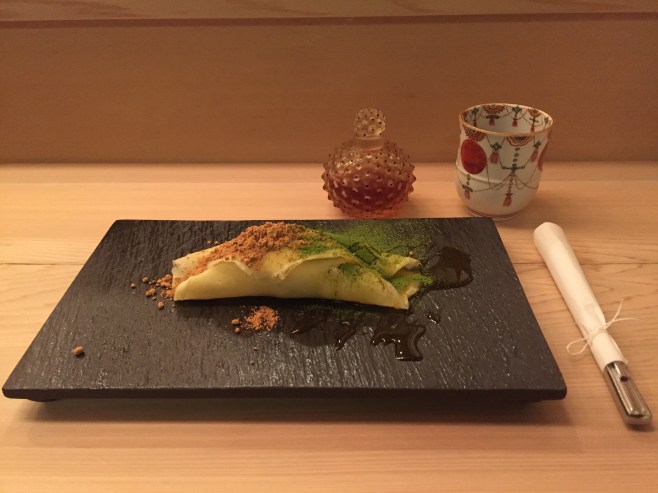
I’ve been fortunate enough to experience kaiseki at its best on a few occasions, most recently at Kichisan in Kyoto.  The picture above – a crepe stuffed with banana and yuzu sorbet drizzled with cognac – shows one of fourteen or so courses served that evening at a dinner that took nearly three hours.  It’s not the type of cuisine to suit the abstinent or the impatient.  What’s the point of preparing and eating food so elaborate, intricate and – let’s be honest – so extravagant?  It certainly has little or nothing to do with satisfying hunger, so the usual frame of reference seems unhelpful.  Of course, for the restaurateur it’s a money making proposition, but it’s probably less lucrative than many other types of commercial food ventures.   So what’s going on with kaiseki?

Unless you’re inclined to conclude that it’s just one of those victim-less crimes – the rapacious ripping off the gullible, the gluttonous, and the greedy – and need look no further, I think the answer can be found by looking at other experiences that are elaborate and transient.  Why do some people pay large sums to watch performance art or new orchestral music – events that require meticulous preparation, are expensive to stage, and that are often unrepeatable in the precise form in which they are experienced?  Can’t the appeal of kaiseki be explained in a similar way?

Japan: Kyoto

Kyoto-69643

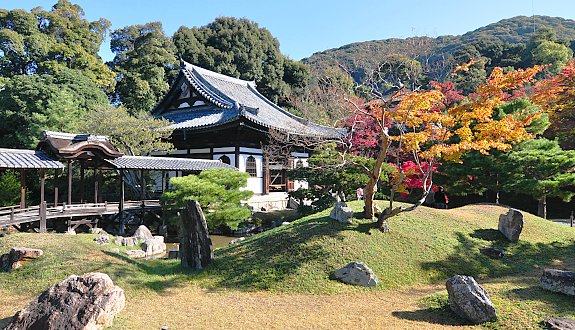
The cherry trees were just starting to flower when I arrived in Kyoto.  The appearance of the blossom marks the peak of the city’s tourism season, but the old, narrow streets leading to Kyomizu-dera temple were quiet and the shops still shuttered when I visited in the early morning.  The day had started grey and chilly.  By the time I had reached the Yasaka shrine a few hours later the sun had broken through and it was warm enough to have a coffee sitting outside and watch the occasional honeymooners in traditional costume walking in Maruyama park.

The spiritual and the temporal co-exist comfortably in most of the Japanese cities I have visited, but nowhere so well as they do in Kyoto.  The city’s many shrines and temples are far more than visitor attractions or historical monuments.  Like ancient parish churches in England, they feel like the heart of a persistent but understated religious culture.  In Kodai-ji and Chion-in temples and in Otani Sobyo I came across scores of Buddhists of all ages quietly praying or meditating, largely oblivious to those like me drawn to the buildings by more secular interests.  In Kyoto, a city otherwise as frenetic as any in Japan, the modern and the secular haven’t swept away a more enduring and contemplative spirit.

3927_02b


After The Quake

July 7th 2005.  I was in central London the day terrorists detonated suicide bombs on three underground trains and a bus.  Fifty-two people were killed and more than seven hundred injured.  What I remember particularly of that terrible day was an image that came to me very suddenly and that has stayed with me ever since: an image of the fabric of daily life being torn by the sudden and indiscriminate violence.  Looking through the ripped fabric, I felt I was looking into a parallel world in which everything seemed more or less familiar, but also slightly and permanently altered.  Feeling secure and safe no longer seemed possible.  In fact, security and safety suddenly seemed like childish ideas, innocent delusions shattered by the bombs as surely as the victims.  For a moment, the proximity of devastating violence created a completely new reality, a reality in which there was no longer a place for innocence.

That glimpse of a new reality cannot be sustained for long.  The thing you see so clearly for a short time through the torn fabric fades.   It’s impossible to live in the new reality because “normal life” repossesses you powerfully, at least until the next devastation rips the fabric once again.  But something small, deep, and fundamental is changed by proximity to death and injury on that scale.  Whatever you catch sight of momentarily through the torn veil – mortality, insecurity, whatever – stays with you and is never wiped away completely.  One’s life is changed, in a way that is perhaps imperceptible to others and inexplicable to oneself but that is real and profound nevertheless.

haruki-murakami_apaisado

The small, subtle, almost invisible changes wrought by violence are the subject of the six powerful short stories collected in Haruki Murakami’s After The Quake.  All the stories were inspired by the Kobe earthquake of 1995 in which more than 6,000 people died.  The quake looms in every story, less a backdrop than a malign influence shaping the lives of the characters.  It’s a provocative and transformational force, causing a woman in one story to leave her husband and a man in another to declare love that had been unspoken for years.

The essence of Murakami can be found in these stories.  Here you’ll find in miniature everything that has made him one of the most impressive, distinctive, and admired novelists writing today.  It’s very difficult to isolate what it is that makes his work so compelling for so many readers.  The prose is spare and stripped down.  Reading Murukami, I often find myself re-reading individual sentences trying to discover how something apparently so simple ends up being so distinctive and powerful.  His characters, so precariously and tenuously connected to life and to the world, so vulnerable and so fragile, look to me like heroes in a violent, dangerous, and uncertain world.

“Pay very close attention.  He is telling us the story of the free spirit that is doing everything it can to escape from within him.  That same kind of spirit is inside me, and inside you.  There – you can hear it, I’m sure: the hot breath, the shiver of the heart.”