Academy Street

Isn’t it miraculous that, through the careful and artful combination of words on a page, it’s possible to communicate truthfully something of the essence of what it is to live, to be human?

My second book of 2016 was Academy Street, a debut novel by the Irish writer, Mary Costello.  It’s a short novel – fewer than a hundred and fifty pages of taut, precise prose – that tells the story of Tess Lohan from her childhood days on a family farm in the west of Ireland through to her emigration and old age in New York.  Tess’s life is an unexceptional one, quietly lived, but it’s the great achievement of this novel that you turn its final page and appreciate that there’s no such thing as an unexceptional or quietly lived life.  The milestones of Tess’s life – the death of her mother, the failure of love, the agonies and ecstasies of being a parent, the tiny accumulation of minor disappointments and triumphs – are not much different from any other.  It’s in what we do with what happens that we find what’s distinctive and unique in every human life.

The novel is much like the life it describes: a study in quietude. Its contemplative tone and the spare, measured writing reminded me of John McGahern and Anne Enright.  I was, but only very occasionally, jarred by sentimentality, bu this is a lovely, memorable book, and I’m looking forward to whatever comes next from Mary Costello.

AcademyStreet_Instagram


Stories of home

If you could eat only one type of cuisine for the rest of your life, which would you choose?  Italian, French, Indian?  It’s a question I have occasionally discussed with friends and their answers often illuminate their personalities.  Even more illuminating is the question “If you could read only one nation’s literature for the rest of your life (whether in translation or not), which would you choose?”

I don’t find it a difficult question to answer.  For me it would be Ireland (including its diaspora), without hesitation.  Why?  It can’t simply be because Ireland has produced a handful of writers whose work is inexhaustibly fascinating to me and repays repeated reading (think of Samuel Beckett, James, Joyce, and W.B. Yeats).  Can’t every country make a similar claim?  And it can’t be because it’s a country that refreshes its stream of fascinating writers on a regular basis.  Ireland’s stream of new talent is no greater than England’s or America’s.

So what is it that draws me to stories from Ireland?  It has to be something to do with a connection to “home”.  I read the stories of William Trevor, John McGahern, and Colm Toibin and I hear the voices of Ireland and the rhythms, cadences, and accents of Irish men and women talking.  I can picture the settings, the places, the faces.  I understand at some intuitive level the lives, feelings, and motivations of the characters and that deepens immeasurably the experience of reading and my engagement with the stories.  I like my answer but don’t like the implication.  Will I always miss nuances in a John Updike novel because I wasn’t born or raised in America or because my parents weren’t Americans and will my experience always be less than that of a reader who was?  Is there no such thing as a global story?

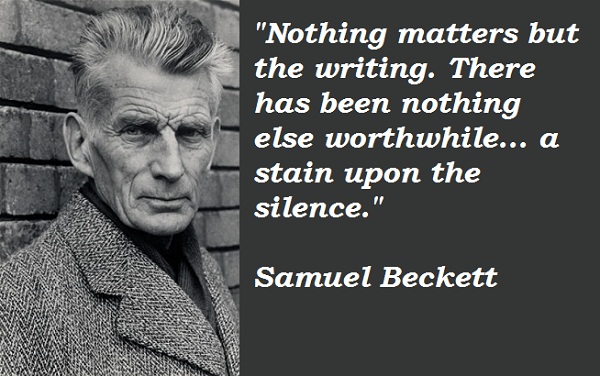
samuel-beckett-quotes-2

The Buried Giant

My first book of 2016 could prove to my least predictable choice of the year.  I loathe fantasy fiction, so why did I choose as my first book a novel that features ogres, she-devils, and Sir Gawain (yes, King Arthur’s faithful sidekick)?  Simple.  It’s by Kazuo Ishiguro, one of my favorite living novelists, and I was intrigued that he should use Britain in the early post-Roman era as the setting for his newest book.

It’s a strange, simple tale of two protagonists, Axl and his wife, Beatrice.  They travel from their home to find their grown son and along the way encounter hostile Saxons, dangerous ogres, and the aging Sir Gawain.  Little happens very slowly, but it’s the eerie atmosphere that stayed with me long after I closed the book that makes The Buried Giant so distinctive.  It’s a book about the importance of memory and the dangers of forgetting, and about how the creation of a sustainable future (whether personal or political) is impossible if memories are lost.

A great novel?  No.  Ishiguro’s best?  Certainly not.  But it’s a deceivingly simple, unsettling, and memorable story.

51tXDWW3TAL._SX341_BO1,204,203,200_

A year of reading


I once asked a friend how he chooses the books he reads.  His answer?  “Life is too short and too busy to read bad books, so I only read the really good ones”.  Not the most helpful answer perhaps, but he was trying to say something serious.  Reading a book takes a commitment of time and effort and there are millions of books to choose between.  But how do you know what’s good or even what you like?  The simplest thing would be to read only the genres we love or the authors we admire, but where does that leave us if we want to experiment with new styles, new forms, and new writers?  What about the new books our friends and loved ones recommend, sometimes so passionately?  What about the hottest new book, the one every critic raves about?  And what about reading backwards, filling the gaps in our knowledge of the great classics?

I don’t have the answers to the questions, so I’m going to do in 2016 what I’ve done every year since I started to read seriously more than forty years ago – I’m going to follow my nose, my prejudices, and my instincts.  What does that mean in practice?  More fiction than non-fiction.  More newly published titles than classics.  Probably no fantasy or science fiction and little poetry.  And, of course, only really great books.